

The 7 Best Birding Sites in Brazil's Atlantic Forest: Ranked by the Guides Who Work There


"If I only have one week in the Atlantic Forest, where should I go?"
I have been asked that question more times than I can count: in emails, at bird fairs, over dinner on the last night of a tour, when the list is closed and the conversation turns to the next trip. And I have always had an answer ready. The trouble is that every guide on our team also has an answer ready, and they are not all the same answer. Ciro would send you to Bahia. Fernando would find a way to include the Araucaria highlands of the South. João Vitor would put you in a car to the coast of São Paulo before you had finished asking.
So in late September 2025 I did the fair thing to do; I sent a short form to our guides with one question: list your top five places in the Atlantic Forest for birdwatching, in order of preference. No definitions, no criteria, no discussion beforehand. Just the five places each of them would go first.
Ten guides answered. Fifty picks came back, naming seventeen different places across three regions of Brazil. One park appeared on every single list. And the rest of the ranking surprised me enough that I decided it deserved an article rather than a simple social media post.
This is that article. It is a ranking, and I have kept the numbers honest, but it is really an argument about how big and how varied this biome is. If you want the short version: Intervales, Itatiaia, Serra Bonita, Urupema and Ubatuba (tied), Campos do Jordão, and Boa Nova. If you want to know why, and what each of these places is actually like to bird, read on.
How We Built the Ranking
Ten people answered the form: João Vitor Andriola, Felipe Arantes, Tatiana Pongiluppi, Ciro Albano, Arthur Gomes, Lucas Barros, Carlos Gussoni, Andre De Luca, Fernando Farias, and me. Between us, that is several decades of guiding in the Atlantic Forest, from the Bahia lowlands to the pampas edge in Rio Grande do Sul. Some of us live inside the biome; all of us work in it every year.
I scored the lists the way most ranked-choice polls do: five points for a first choice, four for a second, three for a third, two for a fourth, one for a fifth. Ten guides times fifteen points each gives 150 points in play. A place that everyone ranked first would score 50.
Two editorial decisions need saying out loud. First, Arthur named Estrada da Romaria, the dirt road that climbs out of Campos do Jordão through Araucaria forest, while Carlos named Campos do Jordão State Park and I wrote simply "Campos do Jordão." These are the same municipality and, for a visiting birder, the same circuit, so I counted them together. Second, Ubatuba and Urupema finished with exactly nine points each, from four guides each, and I saw no honest way to separate them. They share fourth place.

The result has a clear shape. Intervales scored 46 of a possible 50 and was the only place named by all ten guides; seven of us put it first. Itatiaia followed with 31 points from eight guides, and Serra Bonita with 20 from seven. Then the curve drops: Ubatuba and Urupema on nine, Campos do Jordão on seven, Boa Nova on six. Below that, Sítio Macuquinho on five, and a long tail of places that one or two guides love enough to spend a pick on. I cut the list at seven because that is where the data cuts itself: after Boa Nova the gaps close up and the ranking becomes a matter of who happened to answer. Everything below seventh place gets its due in the honorable mentions.

A word on what this ranking is not. It is not a count of species, although I give eBird totals for every site in the Top 7, and for most of the others, so you can see the scale of each place. It is not a ranking of endemics per hectare, or of lodges, or of photographic hides. It is ten professional opinions about where the birding is best.
Not Just the Southeast
If you had asked me before the survey where the best Atlantic Forest birding was, I would probably have talked about São Paulo and Rio de Janeiro. That is where most of the classic sites are, where most of the tours run, and where most foreign birders go on their first Brazilian trip. The Top 7 says something different. Four of the seven are in the Southeast, yes. But two are in Bahia, in the Northeast, and one is in Santa Catarina, in the South.

That spread is the real story. The Atlantic Forest runs down the Brazilian coast for more than three thousand kilometres, from Rio Grande do Norte to Rio Grande do Sul, and reaches inland into Minas Gerais, Paraguay and Argentina. Along the way it changes almost completely. The forests of southern Bahia hold species that never cross the Rio Doce, let alone reach São Paulo. The Araucaria highlands of the South have a bird community built around one tree. Between them, the Serra do Mar and the Serra da Mantiqueira stack lowland, montane and high-altitude forest on top of each other within a single day's drive. Ribeiro and colleagues estimated in 2009 that somewhere between 11 and 16 percent of the original forest remains, most of it in small fragments, and yet the biome still holds more than two hundred endemic bird species. No single site has more than a fraction of them. That is why the guides' answers scatter, and why a ranking of the Atlantic Forest ends up being a map of it.
Here are the top seven, in order.
1. Intervales, São Paulo: The One Every Guide Agreed On
Intervales is the answer to the one-week question, and after this survey I no longer feel I am being partial when I say so. Ten out of ten guides named it. Seven put it first. In an exercise designed to expose our disagreements, it was the one place we did not disagree about.
The park sits on the crest of the Serra de Paranapiacaba, with its headquarters in the municipality of Ribeirão Grande, about three to four hours southwest of São Paulo city. It covers 41,704 hectares on its own, from roughly 60 to 80 metres up to about 1,100 metres, and it is not on its own: Intervales is one piece of the Paranapiacaba mosaic, a block of contiguous state parks and reserves (PETAR, Carlos Botelho, Xitué, Nascentes do Paranapanema and others) that together protect well over 120,000 hectares of continuous forest. It is one of the largest continuous blocks of Atlantic Forest left in the Southeast, and the birds behave accordingly. Species that survive elsewhere as scattered pairs are simply common here.
The history is worth a paragraph, because it explains the place you find when you arrive. Before it was a park, this was Fazenda Intervales, a farm that passed to Banespa, the São Paulo state bank, which built the roads, the little settlement of houses and a palm-heart processing plant. The state took over management in 1987 and the park was decreed in 1995. The bank's houses became the pousadas where birders now sleep, and the bank's roads, Estrada do Carmo and Estrada da Barra Grande, became the two classic birding transects. A bank's palm-heart factory turned into one of the best birding parks in South America.

What you go for is depth rather than any single bird, but the single birds are very good. Black-fronted Piping-Guan (Pipile jacutinga), endangered and hunted out of most of its range, is seen regularly. The bamboo stands hold the specialists that make the Paranapiacaba famous among birders: White-bearded Antshrike (Biatas nigropectus), Spotted Bamboowren (Psilorhamphus guttatus), and, with luck, Helmeted Woodpecker (Celeus galeatus). Blue-bellied Parrot (Triclaria malachitacea) feeds near the pousadas. Bare-throated Bellbird (Procnias nudicollis) rings across the valleys in the breeding season. Black-legged Dacnis (Dacnis nigripes), Slaty Bristlefront (Merulaxis ater), Hooded Berryeater (Carpornis cucullata), Solitary Tinamou (Tinamus solitarius) and Spot-winged Wood-Quail (Odontophorus capueira) are all on a normal three-day list. And then there are the crakes. The park's local monitors have spent years feeding Red-and-white Crakes (Laterallus leucopyrrhus) at the edge of the marsh by the headquarters, and a bird that most birders know only as a voice will, on most mornings, walk out onto the grass in front of you.
Those monitors are half the reason Intervales works. A local guide is required for most of the park, and the people who do this job, from the surrounding community, know the territories of individual birds. They speak Portuguese, and most of them know the English names of the birds better than I know the Portuguese names of some. Bring patience for the Carmo road, which needs a 4x4 or a stiff uphill walk, and bring rain gear from November to April, when the days could get pretty wet.
On eBird, the Intervales hotspot group (nine hotspots) stands at 537 species: PE Intervales. Intervales is a fixed stop on our Southeast Brazil Popular Tour and on the Southeast/South Brazil Supreme Tour, which you can find in our Tours Page.
2. Itatiaia, Rio de Janeiro and Minas Gerais: Two Parks Stacked on Top of Each Other
Itatiaia was Brazil's first national park, created by decree on 14 June 1937 on the Rio de Janeiro side of the Serra da Mantiqueira, and it has been on birders' itineraries for almost as long. Ernest Holt published an ornithological survey of the Serra do Itatiaia in 1928, nine years before the park existed. Eight of our ten guides named it, and Carlos Gussoni put it first.
The park today covers 28,084 hectares across four municipalities, and the thing to understand before you go is that it is really two parks joined by a mountain. The lower section, entered from the town of Itatiaia off the BR-116, runs from about 600 metres up through dense montane rainforest, with the old hotels that birders have used for decades: Hotel do Ypê with its feeders and gardens, Hotel Donati among the chalets, the ruins of Hotel Simon by the Três Picos trailhead. The upper section, the Planalto, is entered from Itamonte on the Minas Gerais side, where the BR-485, better known as the Agulhas Negras road, climbs past 2,400 metres, the highest point reached by any federal highway in Brazil, into campos de altitude (high-altitude grassland) and rock. The summit, Pico das Agulhas Negras, is 2,791 metres.

Each section has its own birds, and a serious visit needs both. Down low: Frilled Coquette (Lophornis magnificus) and Brazilian Ruby (Clytolaema rubricauda) at the feeders, Brassy-breasted Tanager (Tangara desmaresti) and Gilt-edged Tanager (Tangara cyanoventris) in the mixed flocks, Slaty Bristlefront and White-bibbed Antbird (Myrmoderus loricatus) on the Três Picos trail, Swallow-tailed Cotinga (Phibalura flavirostris) if the season is right, and Blue-winged Macaws (Primolius maracana) that have become a regular sight around the Ypê. Up high: Itatiaia Spinetail (Asthenes moreirae), a bird of the high grasslands that exists almost nowhere else on Earth, Black-and-gold Cotinga (Lipaugus ater) calling from the cloud forest below the road, Rufous-tailed Antbird (Drymophila genei), Serra do Mar Tyrannulet (Phylloscartes difficilis), Diademed Tanager (Stephanophorus diadematus), Bay-chested Warbling-Finch (Castanozoster thoracicus), Green-crowned Plovercrest (Stephanoxis lalandi) and Black-capped Piprites (Piprites pileata). Brown Tanager (Orchesticus abeillei), the only member of its genus, is one of the classic Itatiaia birds and can be found at both ends.
One correction that comes up often enough to be worth making: Grey-winged Cotinga (Lipaugus conditus) does not occur in Itatiaia. It is confined to the mountains of Rio de Janeiro state, the Serra dos Órgãos and its neighbors, and if it is on your target list you need Nova Friburgo, further down this article, not the Mantiqueira.
The Itatiaia hotspot group on eBird (22 hotspots) holds 554 species: Parque Nacional do Itatiaia. The lower section alone stands at 448 species (Parte Baixa) and the Agulhas Negras road at 425 (Estrada Agulhas Negras, MG). Itatiaia is on the Southeast Brazil Popular Tour and on the Southeast/South Brazil Supreme Tour, which you can find in our Tours Page.
3. Serra Bonita, Bahia: A Moth Collector's Mountain
Serra Bonita was Ciro's first choice, and seven of us named it, which for a private reserve five hundred kilometres south of Salvador is remarkable. It is the highest-ranked site outside the Southeast, and it is the one that most changes what "Atlantic Forest birding" means for a visitor.
The reserve exists because of a lepidopterist. Vitor Becker, an entomologist, and his wife Clemira Souza began buying up smallholdings on the slopes of the Serra Bonita, in the municipality of Camacan, in the late 1990s, at a time when the mountain's forest was being cleared piece by piece. By 2001 they had assembled about 1,200 hectares from more than forty properties and founded the Instituto Uiraçu to manage them. Today the consortium of private reserves (RPPNs, Reservas Particulares do Patrimônio Natural) covers roughly 2,500 hectares, depending on which parcels you count, between about 200 and 950 metres. On top of the mountain sits a research centre with laboratories, an auditorium and the Becker collection of moths, one of the largest in the world, and a small lodge with eight suites and a veranda that looks out over cloud forest. The birds come to the balcony.
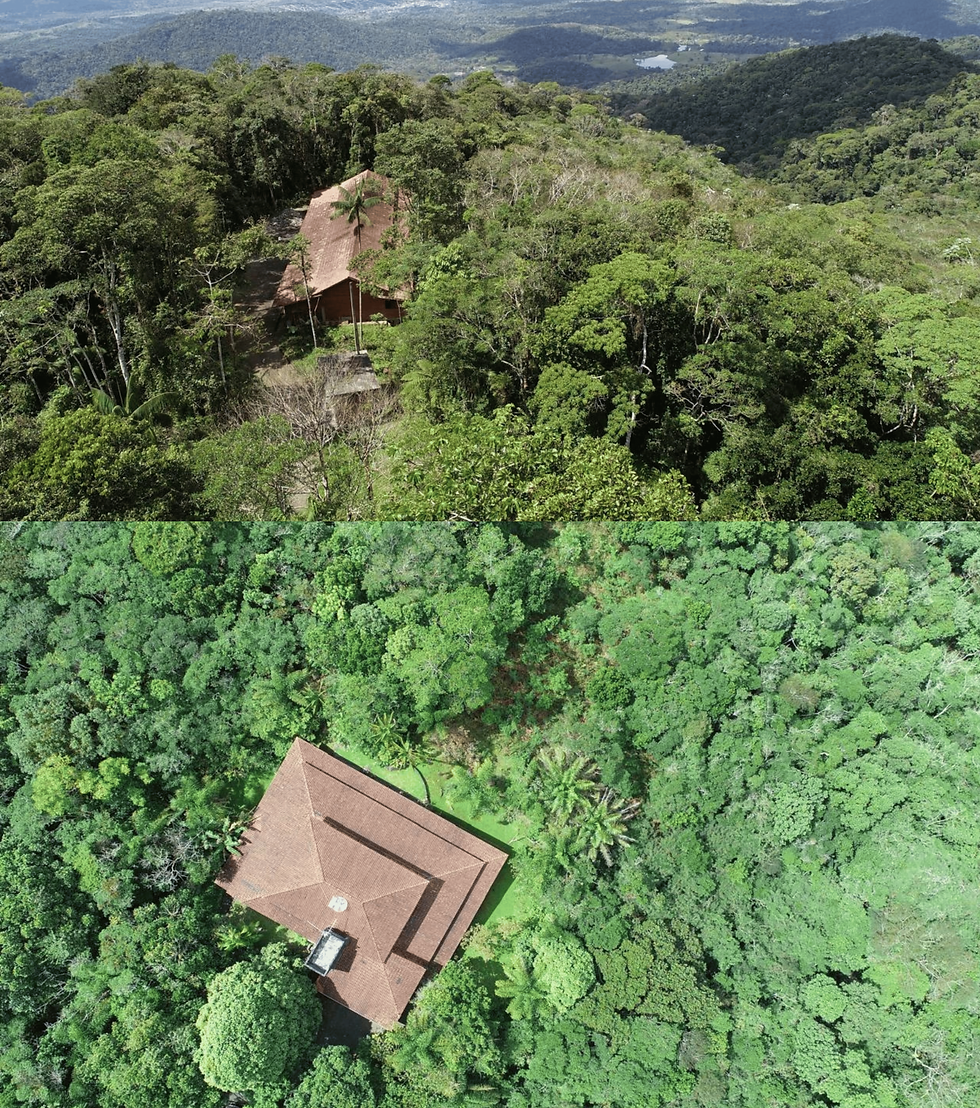
A 2019 paper by Vagner Cavarzere, Ciro Albano and colleagues in Papéis Avulsos de Zoologia titled the place, accurately, "an overlooked hotspot for birds in the Atlantic Forest," and recorded 368 species across the wider Serra Bonita massif, some 7,500 hectares from the cacao lowlands to the summit; 143 of them are Atlantic Forest endemics and 16 are globally threatened. The names on that list are the reason people fly to Ilhéus. Banded Cotinga (Cotinga maculata), critically endangered and one of the most beautiful birds in South America, feeds on fruiting trees along the reserve road. Plumbeous Antvireo (Dysithamnus plumbeus), Striated Softtail (Thripophaga macroura) and Salvadori's Antwren (Myrmotherula minor), all globally vulnerable, are here. Bahia Tyrannulet (Phylloscartes beckeri), a species described only in 1995, and Bahia Spinetail (Synallaxis cinerea) are here too. Harpy Eagles (Harpia harpyja) have nested on the reserve. In the shade-grown cacao plantations (the cabruca) below the mountain lives Pink-legged Graveteiro (Acrobatornis fonsecai), a furnariid in its own genus, described in 1996 from the cacao country of southern Bahia and found almost nowhere else.
Be honest with yourself about the logistics. The reserve road needs a 4x4, access is by arrangement with the Instituto Uiraçu, and the summit spends a good part of many mornings inside a cloud. Banded Cotinga is seen on most visits by groups that put in the days, but it is a canopy bird in a big forest and nobody should promise it to you. They are only seen in the lowlands. What Serra Bonita offers is a set of birds that exist in a few valleys of Bahia and nowhere else, in comfort, and occasionally from your veranda. That is rare in the Atlantic Forest.
On eBird: RPPN Serra Bonita, 430 species. Serra Bonita is a fixed stop on the Northeast Brazil Popular Tour and on the Northeast Brazil Supreme Tour, which you can find in our Tours Page.
4. Urupema, Santa Catarina: The Cold Town With Twenty Thousand Parrots
Fernando, who is one of our guides on our southern tours, put Urupema second on his list, and Ciro, Lucas and I all found room for it. It is the only site in the Top 7 from the South, and it earns its place with a single event that has no equivalent anywhere else in the biome.
Urupema is a small town on the Serra Catarinense at roughly 1,400 metres, cold enough that in 2021 a federal law named it Brazil's National Capital of Cold; the weather station there has recorded minus 9.4 °C, and frost comes on around fifty mornings a year. The forest here is not the dense, dripping Atlantic Forest of the coast. It is Araucaria forest, Floresta Ombrófila Mista, open stands of Brazilian pine (Araucaria angustifolia) over grassland, and in autumn the pines drop their seeds, the pinhão, and the parrots come.

Red-spectacled Parrot (Amazona pretrei), a vulnerable species endemic to the Araucaria region, gathers almost its entire world population into the municipalities of Painel, Bocaina do Sul and Urupema in May and June. Projeto Charão has counted the roosts every year since 1995, from four fixed points around the roost, from an hour before sunset to half an hour after: about 15,700 birds in 2015 and about 20,100 in 2017, and counts reported from the 2023 season reached roughly 22,000. We have written about the experience of standing under that flight in a separate article on the Red-spectacled Parrot festival, and I will not repeat it here except to say that it is mind-boggling.
Outside the parrot season, Urupema is still one of the best places in Brazil for the Araucaria specialists: Araucaria Tit-Spinetail (Leptasthenura setaria), which feeds almost exclusively in the pines, Striolated Tit-Spinetail (Leptasthenura striolata), Long-tailed Cinclodes (Cinclodes pabsti) on the rocky pastures, Planalto Tapaculo (Scytalopus pachecoi), Mottled Piculet (Picumnus nebulosus), Azure Jay (Cyanocorax caeruleus), Vinaceous-breasted Parrot (Amazona vinacea), which is endangered and also comes for the pinhão, and Black-and-white Monjita (Heteroxolmis dominicana) in the wet grassland. The species count is modest by Atlantic Forest standards, and that is the honest trade-off: you come to Urupema for a specific community and a specific spectacle, not for a long list.
On eBird: Urupema, Eco-Pousada Rio dos Touros, 219 species. Urupema is on our South Brazil Popular Tour, the South Brazil Complete Tour, South Brazil Winter Tour and the Southeast/South Brazil Supreme Tour. Visit our Tours Page for more details.
4. Ubatuba, São Paulo: Hummingbirds at Sea Level
João Vitor put Ubatuba first, ahead of Intervales, and I understand why. Ubatuba is where the Atlantic Forest comes down to the beach. The municipality, on São Paulo's north coast, runs from sea level up the escarpment of the Serra do Mar to around 800 meters, and it packs lowland forest, restinga (coastal sand forest), mangroves and montane forest into one stretch of coast that you can bird from a single hotel.
It is also one of the best-documented birding municipalities in Brazil. Simpson, Cavarzere and Simpson published a list of the documented birds of Ubatuba in 2012, after seven years and around 1,700 hours of fieldwork: 417 species, 109 of them Atlantic Forest endemics, which is 26 percent of everything recorded. Their most intensively worked site was a dirt road at 27 metres above sea level called Folha Seca.

Folha Seca is the reason most birders know Ubatuba. Jonas d'Abronzo has fed hummingbirds around his porch there for almost 30 years, and the garden has recorded 22 species of them. On a normal morning you will see ten or so, and the ones that matter are the endemics: Saw-billed Hermit (Ramphodon naevius) and Festive Coquette (Lophornis chalybeus). Black Jacobin (Florisuga fusca), Brazilian Ruby, Violet-capped Woodnymph (Thalurania glaucopis) and Sombre Hummingbird (Eupetomena cirrochloris) fill in the rest. The access road adds White-necked Hawk (Amadonastur lacernulatus) and Blue Manakin (Chiroxiphia caudata). Further along the coast, Fazenda Angelim is the site for Buff-throated Purpletuft (Iodopleura pipra), an endangered canopy bird that most people see here, alongside Black-cheeked Gnateater (Conopophaga melanops), Spot-backed Antshrike (Hypoedaleus guttatus), Squamate Antbird (Myrmoderus squamosus) and, in the right season, Temminck's Seedeater (Sporophila falcirostris) and Buffy-fronted Seedeater (Sporophila frontalis), the two bamboo-seeding nomads of the Atlantic Forest.
The honest caveats are two. Ubatuba is hot and wet, and from October to March the rain can take whole days. And Folha Seca is a private home, visited by arrangement, where the right thing to bring is a bag of sugar or bananas rather than a fee.
On eBird: Ubatuba, Fazenda Angelim, 448 species; Sítio Folha Seca, 342 species. Ubatuba is on the Southeast Brazil Popular Tour and on the Southeast/South Brazil Supreme Tour (click here for more info: Tours Page).
6. Campos do Jordão, São Paulo: Araucarias at 1,600 Meters
Three of us named Campos do Jordão, in three different forms: Arthur chose the Estrada da Romaria, Carlos the state park, and I the town. Put together, they make sixth place, and they make it for a reason that has nothing to do with the boutique hotels and fondue restaurants that the rest of Brazil associates with the name.
Campos do Jordão is the highest municipal seat in Brazil, at 1,628 metres in the Serra da Mantiqueira, and the state park on its edge, universally known as the Horto Florestal, is the oldest protected area in the state of São Paulo, created in 1941. It covers 8,341 hectares between 1,030 and 2,007 metres, in three formations: Araucaria forest, high-altitude cloud forest and campos de altitude. There is a paradox in its history that any biologist will enjoy: for its first decades the park followed a reforestation policy based on exotic pines, and around 2,000 hectares of Pinus elliottii and Pinus taeda were planted inside a park created to protect Araucaria. They are now classed as degraded areas and are being removed.

The birds are the Araucaria community again, three hours from São Paulo city instead of two days. Araucaria Tit-Spinetail is common in the pines. Vinaceous-breasted Parrot feeds on them. Black-capped Piprites, near threatened and tied to the Brazilian pine across its whole range, is one of the town's flagship species.
On eBird: Parque Estadual de Campos do Jordão (Horto Florestal), 348 species; Estrada da Romaria, 279 species. Campos do Jordão is on the Southeast Brazil Popular Tour and on the Southeast/South Brazil Supreme Tour (visit: Tours Page).
7. Boa Nova, Bahia: Where the Atlantic Forest Meets the Caatinga
Boa Nova was my second choice and Lucas's fourth, and it closes the Top 7. It is a place I would argue for more strongly than its six points suggest, because it is unlike anywhere else on this list.
The town of Boa Nova sits on the eastern edge of the Bahian plateau, and within a few kilometres the vegetation shifts from humid Atlantic Forest on the eastern, rain-facing slopes to a dry, deciduous forest tangled with vines on the western side, the mata-de-cipó (vine forest), and beyond that to caatinga. The Parque Nacional de Boa Nova, created in June 2010, protects 12,065 hectares of this transition, between roughly 450 and 1,100 metres, and a wildlife refuge decreed on the same day adds another 15,024 hectares. This is one of the newest national parks in the Atlantic Forest, and the birds it was created for are some of the most range-restricted in Brazil.

Slender Antbird (Rhopornis ardesiacus) lives on the floor of the mata-de-cipó among the terrestrial bromeliads and is found in a strip of interior Bahia and almost nowhere else. Narrow-billed Antwren (Formicivora iheringi) shares the same vine forest. Boa Nova Tapaculo (Scytalopus gonzagai), endangered, was described as a new species only in 2014, from the humid forest patches above the town. Striated Softtail, Bahia Spinetail, Rio de Janeiro Antbird (Cercomacra brasiliana), Fork-tailed Pygmy-Tyrant (Hemitriccus furcatus) and Pin-tailed Manakin (Ilicura militaris) fill out a list that keeps going on. Pink-legged Graveteiro is in the cacao plantations to the east. On a good day at Boa Nova you bird vine forest at dawn, humid forest mid-morning and caatinga after lunch, and the list at dinner makes no sense to anyone who has only birded the Southeast.
The honest note: Boa Nova is a working town, not a resort, the vine forest is thorny and dry, and the humid patches are small and fragmented. The park has a management plan approved only in 2024. You come here for the birds, and the birds are really worth it.
On eBird: Parque Nacional de Boa Nova, Mata do Charme, 440 species. Boa Nova is on our Northeast Brazil Popular Tour and on the Northeast Brazil Supreme Tour, together with Serra Bonita, which you can find in our Tours Page.
The Honorable Mentions
Ten places received between one and five points, and several of them would make the Top 7 of a different group of ten guides. I have given each a paragraph, because the tail of this survey says as much about the Atlantic Forest as the head.
Sítio Macuquinho, Salesópolis, São Paulo (5 points). Tatiana's third choice and André's fourth. A seven-hectare property in the hills east of São Paulo city that Elvis Japão and Nanda built into a birding lodge, with feeders, a hummingbird garden and trails, and which we have written about in full in our Macuquinho Lodge article. Its eBird list stands at 411 species. It is also the base for the marshes of the upper Tietê, home of the São Paulo Marsh Antwren (Formicivora paludicola), discovered by Dante Buzzetti in 2004 and described in 2013, critically endangered according to BirdLife, with fewer than 700 mature individuals. (eBird and Clements treat it as a subspecies of Marsh Antwren, Formicivora acutirostris, so on your checklist it will appear under that name). The Salesópolis marshes are a stop on our Southeast Brazil Popular Tour. Salesópolis, Macuquinho Lodge on eBird
Nova Friburgo, Rio de Janeiro (3 points). My own third choice. The road up to the Pico da Caledônia climbs to above 2,000 metres in the Serra dos Órgãos and is the most reliable site in the world for Grey-winged Cotinga, a vulnerable species with a population estimated at a few hundred to a thousand mature individuals, endemic to the mountains of Rio de Janeiro state and unknown to science until 1980. The lower valleys around Sumidouro, an hour away, hold the populations of Three-toed Jacamar (Jacamaralcyon tridactyla). Nova Friburgo is a stop on the Southeast Popular Tour and Southeast/South Brazil Supreme Tour. Estrada para o Pico da Caledônia on eBird, 262 species.
PETAR, São Paulo (3 points). Felipe's third choice. The Parque Estadual Turístico do Alto Ribeira, created in 1958, adjoins Intervales directly and protects 35,750 hectares and more than four hundred caves. The birds are largely those of Intervales in a lower, wilder setting. PETAR is on the Southeast Brazil Popular Tour. PETAR, Núcleo Caboclos on eBird
Joinville, Santa Catarina (2 points). Named by both João Vitor and Fernando. The municipality has recorded 485 bird species, and its flagship is Kaempfer's Tody-Tyrant (Hemitriccus kaempferi), a vulnerable lowland endemic first collected here in 1929 and lost to science until 1991. The estuaries of Babitonga Bay hold Marsh Antwren (Formicivora acutirostris) and Scarlet Ibis (Eudocimus ruber). Joinville is on the South Brazil tours. Joinville, Estrada Arataca on eBird, 254 species.
Curitiba region, Paraná (2 points). João Vitor's fourth choice. The Araucaria forests and montane forests within an hour of the state capital, at Piraquara, Quatro Barras and the Serra da Baitaca, hold the southern bamboo and pine specialists, and the region is where our South Brazil tours begin.
Legado das Águas, São Paulo (2 points). Arthur's fourth choice. A 31,000-hectare private reserve in the Vale do Ribeira, established in 2012 on former hydroelectric land and billed as the largest private Atlantic Forest reserve in Brazil, with more than 290 bird species recorded and one of the three most important populations of southern muriqui in the world.
Linhares, Espírito Santo (2 points). Tatiana's fourth choice. The Reserva Natural Vale and the adjoining Sooretama Biological Reserve form a block of more than 50,000 hectares of lowland tabuleiro forest, the best place in the world to see Red-billed Curassow (Crax blumenbachii), endangered, alongside Black-headed Berryeater (Carpornis melanocephala), Ochre-marked Parakeet (Pyrrhura cruentata) and Red-browed Parrot (Amazona rhodocorytha). Linhares is on our Espírito Santo and Minas Gerais Tour. Reserva Natural Vale on eBird, 402 species.
Paraty, Rio de Janeiro (1 point). Felipe's fifth. Part of a UNESCO World Heritage property that holds 57 percent of the Atlantic Forest's endemic bird species, and the home of Black-hooded Antwren (Formicivora erythronotos), endangered, known from nineteenth-century specimens and unseen for a century until 1987. The Paraty–Cunha road is the classic transect. Estrada Paraty–Cunha on eBird, 254 species.
Vargem Alta, Espírito Santo (1 point). Ciro's fifth, added with a caveat I will quote in spirit: he would rank it higher if it were not for the pressure of the Nemosia. The Mata dos Caetés above Vargem Alta is one of the two known homes of the Cherry-throated Tanager (Nemosia rourei), critically endangered, with around twenty individuals in the wild. The pressure is real, and I have written about it, and about what an honest visit involves, in our article on the Cherry-throated Tanager. Vargem Alta is on the Espírito Santo and Minas Gerais Tour.
What the Ranking Does Not Tell You
Two main things and a suggestion.
The first is that these seven places do not add up to one trip. Serra Bonita and Boa Nova are a long day's drive from each other and a flight from everything else. Urupema is two days south of São Paulo by road. The Top 7 is a map of the biome, not an itinerary, and if you try to do all seven in a fortnight you will spend most of it in a vehicle.
The second is the season. The Southeast sites are at their best from roughly September to December, when the birds sing and the rains have not yet settled in; Intervales and Ubatuba are drier and easier from May to September, and the Itatiaia highlands are cold and clear in winter. Urupema is a May and June destination if the parrots are the point. The Bahia sites can be birded most of the year. If you want the long version of this, we have written a month-by-month guide to birding in Brazil.
The suggestion is: if you can only see one, see Intervales, and give it three full days. If you can see three, add Itatiaia and one of the two Bahian sites, and accept the flight. If you have three weeks, you can string Intervales, Itatiaia, Ubatuba, Campos do Jordão and the Salesópolis marshes together on a single route, then drop south to Urupema and the Araucaria highlands. That is, more or less, the shape of our Southeast/South Brazil Supreme Tour, and after this survey you understand better why we built it that way.
I expected Intervales to win. However I did not expect it to be unanimous. Ten people with ten different home ranges, ten different favorite birds and at least three strong regional loyalties all named the same park, and seven of them named it first. Whatever else this article does, it should settle the one-week question.
I am already curious about what the same question would produce in five years. New reserves are opening, new species are being described from the Bahian mountains, and a few of our younger guides have favorite valleys that none of the rest of us have seen yet. I am also curious to see the “Top 5’s” of the Amazon and the Cerrado. How about you? What would you like to see next?
For private tour arrangements in any of these places, get in touch via our contact page.
Frequently Asked Questions
What are the best birding sites in Brazil's Atlantic Forest?
Based on a 2025 survey of ten Brazil Birding Experts guides, who each ranked their five favorite Atlantic Forest sites, the top seven are:
1. Intervales State Park, São Paulo (46 points, named by all ten guides)
2. Itatiaia National Park, Rio de Janeiro and Minas Gerais (31 points)
3. RPPN Serra Bonita, Bahia (20 points)
4. Urupema, Santa Catarina (9 points, tied)
4. Ubatuba, São Paulo (9 points, tied)
6. Campos do Jordão, São Paulo (7 points)
7. Boa Nova, Bahia (6 points)
Ten more sites received between one and five points, among them Sítio Macuquinho, Nova Friburgo, PETAR, Joinville, Linhares and Vargem Alta.
Which Atlantic Forest site has the most bird species on eBird?
Of the sites in this ranking, the Itatiaia National Park hotspot group has the largest eBird list, with 554 species across 22 hotspots, followed by Intervales State Park with 537 species across nine hotspots. Fazenda Angelim in Ubatuba (448), Mata do Charme in Boa Nova National Park (440) and RPPN Serra Bonita (430) follow. These figures were read on eBird in September 2026 and change over time. Note that a species total is not the same as a quality ranking: Urupema, with 219 species at its main hotspot, tied for fourth place in the survey.
Is Intervales the best place for birding in the Atlantic Forest?
It was the only site named by all ten guides in our survey, and seven of them ranked it first, so among professional guides the answer is close to a consensus. It combines one of the largest continuous blocks of Atlantic Forest in Brazil (the Paranapiacaba mosaic, over 120,000 hectares) with lodging inside the park, experienced local monitors and regular, though never guaranteed, encounters with hard species such as Black-fronted Piping-Guan, White-bearded Antshrike, Spotted Bamboowren, Blue-bellied Parrot and Red-and-white Crake.
How many days do I need at Intervales?
Three full days is the minimum we recommend, especially if you have never been to the Atlantic Forest. The park has two long birding roads (Estrada do Carmo and Estrada da Barra Grande), not to mention Estrada do Lajeado (my personal favorite but slightly more difficult than the other trails) a marsh, and forest at several elevations, and the bamboo specialists in particular reward repeated visits. Many groups spend four nights.
When is the best time to go birding in the Atlantic Forest?
For the Southeast sites (Intervales, Itatiaia, Ubatuba, Campos do Jordão), September to early December offers the most song and activity, while May to September is drier and more comfortable, especially at Intervales and on the coast. Urupema is a May and June destination if you want the Red-spectacled Parrot roost. The Bahia sites, Serra Bonita and Boa Nova, can be birded for most of the year.
Can I visit Serra Bonita independently?
Access to RPPN Serra Bonita is by arrangement with the Instituto Uiraçu, which runs the reserve and its lodge. The road to the summit requires a 4x4. Most visiting birders go with a tour or book directly with the reserve well in advance.
Is the Atlantic Forest good for beginner birders?
Yes, with the right sites. Intervales, Itatiaia and Ubatuba have feeders, lodges inside or beside the forest and good roads, and they produce a long list without long hikes. Serra Bonita and Boa Nova are better suited to birders who already have some experience with forest birding, because the target species are skulking, range-restricted and require time.
Why is Grey-winged Cotinga not on the Itatiaia list?
Because it does not occur there. Grey-winged Cotinga (Lipaugus conditus) is restricted to the mountains of Rio de Janeiro state (Serra dos Órgãos, Serra do Tinguá, and the Pico da Caledônia above Nova Friburgo). Itatiaia is in the Serra da Mantiqueira, a separate range, where the high-altitude specialties are Itatiaia Spinetail and Black-and-gold Cotinga.
Which Brazil Birding Experts tours visit these sites?
The Southeast Brazil Popular Tour (17 days) visits Intervales, Itatiaia, Ubatuba, Nova Friburgo, Campos do Jordão, Salesópolis and PETAR. The Southeast/South Brazil Supreme Tour (29 days) adds Curitiba, Joinville and Urupema. The Northeast Brazil Popular (18 days) and Supreme Tours (25 days) are the set departures that reach Serra Bonita and Boa Nova. The South Brazil tours cover Curitiba, Joinville and Urupema, and the Espírito Santo and Minas Gerais Tour covers Linhares and Vargem Alta. Any combination can be arranged as a private trip.
References
Alves, M.A.S., Pimm, S.L., Storni, A., Raposo, M.A., Brooke, M. de L., Harris, G., Foster, A. & Jenkins, C.N. (2008). Mapping and exploring the distribution of the Vulnerable grey-winged cotinga Tijuca condita. Oryx 42(4): 562–566. https://doi.org/10.1017/S0030605308001014
Cavarzere, V., Albano, C., Tonetti, V.R., Pacheco, J.F., Whitney, B.M. & Silveira, L.F. (2019). An overlooked hotspot for birds in the Atlantic Forest. Papéis Avulsos de Zoologia 59: e20195905. https://doi.org/10.11606/1807-0205/2019.59.05
Del-Rio, G., Rêgo, M.A. & Silveira, L.F. (2015). A multiscale approach indicates a severe reduction in Atlantic Forest wetlands and highlights that São Paulo Marsh Antwren is on the brink of extinction. PLOS ONE 10(3): e0121315. https://doi.org/10.1371/journal.pone.0121315
Holt, E.G. (1928). An ornithological survey of the Serra do Itatiaya, Brazil. Bulletin of the American Museum of Natural History 57(5). https://digitallibrary.amnh.org/handle/2246/963
Maurício, G.N., Belmonte-Lopes, R., Pacheco, J.F., Silveira, L.F., Whitney, B.M. & Bornschein, M.R. (2014). Taxonomy of "Mouse-colored Tapaculos" (II): An endangered new species from the montane Atlantic Forest of southern Bahia, Brazil (Passeriformes: Rhinocryptidae: Scytalopus). The Auk 131(4): 643–659. https://doi.org/10.1642/AUK-14-16.1
Muylaert, R.L., Vancine, M.H., Bernardo, R., Oshima, J.E.F., Sobral-Souza, T., Tonetti, V.R., Niebuhr, B.B. & Ribeiro, M.C. (2018). Uma nota sobre os limites territoriais da Mata Atlântica. Oecologia Australis 22(3): 302–311. https://doi.org/10.4257/oeco.2018.2203.09
Pacheco, J.F., Whitney, B.M. & Gonzaga, L.P. (1996). A new genus and species of furnariid (Aves: Furnariidae) from the cocoa-growing region of southeastern Bahia, Brazil. Wilson Bulletin 108(3): 397–433. https://digitalcommons.usf.edu/wilson_bulletin/vol108/iss3/2/
Ribeiro, M.C., Metzger, J.P., Martensen, A.C., Ponzoni, F.J. & Hirota, M.M. (2009). The Brazilian Atlantic Forest: How much is left, and how is the remaining forest distributed? Implications for conservation. Biological Conservation 142(6): 1141–1153. https://doi.org/10.1016/j.biocon.2009.02.021
Simpson, R., Cavarzere, V. & Simpson, E. (2012). List of documented bird species from the municipality of Ubatuba, state of São Paulo, Brazil. Papéis Avulsos de Zoologia 52(13): 217–283. https://www.scielo.br/j/paz/a/S6hmMVtjphTdRktyC4QQphn/?lang=en
Tella, J.L., Martínez, J., Dénes, F.V., Zulian, V., Hiraldo, F. & Prestes, N.P. (2026). Applying a method to estimate the breeding and non-breeding population fractions of the globally threatened Red-spectacled Amazon. Biology 15(2): 190. https://doi.org/10.3390/biology15020190
Vale, M.M., Tourinho, L., Lorini, M.L., Rajão, H. & Figueiredo, M.S.L. (2018). Endemic birds of the Atlantic Forest: traits, conservation status, and patterns of biodiversity. Journal of Field Ornithology 89(3): 193–206. https://doi.org/10.1111/jofo.12256
Online resources: eBird hotspot pages linked in the text (species totals read in September 2026); ICMBio, Unidades de Conservação (Parque Nacional do Itatiaia; Parque Nacional de Boa Nova); Fundação Florestal / Guia de Áreas Protegidas do Estado de São Paulo (Parque Estadual Intervales; Parque Estadual de Campos do Jordão; PETAR); Instituto Uiraçu (RPPN Serra Bonita); Projeto Charão.


Comments