

Sítio Cotinga: A High-Altitude Atlantic Forest Refuge In The Heart Of The Serra Do Mar


I had always heard about the famous Sítio Cotinga and never had the chance to visit. It was one of those names that kept coming up in conversations among guides and in birding groups, always followed by praise and by that glint in the eyes of people who come back wanting to return. “You have to go,” they told me. So…
In June of last year, I finally went, and I went with my family. My wife, my two daughters and I, on a family trip that, at the same time, was also a scouting trip. From the very first night it was clear that this was not just another point on the map of the Atlantic Forest.
As the afternoon faded, we watched a true ballet of Long-trained Nightjars (Macropsalis forcipata). Two birds cut through the air like fairies of the night, in silent, hypnotic movements. Luísa was completely enchanted, and so were we. A moment I will never forget.

And the most important detail: our chalet had no Wi-Fi. What many would see as a problem turned into an unexpected gift. No screens, no notifications, no TV; just the sound of the forest, the cold wind at altitude, and the rare sense of being truly present. It was a deeply special experience for our family, a simple and true reconnection with the rhythm of nature. A connection so strong that, on the two nights we stayed there, the whole family fell asleep at exactly the same time, without much difficulty.
Casa Alto da Caathéoca Cabana Florestal
Chalets at Sítio Cotinga. On the left: Casa Alto da Caathéoca. On the right: Cabana Florestal. Photo: Paulo Rubim
A Forest Born of a Bold Decision
Long before it welcomed visitors, Sítio Cotinga was born of restlessness. Paulo Rubim, an ecologist, and Giovana Souza, a biologist, spent years working in natural areas across Brazil, especially in the Amazon, among environmental licensing, management plans, and scientific research. But something inside them kept saying that publishing papers was not enough if there was no concrete contribution on the ground.
Sítio Cotinga Family Portrait Giovana and Paulo from Sítio Cotinga in the early days
Sítio Cotinga Family Portrait. Photo: Paulo Rubim
In 2013, still living in a small apartment in São Carlos, they began looking for a place where they could raise their son surrounded by forest and put into practice everything they had defended in theory.
Fate pointed to a property next to the Parque Estadual da Serra do Mar (Serra do Mar State Park), in São Luiz do Paraitinga. What was originally a large cattle ranch turned into another story when the former owner understood the couple’s purpose and offered them a smaller area: a mix of forest and abandoned pasture, at more than 1,500 meters above sea level.

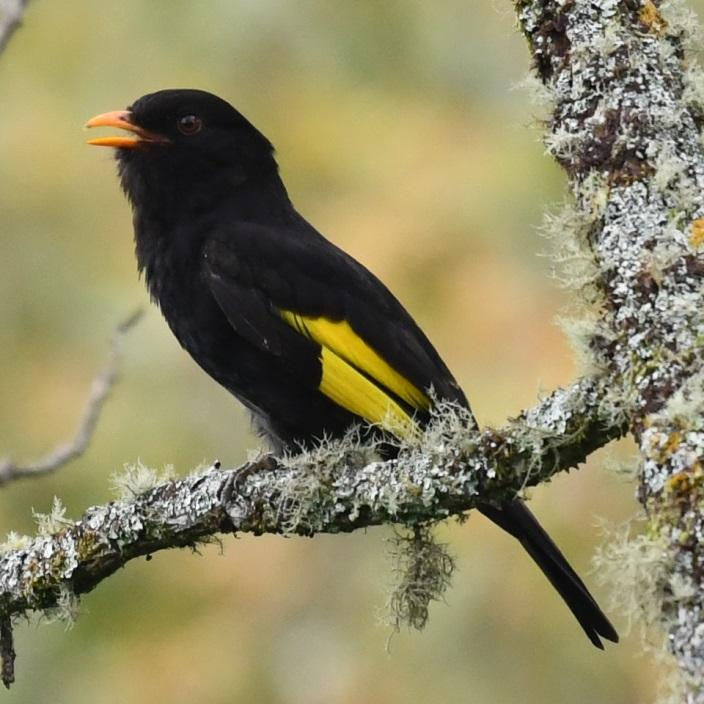
During one of their first visits, they heard so many calls of the saudade (Black-and-gold Cotinga, Lipaugus ater ) that the name of the future refuge came naturally. And so, in January 2014, Sítio Cotinga was born.
Building a Life on the Mountain
The first years were about resilience. They moved to the bucolic village of Catuçaba while building, with their own hands, a pau-a-pique (wattle-and-daub) house high on the mountain. They split their time between consulting work, life in the village, and trips up to the site to raise what has today become a refuge for people and birds.
Pau-a-pique (wattle-and-daub) house built by hand by Paulo and Giovana high on the mountain, Sítio C Pau-a-pique (wattle-and-daub) house built by hand by Paulo and Giovana high on the mountain, Sítio C Pau-a-pique (wattle-and-daub) house built by hand by Paulo and Giovana high on the mountain, Sítio C
The pau-a-pique house under construction at the site. Photo: Paulo Rubim
It was also during this period that the potential for birding began to reveal itself. Even without any structure to receive visitors, some guides started bringing small day-use groups, and true jewels of the high-altitude Atlantic Forest were being discovered there.
The Birds of Sítio Cotinga
Today, more than 60 endemic species have been recorded across the property’s 36 hectares. For such a compact place, the diversity is impressive, and it is explained by the altitude, by the direct connection with the continuous forest of the Parque Estadual da Serra do Mar, and by the presence of different vegetation strata, from mature forest to regenerating edge.
The list of residents includes species that justify a trip on their own. The Rufous-tailed Antthrush (Chamaeza ruficauda), as elusive as they come, appears on the more closed-in trails with a frequency that surprises. And during our visit, I had a memorable encounter with one. The Black-throated Grosbeak (Saltator fuliginosus), discreet in the understory, is another regular presence. The Green-crowned Plovercrest (Stephanoxis lalandi), endemic and unmistakable with its iridescent crest, frequents the edges and clearings, and is always close to the family’s house.
The Hooded Berryeater (Carpornis cucullata) and the Black-and-gold Cotinga (Lipaugus ater), two endemic cotingas that give the place not only its name but also its soundtrack, are heard almost daily in the right season. And the Gray-backed Tachuri (Polystictus superciliaris), typical of high-altitude grasslands, appears in the more open areas of the property.
Green-crowned Plovercrest Buff-throated Warbling-Finch Rufous-tailed Antthrush
A mosaic of species: Green-crowned Plovercrest, Buff-throated Warbling-Finch and Rufous-tailed Antthrush.
Photos: Caio Brito
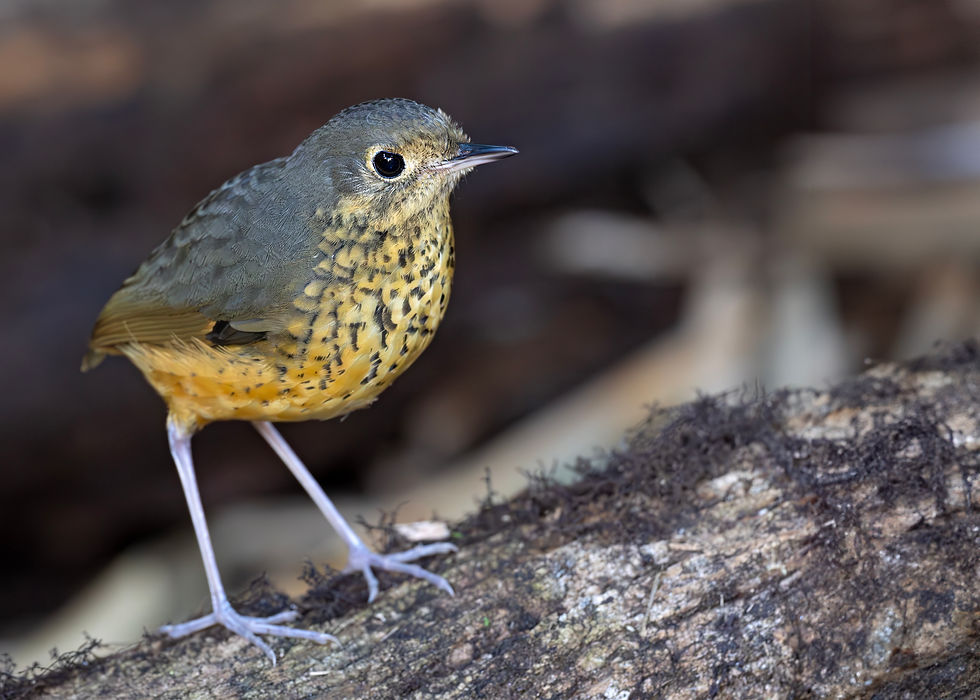
For birders seeking the Speckle-breasted Antpitta (Cryptopezus nattereri), the site offers one of the best chances in the region. During our visit, we managed to observe it in excellent conditions, something many birders spend years trying to do. It is a species that demands patience. Here at Sítio Cotinga, I did not even need to spend mine; in less than 30 minutes it was already at our feet, putting on a beautiful show, even bringing me to tears.
Other notable species include the Serra do Mar Tyrannulet (Phylloscartes difficilis), Brown Tinamou (Crypturellus obsoletus), Bay-chested Warbling Finch (Castanozoster thoracicus), Black-throated Grosbeak, Gray-backed Tachuri, Rufous-tailed Antbird (Drymophila genei) and White-browed Woodpecker (Piculus aurulentus).
What We Found There
For birders, the place has a special atmosphere. It is not only about lists or rare species; it is about the feeling of isolation, of silence, of walking trails that few people visit.

Sítio Cotinga has only two chalets, and perhaps that is exactly what keeps the experience so intimate. Small groups, unhurried photography, trails you can explore at your own pace, and a constant sense of being far from the fast world down below.
I easily see the place as a perfect pause for anyone arriving in São Paulo with a few extra days before or after a big trip through Brazil. Two nights already allow for a full immersion; three nights make the experience even deeper.
Conservation Through Presence
The constant presence of people and photographers has helped to significantly reduce hunting pressure in the region. Today, the greatest challenge is the recurring forest fires, driven by the expansion of extensive cattle ranching in the surrounding area.

Firebreaks were opened, areas began to regenerate, and every protected hectare represents vital space for the endemic species of the Atlantic Forest. Although surrounded by pasture on three sides, the site keeps a direct connection with the continuous forest of the Parque Estadual da Serra do Mar, ensuring the movement of animals and ecological continuity.
A Place That Stays With You
Perhaps the most beautiful thing about Sítio Cotinga is something hard to put into words. It is not a luxury destination, nor a place designed for large groups. It is a simple, honest refuge, deeply connected to the forest.


Giovana and Paulo welcome each visitor the way you open your home to friends. And when you leave, you carry with you that rare feeling of having slowed down for a few days.
For us, it was more than a scouting trip. It was an invitation to reconnect with what truly matters: the natural connection, both with the land and with our family.

Giovana and Paulo welcome each visitor the way you open your home to friends. And when you leave, you carry with you that rare feeling of having slowed down for a few days.
For us, it was more than a scouting trip. It was an invitation to reconnect with what truly matters: the natural connection, both with the land and with our family.
Frequently Asked Questions
Where is Sítio Cotinga located?
Sítio Cotinga is in São Luiz do Paraitinga, in the interior of São Paulo, at more than 1,500 meters above sea level, next to the Parque Estadual da Serra do Mar. Access is by dirt road from the village of Catuçaba.
How many bird species have been recorded at Sítio Cotinga?
More than 60 Atlantic Forest endemics have been recorded, and more than 270 species in total across the property’s 36 hectares. The full list can be consulted on eBird.
What are the most sought-after species at Sítio Cotinga?
Among the species most sought after by birders are the Rufous-tailed Antthrush, the Speckle-breasted Antpitta, the Hooded Berryeater, the Black-and-gold Cotinga, the Green-crowned Plovercrest and the Long-trained Nightjar.
What is the best time to visit Sítio Cotinga?
The site can be visited all year round. From May to August (winter) there is more activity at the feeders, and the Long-trained Nightjar arrives in June. December and January are very rainy. From September to November is a good period to observe cotingas.
How many guests does Sítio Cotinga host at a time?
The site has only two chalets, which ensures an intimate experience with no crowding. It is ideal for couples, small groups of birders, or families seeking immersion in nature.
Do I need a guide for birding at Sítio Cotinga?
It is not mandatory, but it is highly recommended. An experienced guide maximizes the chances of encountering elusive species such as the Rufous-tailed Antthrush and the Speckle-breasted Antpitta.
Is Sítio Cotinga suitable for bird photographers?
Yes. The setting is excellent for photography: quiet trails, good proximity to the birds, and natural light filtering through the forest. The absence of large groups allows for long, calm photography sessions.
What is Sítio Cotinga’s contribution to conservation?
The site protects 36 hectares of high-altitude Atlantic Forest connected to the Parque Estadual da Serra do Mar. The constant presence of guests has reduced hunting pressure, and firebreaks opened by the owners help protect the forest against fires. Each visit contributes directly to the maintenance of this refuge.


Comments