

The Slaty-Masked Tinamou: A New Bird From the Edge of the Brazilian Amazon


There is a moment in the life of every ornithologist when a “simple” sound changes everything. Mine had already come in 2012 (another story to tell about a new species of Pygmy-Tyrant). But in 2023, another “simple” sound set butterflies to my stomach. It was when Bruno Rennó sent me a recording on my phone. No context, no explanation, just a short message: "Listen to this."
I hit play. It was a tinamou. But it was not any tinamou I knew, and I should know every one that is possible in Brazil. The structure of the sound was too long, too complex, with elements that did not fit any described species. I felt that prickle on the back of the neck every birder knows, the one that says: this is something else.
A few years later, on December 2, 2025, another friend, Luis Morais, one of Brazil's leading specialists in tinamous, published with four colleagues the formal description of a species that was completely new. Not a taxonomic split, not a revalidated subspecies. An animal science simply did not know about, found on a steep slope in Serra do Divisor, in the far west of Acre. It was named Tinamus resonans, the Slaty-masked Tinamou, or in Portuguese, Sururina-da-serra.
This is its story.

An Island of Mountains in the Middle of the Amazon
To understand this bird, you first have to understand where it lives.
Serra do Divisor is a ridge roughly 60 kilometers long in the far west of Brazil, on the border with Peru. It is a narrow formation, two to five kilometers wide, and relatively low: the general elevation of the region sits around 200 meters, and the peaks of the range reach 600 to 800 meters. That is not much next to the Serra do Mar or the Andes. But Serra do Divisor does not need altitude to be extraordinary.
What makes it singular is the soil. The range is a sandstone uplift (quartz arenite, to be precise) produced by the same tectonic process that raised the Andes. It is, in Luis's words, "a little crumb broken off the Andes." Because of that it holds many links with the Andes, in flora, in fauna, and above all in geology.
That pure, sandy, extremely nutrient poor soil creates a mosaic of habitats that exists nowhere else in the Amazon. At the base of the range, tall, dark, humid submontane forest. On the tops, campinarana, stunted open vegetation growing on sand. And on the slopes, between those two extremes, a transitional forest with campina characteristics that is absolutely typical of Serra do Divisor.
"When you go to Serra do Divisor and you are up on the slope, when you step off the trail your foot sinks to the knee. Into a very dense leaf litter, until you reach a super complex substrate that local people call bucha: interwoven micro roots that form the floor of the forest."
It is exactly in that slope forest that the Slaty-masked Tinamou lives.
And there is a biogeographic detail that makes it stranger still. Serra do Divisor is completely isolated by thousands of kilometres of Amazonian lowland, in every direction. Atmospheric air travels thousands of kilometres from east to west without meeting a single topographic obstacle, and then collides with these mountains. Small as it is, the range plays a disproportionate role in those air masses, precisely because it stands alone in an ocean of flat forest.

A Place Nobody Knew
Serra do Divisor carries that name because it divides countries, but more fundamentally because it divides watersheds. And in the Amazon, human life has always been tied to rivers. Traditional populations and Indigenous people lived, and live, along the basins. The range, belonging to no navigable basin, stayed historically uninhabited.
"From Serra do Divisor to the Ucayali, to the Ojo de Contaya, is an almost uninhabited area. On the range itself there is no native local population. There is a very small village, ten or fifteen houses, at the foot of the range. People who settled there 80 or 100 years ago, in the rubber cycle. But they do not live on the range. There are no roads, there is nothing that climbs the range, except birders."
That isolation explains how a bird the size of a tinamou stayed unknown until now. It is not that nobody looked. It is that almost nobody was there. The few ornithologists who visited the region worked in the lowlands, in the accessible habitats. Or would simply go straight to the plateou. The slopes, steep and treacherous, stayed off the radar.
Until the first birders started exploring. Luis among them.
The Discovery
Luis Morais first went to Serra do Divisor mainly for the Red-billed Ground Cuckoo (Neomorphus pucheranii), one of the species in his doctoral work. But he carried with him a piece of information that would not leave him alone: years earlier, Ricardo Plácido had sent him a recording made by Fernando Igor de Godoy, a tinamou song nobody could identify. The same recording that came to me at that same time but from another direction.
"I heard it, and I am a student of tinamous. They have been one of my favorite groups since I can remember. I have a very close life history with tinamous. Since I was a child, as a hunter, as someone who grew up in the bush."
Luis knew every documented tinamou species. He had listened to every available recording, of every species, from Brazil and neighbouring countries. And that sound matched nothing. He suspected it might be an undocumented vocalisation of some western Amazonian species, perhaps Crypturellus bartletti, perhaps C. casiquiare, which would have been a new record for Brazil. But he could not settle it without going into the field.
A respected ornithologist went as far as identifying the sound as Crypturellus soui, the Little Tinamou. Luis, Ricardo and Fernando Igor disagreed. Luis knew the Little Tinamou very well, including the regional accents of the species. This was far too different.
On the range, the first days were frustrating. Luis climbed the slope, played the sound, and heard the answer coming from the foot of the mountain. He went down. The recording he had (made by Fernando Igor, from a distance) was partial and low quality, not good enough to work as playback. He kept at it whole afternoons with no response.
"Then one particular afternoon I managed to listen carefully and get a recording of the song from far away. For the first time I could grasp the complete structure of the sound. The song of this species is the most complex of all tinamous. It is the longest. It has smooth, flute-like elements, and also undulating elements. Two very distinct sections, with a rising system that makes the sound very complex."
From that recording Luis used a technique that is close to a signature of his: modelling the sound artificially. Not with artificial intelligence, but by hand, controlling tones, distortions, modulations and volumes until he had a reproduction convincing enough to provoke a response.
It worked. On the last day of that trip, the bird answered. Luis was playing from one ridge and would have sworn the sound was coming from another, an effect of the absurd resonance this species produces on the slopes. A voice so powerful and so smooth that it reverberates through the physical space of the mountain forest until any sense of distance and direction falls apart. That is where the scientific name comes from: resonans.
"When the bird came closer, I could see where it was, and it was already very close. It came towards me. I had no blind/hide, nothing, I crouched down on the trail, and the bird came right in front of me and stood there singing."
Luis went, in his own words, crazy. He saw it was an animal totally different from anything known. And he began to believe he was looking at a new species.

A Tinamou With No Fear
What surprised Luis in that first encounter, and was confirmed on later expeditions, was something entirely unexpected in a tinamou: this bird shows no aversion to human presence.
Tinamous are, by definition, skulkers. They are the animals you do not see on a trip. Getting a good look at a tinamou is rare even for experienced guides. But the Slaty-masked Tinamou approaches, engages with playback, and stays close even when it registers that people are there.
"We get very close, we move, we make noise, and the bird keeps interacting with the playback as if there were nobody there. That is also a concern for the long-term survival of the animal."
There is a likely explanation for this behaviour: the species evolved in an environment with no human hunting pressure. There was never a native population on the range. The people who live at its foot do not hunt up the slope, because it is too steep. The bird simply never learned to fear people.
That is exactly why the New York Times compared it to the Dodo. Not by relationship, since they are completely different birds. But the circumstances are the same: a ground-dwelling species with limited flight, no fear of humans, a distribution restricted to a sky island, and potential value as game. It is, unfortunately, a fair comparison.
How to Recognise It
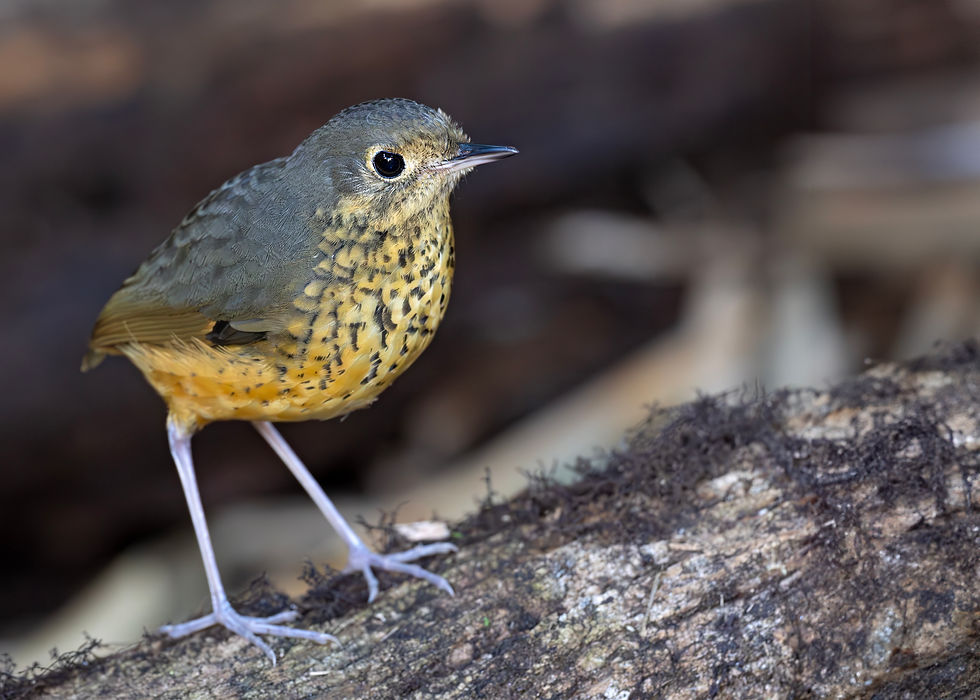
The Slaty-masked Tinamou has the same shape as the tinamous of the undulating-voice group, like the Little Tinamou (Crypturellus soui) and the Variegated Tinamou (Crypturellus variegatus). But the colors match neither.
The breast is a vivid, intense rufous that recalls the Variegated Tinamou. The bill, though, is shorter, and the flanks are not barred with black, only very subtle beige bands, almost imperceptible. The back is a plain, matte brown with no barring at all, unlike the strongly barred mantle of the Variegated Tinamou and its close relatives.
"What draws the most attention are the head markings: a bluish grey forehead with a mask running through the eye, forming an ochraceous supercilium. It is a very sharp pattern, very consistent across all individuals, and it occurs in no other tinamou species."


A Name Still Being Settled
One detail worth recording for the taxonomists in the room. The original description placed the species in the genus Tinamus, following a recent nomenclatural revision that returned that name to the Little Tinamou group on grounds of priority. The South American Classification Committee accepted the species unanimously, but recommended treating it provisionally as Crypturellus resonans, on the understanding that it clearly belongs in the Crypturellus clade and that the generic question still needs to be resolved in a proposal of its own.
In other words: the bird is beyond dispute, the genus name is still being stitched together. If you see Crypturellus resonans on a list, that is why.
A Bird Born Threatened
The species was assessed as Vulnerable. The reasons are several, and some of them do not require anyone to go anywhere near the bird.
The most insidious threat is climatic. Species endemic to montane environments are exposed to a phenomenon well documented by science: the escalator to extinction. As global temperature rises, the altitudinal belts that define each habitat type tend to rise with it. Half a degree of warming can push the ideal environment 200 metres up the mountain.
The problem is that Serra do Divisor has nowhere to go. Many of its peaks stand at 500 meters, the same elevation where this tinamou lives. With no room to migrate vertically, the species faces a drastic reduction in habitat that could cause population collapse within a few generations.
"With very small consequences from climate change, you can extinguish a species in very few generations."
And there are more direct threats. Because of the organic layer that supports the forest over the sandstone, the environment of Serra do Divisor is extremely vulnerable to fire. A widespread burn would destroy not only the forest but the substrate that took centuries to form. Without it, the forest simply does not come back.
Two infrastructure projects also threaten the region directly. The first is a road linking Cruzeiro do Sul to Pucallpa, in Peru, which would cut through the range very close to where the species was discovered and which, surprisingly, is already written into the decree that created Serra do Divisor National Park. The second, more ambitious, is a transcontinental railway crossing Acre towards Lima, part of a commodity export corridor.
And there is a proposal that is even worse: a bill in the Brazilian Senate to downgrade Serra do Divisor National Park to an Environmental Protection Area, which would sharply reduce its legal protection. One of the arguments is that the range holds the only rock formations in Acre useful for civil construction. And where is that rock? In the mountains, exactly where this bird lives.

Getting to Serra do Divisor
Serra do Divisor sits in the far west of Acre, and nobody arrives there by accident. Access is through Cruzeiro do Sul, which receives Gol flights and is connected to Rio Branco by road. From Cruzeiro do Sul you drive to Mâncio Lima, and from there it is eight hours by boat to the base of the range.
It is not an easy trip. But once you are there, three simple pousadas at the foot of the range offer basic structure for birders.
For the mountain itself, there is a single trail, 400 to 500 meters of elevation, giving access to the upper parts. That is the altitudinal band where the tinamou lives. The research team reached other areas by climbing through the forest, on terrain that is completely out of reach for most people.
"The Sururina is very likely on a trip out there. It would be hard to go and not see it. That comes down to it being a tame tinamou, which is completely unexpected. The tinamou is the animal you do not see on a trip. But at Serra do Divisor, it is one of the surest birds there is... for now."
That last clause is the honest part, and it is worth taking seriously. The tameness that makes this bird easy to see today is exactly the trait that makes it fragile tomorrow.


More Than a New Species
I have never been to Serra do Divisor, but I intend to go very soon. It is one of the places at the top of my list. A combination of isolation, biogeographic complexity, and the sense that there are still things there waiting to be found.
The story of this bird interests me for several reasons, but perhaps the main one is what it says about the state of ornithological knowledge in Brazil. It is 2026, and a completely new bird, not a split, not a revalidation, an animal nobody knew, has been described from a Brazilian national park. That should fill us with wonder and with worry in equal measure.
With wonder, because it shows there are still corners of the Amazon, and of Brazil, holding real surprises, even for the most experienced among us. With worry, because this bird is born already threatened by climate change, by fire, by infrastructure projects, by a bill that wants to tear out the mountains where it lives and turn them into asphalt.
The Slaty-masked Tinamou is at once a celebration and a warning. Proof that nature still surprises us, and a reminder that each of those surprises can be the last, if we are not paying attention.

Frequently Asked Questions
What is the Slaty-masked Tinamou?
The Slaty-masked Tinamou (Tinamus resonans), Sururina-da-serra in Portuguese, is a tinamou (family Tinamidae) that was completely new to science, described formally in December 2025 by Luis Morais and colleagues from specimens found at Serra do Divisor, in the far west of Acre, Brazil. It is not a taxonomic split, and not a revalidated subspecies, but an animal that was unknown until recently.
Where exactly was the Slaty-masked Tinamou found?
On the slopes of Serra do Divisor, an isolated range in the far west of Acre, on the border with Peru. It occupies slope forest between roughly 400 and 600 meters, a transitional habitat between the submontane forest below and the campinarana of the ridge tops.
How do you get to Serra do Divisor to look for it?
Access is through Cruzeiro do Sul, Acre, which receives commercial flights. From there you drive to Mâncio Lima, then take a boat for about eight hours to the base of the range. Three simple pousadas operate locally. A single access trail leads up to the slopes where the tinamou lives.
What are the realistic chances of seeing the Slaty-masked Tinamou?
Better than for almost any other tinamou, which is an unusual thing to be able to say. The species responds to playback and shows little fear of people, so most birders who make the trip and put in the effort on the slope trail connect with it. That said, this is a remote site with hard logistics, and no sighting is ever guaranteed.
When is the best time to visit Serra do Divisor?
Serra do Divisor is accessible year round, and the bird can be seen in any month. The breeding season falls in the dry season, from June to November, when birds are more responsive.
Is the Slaty-masked Tinamou threatened with extinction?
Yes. The species has been assessed as Vulnerable. The main threats are climate change (which compresses montane habitat), the risk of forest fire, road and railway infrastructure projects, and a legislative proposal to downgrade the protection status of Serra do Divisor National Park.
What other interesting birds can be seen at Serra do Divisor?
Acre Antshrike (Thamnophilus divisorius), Red-billed Ground Cuckoo (Neomorphus pucheranii), Lanceolated Monklet (Micromonacha lanceolata), Golden-tailed Sapphire (Chrysuronia oenone), Scarlet-hooded Barbet (Eubucco tucinkae), Black-throated Toucanet (Aulacorhynchus atrogularis), Amazonian Parrotlet (Nannopsittaca dachilleae), Opal-crowned Tanager (Tangara callophrys), Western Striped Manakin (Machaeropterus striolatus) and Rose-fronted Parakeet (Pyrrhura roseifrons), among others.
Can you listen to the song of the Slaty-masked Tinamou online?
Recordings are available at xeno-canto and at the Macaulay Library of the Cornell Lab of Ornithology. The song is described as the longest and most complex of all tinamous, with flute-like and undulating elements in two distinct sections.
Does Brazil Birding Experts run tours to Serra do Divisor?
Serra do Divisor can be included as an extension to our Acre and western Amazon itineraries. Get in touch for details.
References
Morais, L.A., Crozariol, M.A., Godoy, F.I., Plácido, R.A.A. & Raposo, M.A. (2025). A new species of Tinamus (Aves: Tinamiformes) from the western Amazon, Brazil. Zootaxa, 5725 (2), 279 to 291. https://doi.org/10.11646/zootaxa.5725.2.6
South American Classification Committee (2026). Proposal 1069: Recognize new species of Tinamus/Crypturellus. American Ornithological Society. https://www.museum.lsu.edu/~Remsen/SACCprop1069.htm
Online resources: xeno-canto, Macaulay Library (Cornell Lab of Ornithology), eBird hotspot for Serra do Divisor.
For customized itineraries in Acre and the western Amazon, reach out through our contact page.


Comments