

Chapada Diamantina Beyond The Birds: Waterfalls, Caves, Culture and Adventure in the Heart of Bahia


Chapada Diamantina is hard to overstate, and there is really no other way to begin. If you have never heard of it, come with us, because what is hidden in the heart of Bahia will change the way you think about Brazil. And if you already know it, this guide will still reveal corners, flavors, and stories that never made it onto your itinerary.
To understand the Chapada Diamantina, you have to go back in time. In the 19th century, the discovery of diamonds in the riverbeds drew thousands of prospectors from across the globe. The rush was genuinely international: alongside Brazilians came English, French and Dutch buyers and financiers, drawn in large part by the demand for industrial diamonds, and that global pull shaped the region from the very start.
Lençóis, today the main gateway to the region, was born from the mining itself, and its name carries two stories. One says that the white foam of the rivers, seen from high on the ridge, looked like bedsheets (lençóis in Portuguese) spread out to dry. The other points to the cloth tents the prospectors pitched for shelter: from a distance, that cluster of pale tents looked like laundry scattered across the hills, and the settlement came to be called Vila dos Lençóis, the Village of Bedsheets. The diamond cycle brought fleeting wealth, built mansions that still stand, shaped a culture of resilience and improvisation, and left scars and beauty in equal measure. When the diamonds ran out, what remained was a region of geological and cultural force that few places in the world can match.
That is exactly why this guide exists. On BBE tours through the Chapada Diamantina, the mornings and afternoons in the field are dedicated to birds, and the avifauna here is extraordinary. But between one outing and the next, the days fill with experiences our groups consistently call as memorable as their best sightings: waterfalls that take your breath away, food that tells the story of generations, trails that reveal a geology over a billion years old, and a rupestrian flora as singular as the birds we came to watch. The Chapada Diamantina is all of this at once, and you cannot separate the parts.
This guide was built over years of leading groups to the region, with the deep knowledge of Lúcio, a good friend and guide, and also a lifelong student of the Chapada Diamantina.
As Lúcio likes to say:
“Whoever comes here only for the waterfalls misses half. Whoever comes only for the birds misses the other half. Chapada Diamantina has to be lived whole.”
That is the spirit in which we put this itinerary together.
Before diving into the experiences, it helps to place Chapada Diamantina on the map, because the distances are deceiving. Chapada Diamantina is a vast highland region in the interior of Bahia, in northeastern Brazil, covering more than 40,000 square kilometers of plateaus, valleys, and rock formations over a billion years old. It is large enough that nothing is quite as close as it looks. Lençóis, to the east, is the main gateway and the most common base. To the west lies the Vale do Capão, in the municipality of Palmeiras, the starting point for the great treks. To the north, Iraquara holds the caves. And far to the south sit Mucugê and Ibicoara, a few hours' drive from Lençóis. Keeping that rough shape in mind explains why no single itinerary can cover everything, and why it pays to choose well.
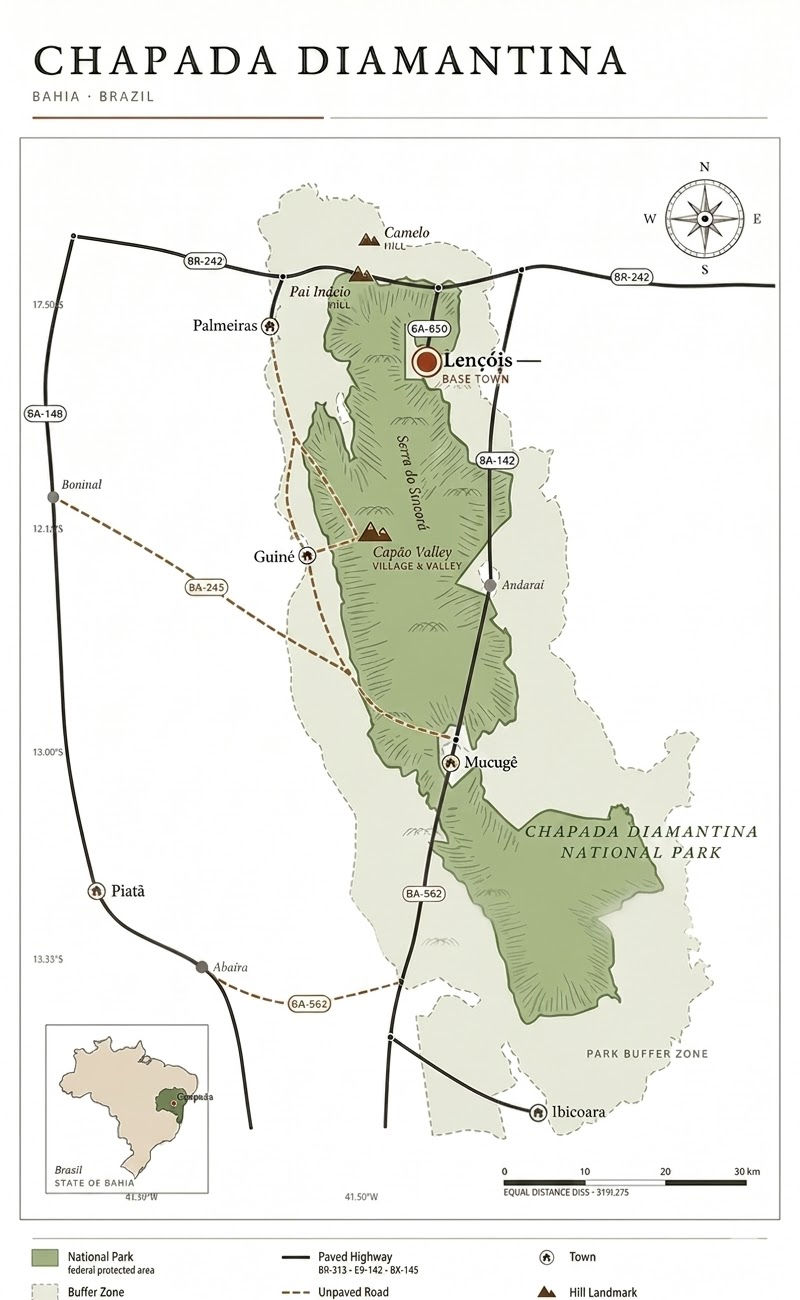
History, Culture & Local Experiences
Chapada Diamantina carries centuries of history in every rock formation, every cobbled street, every recipe handed down through generations. For those who arrive with attentive eyes, the traces of the diamond rush, the sertanejo (backcountry) traditions, and the local initiatives tell a story as rich as any landscape.
Serra das Paridas Archaeological Complex
Forty kilometers from the center of Lençóis, Serra das Paridas holds one of the most impressive collections of rock art in Chapada Diamantina. The paintings, spread across panels along the rock formations, date back thousands of years and include human figures, animals, and scenes that still resist interpretation. Access is easy and the visit is guided, which makes all the difference: without the context, the paintings are beautiful but silent. Late afternoon is the best time, when the light brings out the pigments and the heat has eased. It pairs easily with Cachoeira do Mosquito on the same day.
City Tour in Lençóis
Lençóis is listed as national heritage by IPHAN, and walking its stone streets is a journey back to the diamond-mining era that shaped the whole region. Colonial mansions, century-old squares, and stories of fleeting wealth, cycles of decline, and an unlikely reinvention as an ecotourism hub. A guided walk transforms it: the façades gain names, the corners gain stories, and the town that looks merely pretty by day reveals layers only a local knows. Lúcio knows every corner and always surprises the group with some new detail:
“This house here was once the richest in Lençóis. The owner lost everything in a week when the diamonds ran out. But look at the door: to this day, no one does woodwork like that.”

Stingless Bees
In Mucugê, a guided visit takes you into the world of native stingless bees (meliponines). It is a surprisingly absorbing experience: you learn about the biology of the colonies, the honey of species like jataí, mandaçaia, and uruçu, and you taste honeys ranging from citrus to floral in ways no supermarket jar will prepare you for. For biologists and naturalists, it is fascinating. For anyone curious, it is one of those experiences that change how you look at a garden.

Sítio das Frutas Vermelhas (Red Fruits Farm)
Still in Mucugê, Sítio das Frutas Vermelhas defies every expectation of what grows in the Northeast. Strawberries, cherries, and blackberries cultivated at altitude in the Chapada Diamantina, with explanations of the growing process and a tasting of fruit picked on the spot. It is a family-farming operation, now part of a SEBRAE route that celebrates exactly this kind of small-scale production, run by people who live on and care for the land. The little shop sells pulps, jams, and artisanal liqueurs, all made right there. It pairs perfectly with the stingless bees on the same day.
__________________________________________________________________________________
Food & Flavors of Chapada Diamantina
The food of the Chapada is a surprise in its own right. In a region many associate only with trails and nature, there are flavors that tell the story of the sertão, of colonization, and of the creative adaptations of those who live at altitude.
Casa de Doces Dona Afra (Dona Afra's Sweet House)
In the village of Campos de São João, Casa de Doces Dona Afra is one of those stops that enter the itinerary almost by accident and become a highlight. Artisanal sweets from the sertanejo tradition: goiabada (guava paste), doce de leite (milk caramel), preserves, and liqueurs carrying flavors that exist only here. You can taste them and take some home.
Vinícola Uvva & Restaurante Arenito (Uvva Winery & Arenito Restaurant)
In Mucugê, Vinícola Uvva surprises with wines that have already won international medals, including awards in France. The tour includes a tasting, a visit to the production, and the pleasure of discovering that the Bahian backcountry makes wine, and makes it well. The Restaurante Arenito next door complements it with paired dishes that elevate the experience. Open Tuesday to Sunday. Book ahead, especially in high season.
The Coffee of Chapada Diamantina
Few people associate the Bahian backlands with quality coffee, and that is exactly where the surprise lies. When the diamond cycle ran out, farming became one of the activities that sustained the region, and in some of the highest municipalities the land revealed an unexpected calling: producing some of the finest coffees in Brazil.
The heart of this story is Piatã, the highest and coldest town in the Northeast. Many of its coffee fields sit above 1,300 meters, a rare altitude for coffee in this country. The cold without frost makes the fruit ripen more slowly, sometimes nearly two months longer than in other regions, and it is that slow maturation that concentrates the sugar and the complexity in the bean. The result is coffee with notes ranging from molasses to citrus and red fruits, with elegant acidity and an intense aroma. This is no local exaggeration: coffees from Piatã have already won awards at the Cup of Excellence, one of the most respected competitions in the world.
In October 2024, the region earned its definitive recognition: a Geographical Indication with Denomination of Origin, the same kind of seal that protects famous producing regions around the world. Today, 24 municipalities across the Chapada Diamantina and south-central Bahia belong to the denomination, with Piatã, Mucugê, Ibicoara, and the Vale do Capão among the main producers.
And the best part: you can experience all of it up close. In Piatã, Café do João and Café Rigno welcome visitors for “field-to-cup” experiences, where you follow the bean's journey from the coffee field to the roasting and the tasting. In Mucugê and Ibicoara, Café Igaraçu also opens its doors to travelers curious to understand what makes the coffee of Chapada Diamantina so special. It is the same logic as the stingless bees and the winery: the sertão doing, with excellence, what no one expects. And, as always, behind every farm there is a family and a story worth as much as what ends up in the cup.
__________________________________________________________________________________
Iconic Landscapes & Viewpoints
Chapada Diamantina is, above all, landscape. Tabletop mountains, deep valleys, horizons that stretch as far as the eye can see. These are the places where the grandeur of the region reveals itself fully: places to stop, breathe, and take in a geology that is over a billion years old.
Sunset at Gerais do Camelo
One of the best spots to watch the sunset in the Chapada. Access is by car, with very little walking, which makes it reachable for almost anyone. From there, the view opens 360 degrees over hills and valleys that win everyone over. It is the kind of program that seems simple, and is, but stays in the memory for good. Our recommendation: bring something to drink, pick a rock, sit, and let the sunset do the rest.
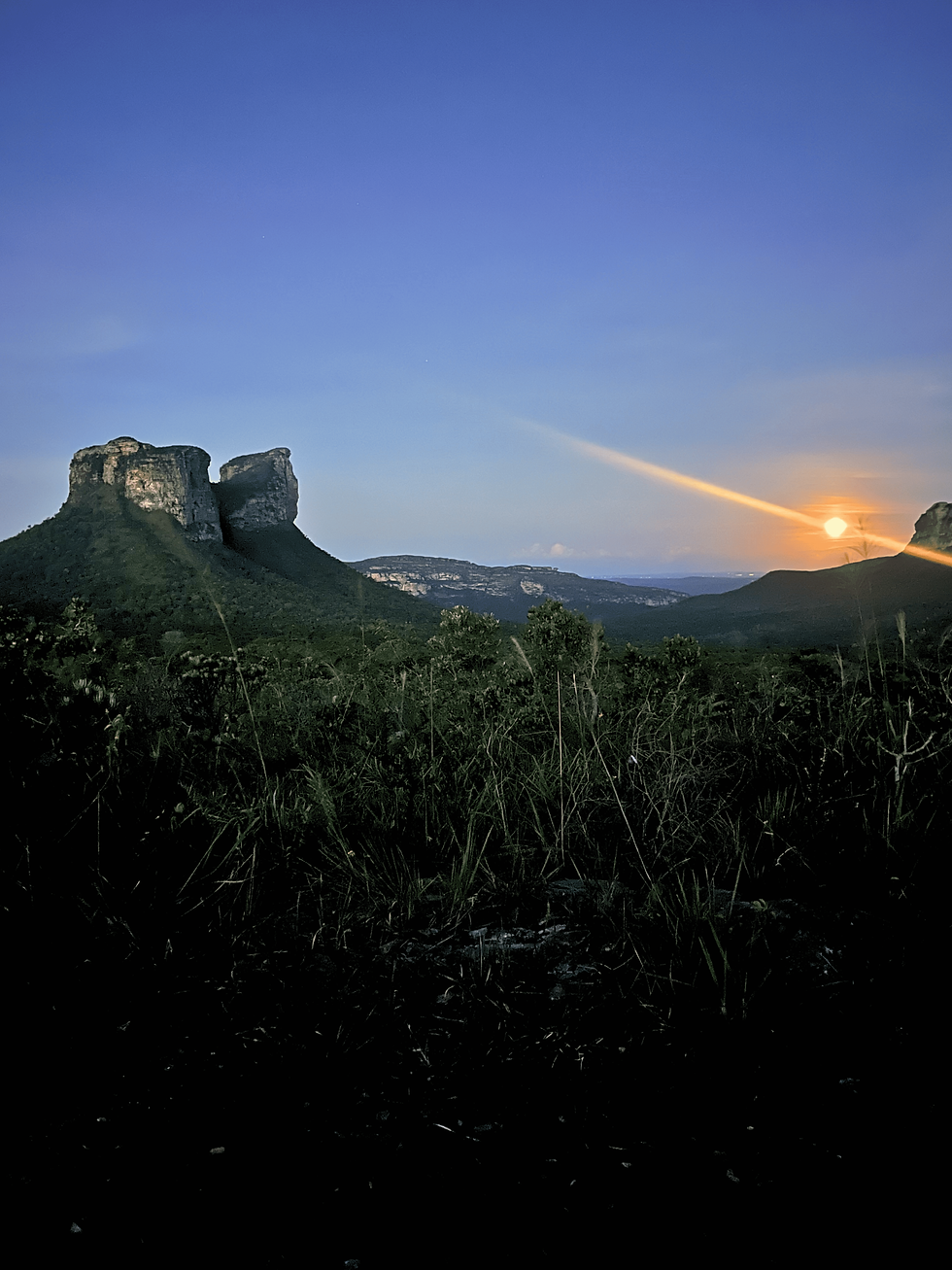
Morro do Pai Inácio
The postcard of Chapada Diamantina. Morro do Pai Inácio, about 27 km from Lençóis along the BR-242 highway, offers a 360-degree view that sums up the grandeur of the region: tabletop mountains, deep valleys, cerrado stretching to the horizon. The climb is short but steep, about 20 minutes at a moderate pace, and late afternoon is the ideal time, when the golden light transforms the landscape.

__________________________________________________________________________________
Waterfalls, Natural Pools & Swimming
If anything defines Chapada Diamantina in the imagination of those who visit, it is the water. Waterfalls dropping from immense canyons, natural pools carved into ancient sandstone, rivers of crystal-clear water that invite you to linger. Each has its own personality, and the hard part is choosing among them.
Cachoeira do Mosquito (Mosquito Waterfall)
Forty kilometers from Lençóis, Cachoeira do Mosquito is one of the most accessible in the Chapada. A short, well-marked trail and a waterfall that rewards every step. The name has nothing to do with insects: it comes from the tiny diamonds found here during the mining boom, so small the prospectors called them mosquitoes. The water is refreshing and the setting, with sandstone walls and gallery forest, is one no camera quite does justice. A light outing, ideal for the start or end of a field day.

Cachoeira do Buracão
In the municipality of Ibicoara, far to the south of the park, Cachoeira do Buracão is probably the most striking waterfall in Chapada Diamantina, and one of the most beautiful in Brazil. About 85 meters drop into a narrow canyon of reddish sandstone, with an emerald-green pool below. The access trail runs roughly 6 km round trip over flat, pleasant terrain, but the final stretch involves swimming or wading to the base of the falls, which is part of the experience. A guide is mandatory. Reserve at least a full day.

Cachoeira do Poço do Diabo (Devil's Pool Waterfall)
A few kilometers from Lençóis, Poço do Diabo is one of the most accessible waterfalls in the Chapada. A short, well-kept trail and a drop of about 20 meters into a wide, inviting pool. The sinister name does the place no justice: it is pretty, calm, and works very well as a half-day program.

Ribeirão do Meio
Near Lençóis, Ribeirão do Meio is the most laid-back program in the Chapada. The highlight is a natural rock slide that drops into a deep pool, an experience that pulls a smile from anyone, regardless of age. The access trail is easy, through gallery forest, and the setting invites you to stay all day. Bring a snack and sunscreen.

__________________________________________________________________________________
Caves & Geology
The geology of Chapada Diamantina is among the oldest on the planet. The sandstones and quartzites that form the great cliffs and plateaus date back over a billion years. The limestone where the caves open is much younger in geological terms, and the caves themselves, carved by water over millennia, are recent on that scale of time. Visiting them combines beauty, science, and the rare sense of standing before something genuinely ancient.
Fazenda Pratinha & Gruta Azul (Pratinha Farm & Blue Cave)
In Iraquara, Fazenda Pratinha is one of the most visited spots in the Chapada, and for good reason. The water is absurdly clear, with visibility that looks unreal. Snorkeling, kayaking, and a zip line are the options, and all are worth it. Right next door, Gruta Azul, the Blue Cave, impresses with the intense color that natural light casts on the cavern walls. It is a full-day outing that works well as active rest between harder field days.

Gruta da Lapa Doce (Lapa Doce Cave)
In the Iraquara area, Gruta da Lapa Doce impresses by sheer scale. Enormous chambers, stalactites and stalagmites in surreal shapes, and the feeling of an underground cathedral that few Brazilian caves offer. The visit is guided and lasts about an hour. It is accessible, requires no special fitness, and pairs well with Fazenda Pratinha on the same day.
__________________________________________________________________________________
Trails & Adventures
For those who love to walk, Chapada Diamantina is a paradise. From easy half-day trails to full-day treks over rugged terrain, and crossings that can last two to five days, the variety is enormous. Each trail reveals a different Chapada, and all reward the effort.
Trilha do Parque da Muritiba (Muritiba Park Trail)
Near Lençóis, the Parque Municipal da Muritiba offers easy trails through rupestrian cerrado and riparian forest, with sweeping views along the entire route. It is a short outing, ideal for a morning or afternoon, that works both as a warm-up for bigger trails and as a stand-alone option for stretching your legs without commitment.
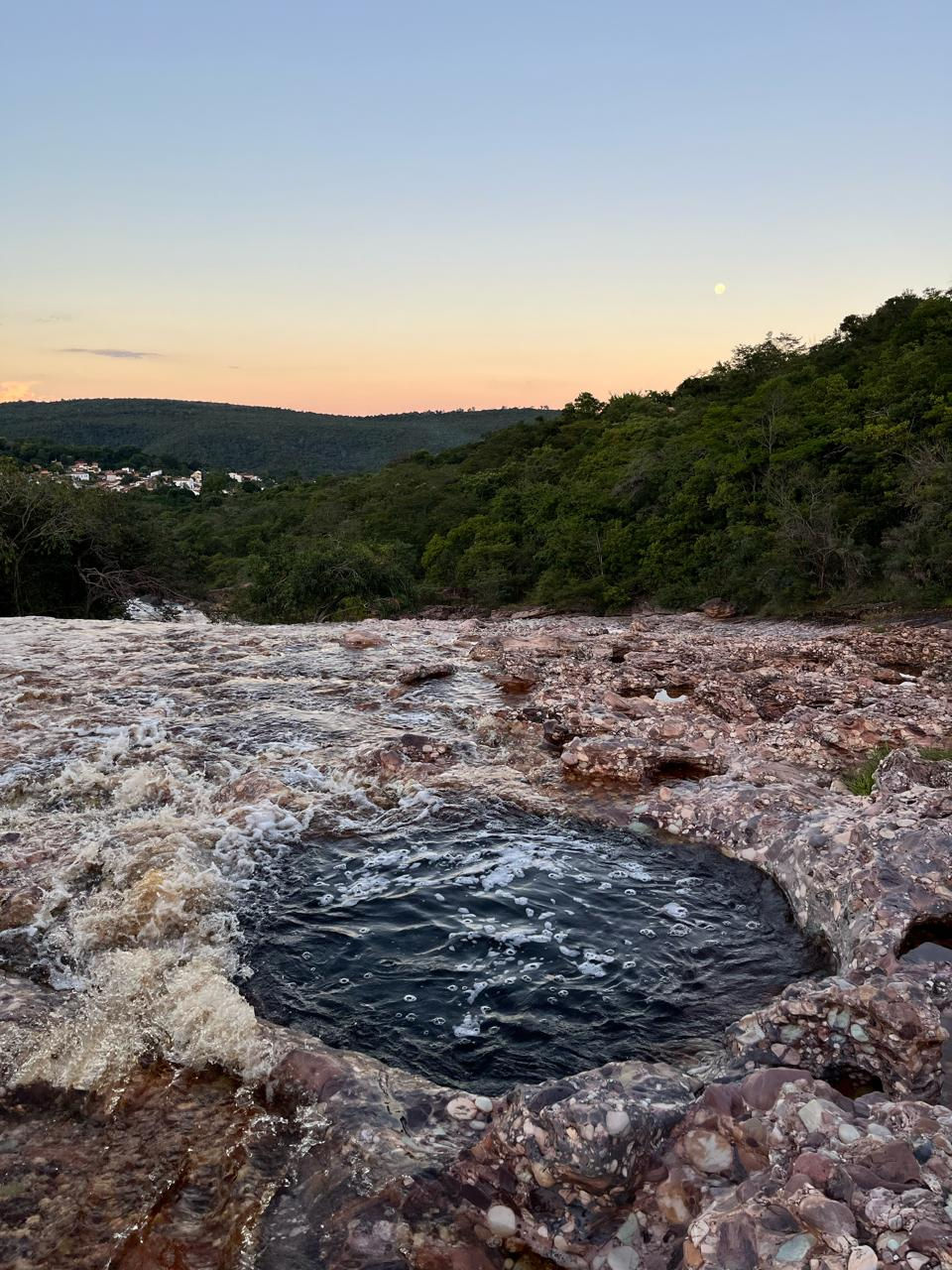
Cachoeira da Fumacinha
In the Ibicoara area, Fumacinha is for those who love a real trek. About 14 km round trip over rugged terrain, with steep descents to the bottom of a canyon where a waterfall of roughly 100 meters falls into an almost unreal setting. It is one of the most beautiful, and most demanding, trails in the Chapada. It requires fitness, a mandatory guide, and at least a full day. The reward matches the effort.
Cachoeira da Fumaça + Riachinho
Cachoeira da Fumaça is one of the highest free-fall waterfalls in Brazil, at about 340 meters. Access from the top, starting from the Vale do Capão, is the most common option: a trail of roughly 12 km round trip through rupestrian cerrado and high-altitude grasslands, with views that justify the effort before you even reach the falls. Riachinho lies on the way back and is the perfect counterpoint: a series of natural pools and small drops where you can swim and rest your legs. Together, they make one of the best possible days in the Chapada.
_________________________________________________________________________________
The Botany of the Chapada
If the birds are the heart of our tours, the flora of the Chapada is the surprise that steals the scene without asking. The meeting of three major biomes (Caatinga, Cerrado, and Atlantic Forest), combined with the high-altitude rupestrian grasslands (campos rupestres), creates a plant mosaic of rare diversity and a level of endemism that places the region among the most important in Brazil for botany.
On the sandstone of the campos rupestres grow the sempre-vivas (everlasting flowers, several genera of Eriocaulaceae, many of them endemic), the canelas-de-ema (Vellozia), with trunks resistant to fire, alongside rock orchids, bromeliads, and carnivorous plants such as Drosera and Genlisea in the waterlogged areas. It is a Chapada revealed at ground level, with blooms that shift with the seasons, and that rewards anyone who slows down to look.

A Special Experience: Nature with Optional Birding
Not everything in the Chapada fits neatly into categories, and Marimbus is exactly like that. It is nature, landscape, and silence, and for those who want it, also one of the best birdwatching spots in the region.
Marimbus, the Mini-Pantanal
For those who come for the birds, Marimbus is a great option. Known as the Mini-Pantanal of Chapada Diamantina, it is a wetland fed by the Rio Santo Antônio, with aquatic vegetation, buriti palm stands, and an avifauna that contrasts completely with the dry cerrado, caatinga, and campo rupestre of the highlands. The tour is by boat or kayak, gliding through channels of vegetation where herons, tiger-herons, kingfishers, and many other birds appear everywhere. It is also one of the best places to see the Least Bittern (Ixobrychus exilis) in the region. A program that works for birders and for anyone who loves water, silence, and scenery.

What Else the Chapada Holds
The list could go on. Chapada Diamantina is a vast region, more than 40,000 square kilometers of plateaus, valleys, rivers, and rock formations over a billion years old. Every municipality has its secrets, every local guide has their favorite corners, and the sense that there is always something more to discover never goes away.
Worth saying: on BBE's classic birding tours through the Chapada Diamantina, the focus is on the birds, and most of these attractions are not part of the standard route. But for anyone who wants to combine the best of birdwatching with these experiences, any of them, and others that did not make it here, can be built into a tailor-made trip designed from scratch around the group's interests.
And that is exactly what Chapada Diamantina offers: a place where nature, history, and culture meet in a way that repeats nowhere else in Brazil.
For a tailor-made trip through Chapada Diamantina, get in touch through our contact page.

Frequently Asked Questions
What is Chapada Diamantina known for?
Chapada Diamantina is known for its tabletop mountains, waterfalls (including Cachoeira da Fumaça, one of the highest in Brazil at about 340 meters), caves, crystal-clear natural pools, and rich birdlife. It is a vast highland region in the interior of Bahia, northeastern Brazil, where the Caatinga, Cerrado, and Atlantic Forest meet.
How do I get to Chapada Diamantina?
The main access is through Lençóis Airport (LEC), which receives flights from Salvador. You can also drive from Salvador (about 420 km, roughly 6 hours) or take a regular bus from Salvador to Lençóis.
How many days do you need in Chapada Diamantina?
Plan at least 5 days to see the main attractions without rushing. On BBE birding tours we usually dedicate 2 to 3 days focused on birdwatching, while a full nature-and-culture trip works best with 7 to 10 days.
What is the best time to visit Chapada Diamantina?
The Chapada can be visited year-round. November to March is wetter, which makes the waterfalls fuller and the vegetation greener. April to October is drier, with cooler nights, especially between June and August.
Is Chapada Diamantina good for birdwatching?
Yes. The region spans transitions between Caatinga, Cerrado, and Atlantic Forest, producing a diverse avifauna with more than 400 recorded species. Areas like Marimbus and the high-altitude grasslands are especially productive.
Do you need a guide for the trails?
Some trails require a guide by law (such as Buracão and Fumacinha). For others, a guide is not mandatory but strongly recommended, both for safety and for the depth a local guide like Lúcio Moraes brings to the experience.
Are the waterfalls accessible for everyone?
It depends on the waterfall. Poço do Diabo and Mosquito are quite accessible, with short, well-marked trails. Buracão requires swimming or wading, and Fumacinha is an advanced-level trek. There are options for every fitness level.
Do the attractions charge an entrance fee?
Most attractions charge a modest entrance fee that often helps maintain the site and support the local community. Because the amounts change frequently, we prefer not to list them here: confirm directly at the attraction or with your guide before visiting.
What should I pack for Chapada Diamantina?
Sunscreen, a hat, light clothing with long sleeves for the cerrado trails, comfortable hiking shoes, swimwear, and an extra layer for the nights, especially between June and August when temperatures can drop significantly.
Can you combine birdwatching with the attractions in this guide?
Yes, and that is exactly the idea behind BBE's tailor-made tours through the Chapada Diamantina. Mornings and afternoons go to the birds, while the cultural, culinary, and adventure experiences fill the gaps, creating a complete trip that goes well beyond the field.
Where should I stay in Chapada Diamantina?
Lençóis is the most practical base, with a good range of guesthouses and restaurants. Mucugê and Vale do Capão are alternatives for staying closer to specific attractions. On BBE tours, we handle all the lodging logistics and usually spend two nights in Lençóis and one night in Mucugê.
__________________________________________________________________________________
References
Parque Nacional da Chapada Diamantina. ICMBio, Brazilian Federal Government. https://www.gov.br/icmbio
BirdLife International. Data Zone, Country Profile: Brazil. https://datazone.birdlife.org/country/brazil
IPHAN. “Architectural and Landscape Ensemble of Lençóis.” http://portal.iphan.gov.br
INPI. Geographical Indication, Denomination of Origin: Café da Chapada Diamantina (registered October 2024). https://www.gov.br/inpi



Comments