

What's The Deal With The Cherry-Throated Tanager? Inside the Search for One of the World's Rarest Birds


It was 2017. Tati — Tatiana Pongiluppi, a biologist working as a volunteer at the time on the conservation program for the species — and I were in the middle of a project we had named Tesouros do Brasil — Treasures of Brazil. The plan was simple: ride a small 250cc motorcycle across northeastern Brazil and the northern reaches of the southeast, find ten of the country's most critically endangered birds, and interview the people whose lives revolved around them — researchers, local residents, anyone who had a story to tell about a species on the edge. The Cherry-throated Tanager was one of the ten.
We arrived at Mata dos Caetés, in Vargem Alta, and stayed in a small, simple house — cold enough that we felt the mountain in our bones that first night. Tati had been to this forest before. On previous visits, she had accumulated ten days of searching — climbing the same trails, scanning the same canopy, listening for a call she had only ever heard on recordings. In all those days, she had never heard a single note.
We went out the next morning.
By eight o'clock, we had seen the bird.
That is, in a sentence, what it means to look for the Cherry-throated Tanager — Nemosia rourei, the saíra-apunhalada in Portuguese, "the stabbed tanager," named for the splash of crimson on its throat as if it had been pierced through the chest. Some people search for years. Some people see it in one morning. Most never hear it at all. The birds are out there, somewhere in that forest patch in central Espírito Santo, and they will or will not show themselves. There is no formula. There is barely a strategy. There is only the forest, the canopy, and an enormous amount of patience.
This article is about that bird. Why it matters, what we know about it, what its history can teach us, and — most importantly — what it really takes, today, to have a chance of seeing it.
A Bird Named For A Wound

The story of the Cherry-throated Tanager begins not in the field, but in a museum drawer in Berlin, in 1870.
That year, the German ornithologist Jean Cabanis — then editor of the Journal für Ornithologie — described a small grey-and-white tanager with a strange and beautiful crimson throat patch. The specimen had reached him through a chain of hands typical of nineteenth-century ornithology: collected somewhere in southeastern Brazil, possibly in the Serra dos Órgãos region of Rio de Janeiro, possibly further north in Minas Gerais (the type locality has never been fully resolved); acquired by a Swiss-Brazilian bird collector named Jean (Johann) de Roure, working in the area around Nova Friburgo and Macaé de Cima; and forwarded to Cabanis through the German naturalist Carl Euler, who specifically requested that the species be named in honor of de Roure himself.
Cabanis published the description as Nemosia rourei — the genus Nemosia from the Greek nemos, "wooded glade," echoing his German vernacular for the bird, Rothkehlige Waldtangare: the "red-throated forest-tanager." It was a small detail in a long catalogue of new tropical species being described in Europe at the time. There was no second specimen. There was no detailed locality. There was no field observation.
And then — for 128 years — there was nothing.
The Cherry-throated Tanager simply vanished from the ornithological record. No collector found another. No naturalist reported a sighting. The single Berlin specimen sat in its drawer through two world wars, through the rise and fall of empires, through the entire twentieth century. By the 1970s, most ornithologists assumed the species was extinct.
The 1941 Sighting
There is one exception in the long silence between 1870 and the rediscovery — and it is a story worth telling, because it almost didn't survive into the literature at all.
In 1941, the German-Brazilian ornithologist Helmut Sick — one of the most important field ornithologists Brazil ever produced — recorded a small flock of Cherry-throated Tanagers near Jatibocas, in the municipality of Itarana, central Espírito Santo. Sick was meticulous, experienced, and not given to wishful identification. He saw the birds, he noted them, and he reported them.
For decades, his record was disputed. The Brazilian ornithologist Olivério Pinto, then the dominant figure in Brazilian ornithology, doubted the observation. Without a specimen, without a photograph, without a recording, the sighting hung in scientific limbo — accepted by some, dismissed by others.
It was only in 1979, in a paper in the Bulletin of the British Ornithologists' Club, that Helmut Sick himself, together with Dante Martins Teixeira, formally defended the validity of the Jatibocas record. Teixeira's careful argument re-established Sick's observation as the only credible twentieth-century record of the species before its rediscovery.
It is an ornithological footnote, but a meaningful one. For nearly forty years, Sick's record was the single thread connecting the museum specimen to the living world. The bird existed. Someone competent had seen it. The forest still held it, somewhere.
February 22, 1998 — The Rediscovery
The bird returned to science on a specific date, in a specific place, through a specific group of people. It is worth naming them.
On February 22, 1998, at Fazenda Pindobas IV — a private property in Conceição do Castelo, central Espírito Santo — a small team led by Cláudia Bauer, José Fernando Pacheco, Augusto César Venturini, Paulo Rogério de Paz, Marlon Pereira Rehen, and Luiz Pedreira do Carmo confirmed the existence of the Cherry-throated Tanager in the wild. The first acoustic recording of the species was made that same day by Pacheco — a recording that still sits in the Arquivo Sonoro Elias Coelho at UFRJ, catalogued as JFP 183A. It is the foundational document of everything that has followed.
The full description was published in 2000, in Bird Conservation International, by Bauer, Pacheco, Venturini, and Whitney — a paper that remains the single most important reference on the species and its rediscovery.
The location matters. Pindobas IV is not Mata dos Caetés. The two sites are sometimes confused in popular accounts, but they are separate properties. Mata dos Caetés — the forest patch that today holds most of the known global population, and where most birders go in search of the species — was only confirmed as a Cherry-throated Tanager site in 2003, five years after the rediscovery.
After 1998, the search expanded. Teams scoured the mountains of Espírito Santo and southern Minas Gerais. New sites were proposed, then ruled out. Surveys in Caparaó National Park in 2021, despite reasonable hope based on habitat similarity, failed to detect the species. But the picture is not entirely bleak: a separate population has since been confirmed in the mountains around Santa Teresa, in central Espírito Santo — a genuinely significant finding, as it means the species' survival does not depend entirely on a single forest patch. Still, the Cherry-throated Tanager is known from only a handful of sites, all within a relatively small region of the state, and remains one of the most range-restricted birds in the Americas.
What We Know About The Bird
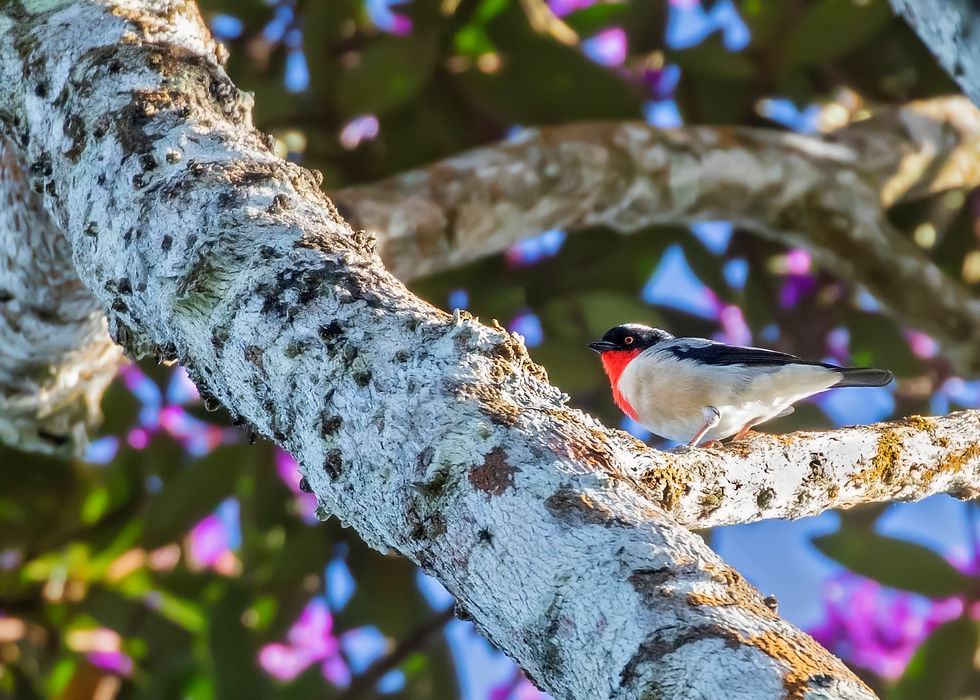
For a species this rare, surprisingly much has been learned in the past two decades — almost all of it from intensive monitoring at Mata dos Caetés.
The Cherry-throated Tanager is a small bird, about 14 cm in total length and weighing roughly 22 grams — the earliest biometric data come from an individual banded at Pindobas IV during the 1998 rediscovery, which was reliably relocated at the site for at least six years. Since then, birds have been captured and banded at Reserva Kaetés — a private reserve (RPPN) established by Instituto Marcos Daniel in 2021 within the broader Mata de Caetés landscape, with support from the Rainforest Trust and the American Bird Conservancy — as part of the long-term monitoring program run by IMD and collaborating researchers — work that has yielded much of what we now know about the species' breeding biology. It is grey above, white below, with a broad black mask across the face, a yellow iris that becomes startling at close range, and the diagnostic crimson "dagger" patch on the throat that gives the bird its Portuguese name. The sexes look alike. Juveniles have a duller, brownish throat patch and darker eyes — a useful field detail, since fledged young at Mata dos Caetés are now part of the resident population.
The species lives in mid- and upper-canopy of well-preserved montane Atlantic Forest, between roughly 850 and 1,250 meters elevation. It joins mixed-species flocks dominated by other tanagers and small insectivorous birds — Sibilant Sirystes, Rufous-headed Tanager, Hooded Berryeater, Plumbeous Antvireo, and others. It is largely insectivorous, foraging actively in epiphyte clusters and outer foliage, occasionally taking small fruits.
Two behavioral details stand out as genuinely unusual.
The species has a far-carrying, nasal "péuuu" call — described in eBird as péuuu, péuuu-see'ee — that is often the first (and sometimes only) clue to its presence. Recordings are now well-documented in xeno-canto and the Macaulay Library, but they remain scarce relative to almost any other tanager. The bird is generally silent, and a single individual passing through a flock can move on without ever vocalizing.
The species is also a cooperative breeder — one of relatively few tanagers known to be so. Studies of nests at Mata dos Caetés (Hoffmann et al. 2024/2025; building on earlier work by Venturini et al. 2002, 2005) have documented multiple adults and juveniles bringing food to a single brood. In one nest watched by myself and Tati years ago — filmed with a digiscoping setup, scope and cell phone propped together — we counted at least five or six different individuals coming to feed the young. It is not parental care. It is family care, in the strict biological sense. And it is one of several reasons why the recovery of the population, slow as it has been, is even possible.
The clutch size is 3–4 eggs, not 2 as earlier sources occasionally state. The breeding season runs roughly October through January. Active nests are monitored, protected, and never approached without authorization from the research team that works the area year-round.
A Population Slowly Recovering

The current global population of the Cherry-throated Tanager is estimated at fewer than 30 mature individuals — most of them at Mata dos Caetés, with a smaller number at Santa Teresa. There is no certainty that they still hang on in Pindobas IV.
Twenty years ago, the count was around ten.
That growth — from ~10 to ~22 known birds, with additional fledglings of recent breeding seasons not yet fully accounted for — is not the result of a new population being found. It is the result of in-situ recruitment: chicks fledging from monitored nests, surviving their first year, and entering the breeding population themselves. Every additional bird is the product of years of nest protection, habitat management, and dedicated field work by the Programa de Conservação da Saíra-Apunhalada (PCSA) — the long-term conservation program that monitors the species in Espírito Santo.
It is, in conservation terms, an extraordinary outcome. A doubling of the known global population through dedicated in-situ work alone, without translocation, without captive breeding, without intervention beyond the careful protection of the forest and its birds.
In December 2025, this long effort was publicly acknowledged with the gazetting of the Parque Estadual Saíra-apunhalada, a new state park in Espírito Santo created specifically to protect the species and its habitat. After nearly two decades of advocacy by researchers, conservation organizations, and the SAVE Brasil network, the bird that gives the park its name now has formal legal protection over a meaningful slice of its world. It is, in a real sense, the first official recognition that this small tanager is a treasure of the state — the kind of recognition that turns a species from a museum curiosity into a public commitment.
The municipality of Vargem Alta, where Mata dos Caetés sits, formally adopted the Cherry-throated Tanager as its symbolic species in 2024. Schools in the region now run environmental education programs built around the bird. None of this guarantees the species' future. All of it makes the future more possible.
The Real Chances Of Seeing It
Now the part of the article that matters most, and that I want to be honest about.
If you come to Mata dos Caetés as part of an Espírito Santo / Minas Gerais birding tour — ours or anyone else's — your chances of seeing the Cherry-throated Tanager are low. Not zero. Not negligible. But low.
Most groups do not see it. Some groups do not even hear it. Tati, who lived in the region and worked professionally on the species, spent ten days at the site in 2017 without a single contact. I have been guiding tours through this area for years and talking to people that visit the area as well. The species shows up sometimes in the first hour of the first morning, and sometimes not at all in two full days of effort. There is no reliable pattern. There is no playback strategy that works for a critically endangered cooperative breeder in active monitoring (more on this in a moment). There is just patience, knowing the territories, working with the research team, and the quiet acceptance that the bird may simply not be in front of you on the mornings you happen to be there. For what it is worth, I have seen the bird on every tour I have guided here — though in some cases only in the final minutes of our visit. On one occasion, we walked 37 km over two days before a group of about six individuals finally passed through the canopy above us, foraging quietly, as if we had never been there at all.
It helps to understand the math. Fewer than 30 individuals across a territory of several hundred hectares, broken into family groups that move quietly through the upper canopy, vocalize sparsely, and pass through any given point on any given day for reasons we still don't fully understand. The phrase "needle in a haystack" is a cliché, but in this case it is also approximately accurate. Maybe a third of the groups we lead through the area get clear contact with the species. The rest get the forest, the supporting cast, the landscapes, and the story.
If you are coming for this bird and only this bird, prepare yourself emotionally before the tour begins. The disappointment of missing a Cherry-throated Tanager is real, and it is deeper for some birders than the disappointment of missing almost any other bird in Brazil — because there is no easy second chance, no other site to swing through next month, no realistic plan B. There is only Mata dos Caetés, and there is only luck.

Come for the bird. Come prepared to miss it. That is the only honest position to take.
A Note On Field Ethics
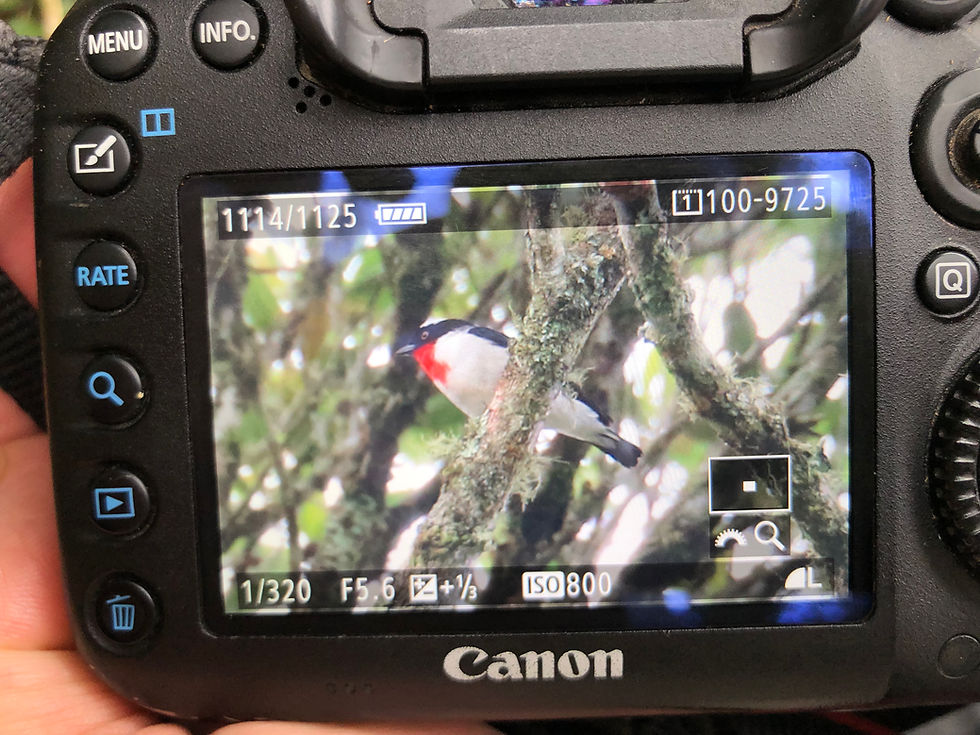
A short word on playback, because it comes up often.
Playback is prohibited at Mata dos Caetés and surrounding Cherry-throated Tanager sites — a rule established by Instituto Marcos Daniel (IMD) and the Programa de Conservação da Saíra-Apunhalada (PCSA), who manage and monitor the area. The reasoning is straightforward: critically endangered cooperative breeders living in family groups in a small known territory are precisely the wrong kind of bird to subject to repeated acoustic stimulation, especially during the breeding season when active nests may be present in the canopy directly above an observer.
Detection at Mata dos Caetés is passive: walking trails slowly, listening attentively, watching the movement of mixed flocks, and working in close coordination with the field researchers who know which territories are active. There is no shortcut. The bird is found, when it is found, by being in the right place at the right hour and paying attention. It is the slowest, oldest method in birding, and for this species it is the only ethical one.
What The Forest Offers, Even Without The Tanager

If the Cherry-throated Tanager does not appear, the morning is not wasted.
Mata dos Caetés sits in some of the best-preserved montane Atlantic Forest left in Espírito Santo, and the supporting cast is excellent on its own. Hooded Berryeater, Spot-breasted Antvireo, White-bearded Antshrike, Rusty-barred Owl, Plumbeous Antvireo, Gilt-edged Tanager, Rufous-headed Tanager, Cinnamon-vented Piha, Golden-tailed Parrotlet, Brown-backed Parrotlet, and Vinaceous-breasted Amazon are all possible on the same trails. Mammals include the critically endangered Buffy-headed Marmoset and Masked Titi Monkey.
The landscapes alone — small valleys of agriculture giving way to forested ridges, the cool montane air at 1,000 meters, the sense of being in one of the last refuges of a vanishing biome — are part of why we keep returning. The saíra is the headline. The forest itself is the reason the headline exists.
Why This Bird Matters

There are more spectacular birds in Brazil. There are rarer ones. There are easier ones. The Cherry-throated Tanager is none of those things, and that is exactly why it matters.
It matters because it disappeared for 128 years and came back. It matters because a small group of people — Helmut Sick in 1941, Bauer and Pacheco and Venturini and Whitney in 1998, the team at the PCSA today — refused, at each step, to let it slip back into the silence. It matters because the population, against everything you might expect, is slowly growing. It matters because in November 2025 a state park was created with this bird's name on the gate.
And it matters because for those of us who live and work in this region, the Cherry-throated Tanager is the most local possible reminder that the Atlantic Forest is still alive, still surprising, and still — barely, against the odds — capable of recovering some of what was lost.
Most birders who come to Espírito Santo will not see it. Some will. All of us, who walk these trails year after year, are part of the story it is still telling.
Frequently Asked Questions
What are the realistic chances of seeing the Cherry-throated Tanager on a birding tour?
Honestly: low. Roughly a third of organized groups visiting Mata dos Caetés get a confirmed sighting of the species. Many groups do not even hear it. There is no reliable strategy to improve those odds beyond patience, time, and working with experienced local guides who know the active territories. If you are coming for this bird, come prepared to miss it.
Where is the Cherry-throated Tanager found today?
The species is known from a handful of sites in central Espírito Santo: Mata dos Caetés (Vargem Alta), and a separate population confirmed in the mountains around Santa Teresa. The species has not been seen for at least 10 years in the original 1998 rediscovery site at Fazenda Pindobas IV (Conceição do Castelo). Surveys in Caparaó National Park and other potentially suitable sites have so far failed to detect additional populations.
Why is the bird called "saíra-apunhalada"?
The Portuguese name translates roughly as "the stabbed tanager" — a reference to the crimson-red patch on the throat that looks as though the bird had been pierced through the chest. It is one of the most evocative bird names in the Brazilian vernacular.
How many individuals are left in the world?
Fewer than 30 mature individuals are currently known. The number has approximately doubled over the past two decades, entirely through in-situ reproduction at Mata dos Caetés under the long-term monitoring of the Programa de Conservação da Saíra-Apunhalada (PCSA).
When is the best time of year to visit?
The species can be detected year-round, but the breeding season (roughly October through January) tends to bring slightly more vocal activity and predictable territoriality. That said, "best time" is a relative concept for a bird this rare. Local conditions, weather, and pure chance play a much larger role than seasonality.
Is it ethical to go looking for this bird?
Yes — provided you go with guides and on tours that respect the field protocols established by the research team that monitors the species. That means no playback, no off-trail walking in active nesting areas, and following the guidance of the local researchers who manage access to the site. Well-managed birding tourism contributes directly to the value of the forest as a protected resource.
Can I visit Mata dos Caetés on my own?
Access is restricted, and the property is privately owned. Visits must be coordinated in advance through researchers or authorized tour operators. Showing up unannounced will not work.
What other birds will I see in the same area?
Mata dos Caetés and the surrounding forests of central Espírito Santo are excellent for Atlantic Forest endemics. Highlights include Hooded Berryeater, Spot-breasted Antvireo, White-bibbed Antbird, Golden-tailed Parrotlet, Gilt-edged Tanager, Cinnamon-vented Piha, Black-billed Scythebill, and Greenish Tyrannulet, among many others. Mammals include the critically endangered Buffy-headed Marmoset.
How does this fit into a longer Brazilian birding itinerary?
The Cherry-throated Tanager is a key target on our Espírito Santo / Minas Gerais Tour, which combines the lowland Atlantic Forest of Linhares, the montane forests around Santa Teresa and Vargem Alta, the highlands of Caparaó and Caraça, and the Cerrado grasslands of Serra do Cipó and Serra da Canastra — where another critically endangered flagship, the Brazilian Merganser, awaits.
For private tour arrangements, get in touch via our [contact page].
References
Bauer, C., Pacheco, J.F., Venturini, A.C. & Whitney, B.M. (2000). Rediscovery of the Cherry-throated Tanager Nemosia rourei in southern Espírito Santo, Brazil. Bird Conservation International 10(2): 97–108.
Cabanis, J. (1870). Ueber eine neue brasilische Nemosie oder Wald-Tangare, Nemosia Rourei nov. spec. Journal für Ornithologie 18(108): 459–460.
Sick, H. & Teixeira, D.M. (1979). Notas sobre aves brasileiras raras ou ameaçadas de extinção. Bulletin of the British Ornithologists' Club 99: 115–120.
Venturini, A.C., de Paz, P.R. & Kirwan, G.M. (2005). A new locality and records of Cherry-throated Tanager Nemosia rourei in Espírito Santo, south-east Brazil, with fresh natural history data for the species. Cotinga 24: 60–70.
Hoffmann, D. et al. (2025). Breeding biology of the Critically Endangered Cherry-throated Tanager Nemosia rourei. Bird Conservation International.
Phalan, B.T., Magnago, G.R. & Hilty, S.L. (2024). Cherry-throated Tanager (Nemosia rourei), v. 2.0. In Birds of the World (Cornell Lab of Ornithology).
Santos, M.R.D. et al. (2021). Action Plan for the Conservation of the Cherry-throated Tanager — Final Report. Instituto Marcos Daniel, Vitória.
BirdLife International (2023). Species factsheet: Nemosia rourei. IUCN Red List.


Comments