

Crake Boy: The Story Of Fernando Moraes And The Art Of Bringing Birds And People Together

On June 30, 2025, I walked a trail in Ilhabela alongside a guide I had not yet met in person, but who already carried a curious reputation among birders: the “crake boy.”

I had gone with the simple intention of photographing some Atlantic Forest birds, with a special focus on the Uniform Crake. Ilhabela had not been on my radar as a serious birding destination: it was through a special invitation to visit the area that this unique opportunity came about. What I found on that first morning with Fernando was something far deeper than I had expected.
Within the first few minutes it was clear that this would not be an ordinary outing. There was no rush, none of that constant anxiety for new records that so often turns a morning in the field into a race against time. Fernando has a rhythm of his own and an enviable calmness. He walked as if revisiting an intimate place, recognizing sounds and movements that were nearly imperceptible: a rustle of dry leaves here (“that little guy is following us”), a soft call there (“so-and-so is already awake”), things I would probably have missed on my own.
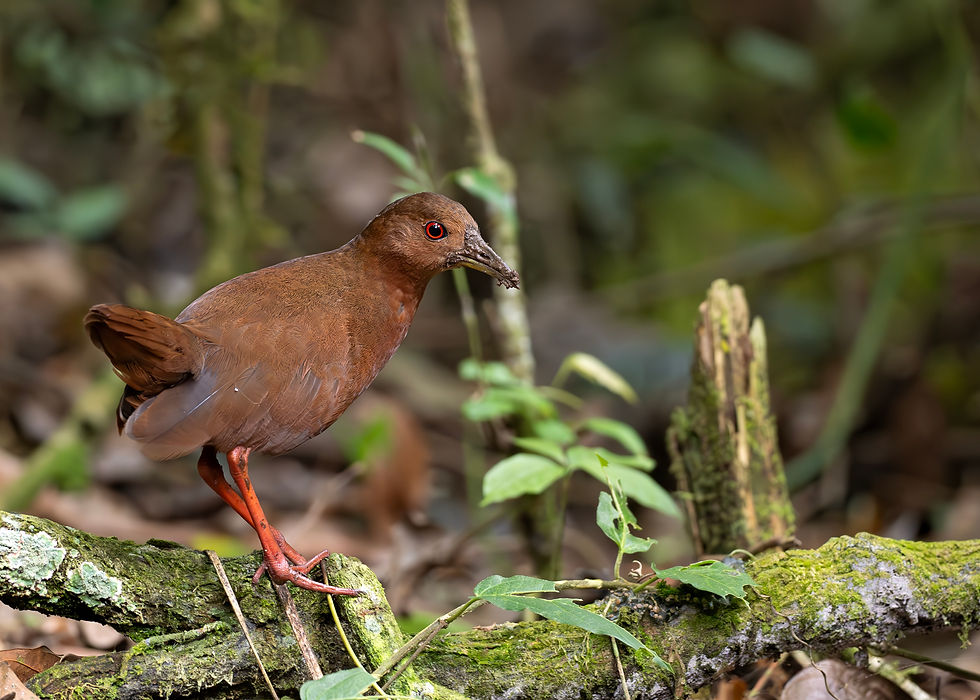
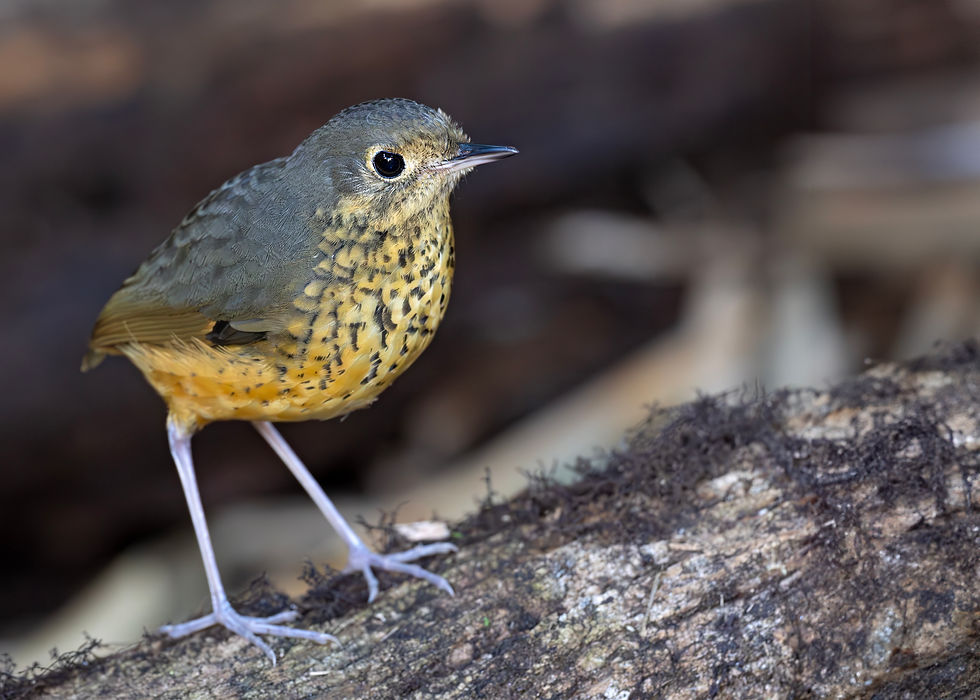
The Uniform Crake (Amaurolimnas concolor), one of the most challenging birds to see, appeared in a rather conspicuous manner among the wet vegetation. The Tufted Antshrike (Mackenziaena severa) came and went countless times, seemingly mesmerized by the crake boy’s care. The Squamate Antbird (Myrmoderus squamosus) and the Star-throated Antwren (Rhopias gularis), birds that do show up with some regularity on an Atlantic Forest birding outing but never sit still for a photo, appeared almost effortlessly. And they did not just appear; they stayed and let me take the best photographs I could ever have imagined of these species. I will never point a camera at these two species again. Adding to the list, species like the Black-eared Fairy (Heliothryx auritus), the White-spotted Woodpecker (Veniliornis spilogaster), and the Long-tailed Tyrant (Colonia colonus) completed a sequence that seemed to unfold naturally, all following a script that Fernando seemed to have written in advance.


That morning I realized it was not just about watching birds. It was about the way they came closer.
A Guide Shaped by the Island Itself
Ilhabela is the largest island on the coast of São Paulo state: 347 km² of Atlantic Forest, mountains reaching nearly 1,400 meters, more than 300 catalogued waterfalls, and a forest cover that, thanks to Ilhabela State Park, remains largely intact. It is an island that most people know for its beaches. Few know the birds it holds within.
Fernando was born there and grew up guiding people along trails and waterfalls long before he ever thought about photography or birdwatching. Contact with the forest was part of everyday life. Not so much by choice, but as the natural setting of his existence. His interest in birds came gradually. First through curiosity of a bird call he did not recognize, then through the sound of the forest as a whole; that web of voices which, for those who pay attention, is never quite the same from one day to the next. Then through an almost obsessive desire to understand who was singing hidden among the leaves.
A training course in adventure tourism turned out to be the turning point. The encouragement came implicitly: to try birdwatching as a possible path. His first camera was simple, a Canon SL2 with a kit lens, and for a long time the goal was not to guide anyone, but to learn.

Learning the songs, observing behaviors, and understanding how birds move through the forest throughout the day. Which species follow which, why certain trees attract more activity than others. Before introducing himself as a guide, there was a long period of observation and learning.
I know this process because I lived something similar. Every real guide goes through it. It is that stage when you do not charge yet, do not present yourself as a professional, but already dedicate every free hour to the field. And it is precisely from that silent time, that intimacy with the place is born. No course teaches that, but clients recognize it within the first minute on the trail. I, as a client, recognized it not in the first minute, but in the first second. “This guy is different!”
The Dream of Putting Ilhabela on the Map
Back then, few birders visited the island. Birdwatching in Ilhabela was nearly invisible. Not for lack of birds, but for lack of someone to show them to the world. Fernando’s routine was split between trails, construction work, and a passion that did not yet seem viable as a profession.
Health problems began to limit his life in construction, and gradually birdwatching stopped being just a side interest. It was not a glamorous, planned transition but rather a necessity meeting a vocation. And the idea of seeing Ilhabela recognized as a birding destination started there, in simple conversations during walks, like a wish that seemed distant but not impossible.

This is a story I have seen repeat itself across many corners of Brazil: from the backlands of Ceará to the highlands of São Paulo. A person with deep knowledge of a place, a passion that does not yet have a name, and the slow discovery that there is an entire world of people willing to travel to see exactly what they see every day. This is how the best stories of birdwatching tourism in Brazil begin. You can find many other great stories on BBE’s Blog Page.
The Uniform Crake
The story that would change everything began almost by accident.
While searching for a Blackish Rail (Pardirallus nigricans) in a flooded stretch of forest, a different call emerged: Amaurolimnas concolor, the Uniform Crake. Rare, secretive, and nearly invisible to most people. A species that, across much of its range, is heard more than seen, and even heard, rarely.
Weeks and months of attempts followed. Trails opened through the mud, frustrated pre-dawn mornings, days that seemed to lead nowhere. Anyone who has ever pursued a difficult species knows this feeling: that mix of stubbornness and doubt that only someone truly passionate can sustain. There is no other way. Gradually, Fernando came to understand the bird’s habits, its schedules, the stretches of forest where the chances were higher. The species began to appear more often, and the first images started circulating among photographers.
The nickname came naturally: Crake Boy (O Menino da Saracura).

But the change did not come immediately. There were periods of doubt, few clients, and the constant feeling that perhaps this path was still uncertain. Persistence eventually opened space for something bigger: people began visiting the island specifically to try to see that bird. A single species, in the hands of a guide who knew it like no one else, began to rewrite the reputation of an entire place.
It is curious how this works. Sometimes a single species is enough to set things in motion. In the case of Ciro with the Araripe Manakin, that is how it happened. In the case of Elvis Japão with the São Paulo [Marsh] Antwren, that is how it happened. And in the case of Fernando with the Uniform Crake, it is happening the same way. One bird leads to another, one visitor tells the next, and suddenly the island that no one associated with birdwatching starts appearing in trip reports and recommendations.
The Art of Bringing Birds Closer
Birding with Fernando does not feel like a sequence of techniques. It is more of a slow construction, built on presence and respect. He does not arrive at the trail with a rigid plan of target species, but rather with a deep understanding of what the forest is offering on that day, at that hour, under those conditions. More than understanding, I would say; this is intimacy.
Some species approach to feed at spots he has known for years. Others only watch from a distance. What stands out most is the absence of rush. Instead of long playback sessions or persistent chases through the forest, the birds appear when the environment seems ready to receive them. Thinking back and trying to recall, I cannot even remember us using playback a single time. Oh, wait! There was one bird we called in with playback: the Grey Elaenia (Myiopagis caniceps). And what a show it put on!


There is a technical dimension, of course. Choices of location, light, and behavior that only come from thousands of hours in the field. But the feeling on the ground is almost intuitive, as if the relationship built over years were more important than any single method. He is the kind of guide who makes it look easy... I know it’s not. The equation is inversely proportional: when it looks easy, it is because the hours in the field and the invisible work have been immense.
Ilhabela for Birders
Beyond the Uniform Crake, Ilhabela holds an Atlantic Forest avifauna with more than 340 recorded species. The island is part of one of the largest continuous forest tracts in the biome, connected via Ilhabela State Park and the Serra do Mar State Park to a forest corridor stretching for hundreds of kilometers.

To make the most of this diversity, the best time to go birding depends largely on the species you wish to observe, but the ideal period is from April to November, when chances of rain are lower. The cooler months (May-August) are strategically advantageous because birds remain active throughout the entire day, which greatly facilitates locating mixed flocks.
Spring is marked by the arrival of migratory birds, such as terns and warblers, and it is also the time when species like the Bare-throated Bellbird, the Streaked Flycatcher, the Piratic Flycatcher, and the Ochre-faced Tody-Flycatcher can be easily spotted. In contrast, summer is considered the worst time; despite the longer days, the excessive heat causes bird activity to drop significantly in the afternoon.
And there is a logistical detail that is not minor: Ilhabela is less than four hours from São Paulo, accessible by ferry from São Sebastião. For international birders with a few extra days before or after a trip through Brazil, it is a natural extension, with one of the most pleasant surprises a birder can have.
When a Story Changes a Destination
Today, Ilhabela is beginning to appear more frequently on the map of birders. Local events, the work of different guides, and the growth of the community have helped build this movement gradually. What was once a beach destination with forest in the background has become, for those who pay attention, one of the best-kept secrets of the Atlantic Forest in São Paulo.
Visitors arrive from different regions, stories accumulate, and the island gains new meanings for those who look beyond the beaches and traditional trails. And at the center of this transformation, still there, quiet, walking the same trail he discovered years ago, is Crake Boy.

More Than Birds
I left Ilhabela even more convinced of something I have carried for years: the birds are just a means.
They bring people together, transform trajectories, and reveal new ways of perceiving the world around us. For some, they represent a livelihood. For others, a profound shift in perspective. Almost a new way of existing. For Fernando, they were all three at once.
Perhaps that is what remains after the walk: the feeling that certain stories do not begin with rare birds or exotic places, but with someone who decided to listen to the forest with enough attention to change their own life. And that, by changing their own life, they ended up changing the way others see an entire place.

Frequently Asked Questions (FAQ)
How do I get to Ilhabela?
Ilhabela is located on the northern coast of São Paulo state, approximately 200 km from the capital. Access is from the town of São Sebastião, where a ferry crosses the channel in about 15 minutes. From São Paulo, the drive takes between 3 to 4 hours via the Tamoios Highway or the Rio-Santos Highway. Regular bus services and private transfers are also available from São Paulo.
Is Ilhabela a good destination for birdwatching?
Yes. With more than 340 recorded species, Ilhabela offers a rich Atlantic Forest avifauna of montane and lowland forest, including difficult species such as the Uniform Crake (Amaurolimnas concolor). The island is part of one of the largest continuous forest tracts in the biome, connected to the Serra do Mar State Park.
What is the best time of year to go birding in Ilhabela?
The ideal period runs from early autumn through late spring (roughly April to November). During the cooler months, birds remain active all day, making it easier to locate mixed flocks. Spring adds migratory species. Summer (December to February) is the least productive due to rain and excessive heat, reducing bird activity in the afternoon.
Is the Uniform Crake easy to see in Ilhabela?
The Uniform Crake (Amaurolimnas concolor) is a naturally secretive and elusive species. With guide Fernando Moraes, who has known its habits and territories for years, the chances of seeing it are significantly higher than anywhere else in its range. Still, encounters with wild species are never guaranteed.
For more information, get in touch via our contact page.


Comments