

The Red-Spectacled Parrot Festival In Southern Brazil: Urupema's Unmissable Wildlife Spectacle

Every year, thousands of Red-spectacled Parrots gather above Urupema, Santa Catarina. Discover Brazil's most extraordinary parrot spectacle — and why it stays with you long after.

I didn't do much research before the first time I went.
It was May 2018, and I was heading to Urupema with Ciro, Cristine and Tatiana. I knew the Red-spectacled Parrot existed, of course — but I had no real picture of what was waiting for us. I was expecting to see parrots. A new species for me (lifer), maybe a few flocks. Something nice.
Then we turned onto the road leading into town, and the first flocks started crossing in front of the car. And then more. And more.
By the time we reached the lodge, it was late afternoon, and the sky was already moving. Flock after flock, the sound building before the birds even appeared — that rolling, overlapping call of hundreds, even thousands of wings and voices arriving from beyond the hills. I stood there, completely still, not really knowing what to say.
I remember thinking: I have to come back here every single year.
That feeling — of being completely unprepared for something extraordinary — is, I think, the best possible introduction to the “Red-spectacled Parrot festival”. Because no description quite does it justice.
The sky fills with green wings and flashes of red. And nothing prepares you for it.
Red-Spectacled Parrot: A Bird That Moves With the Forest
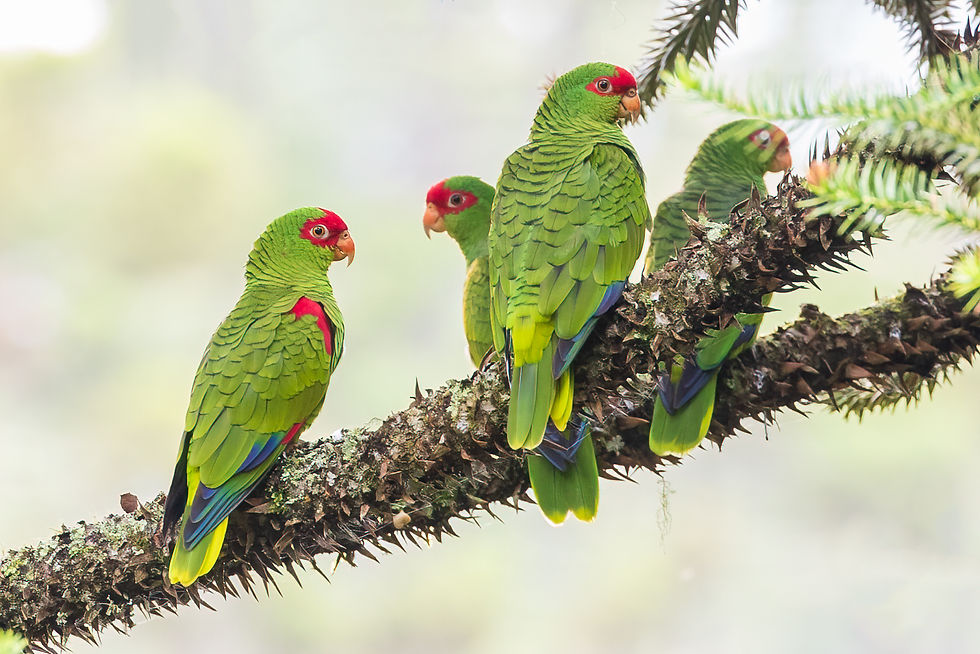
The Red-spectacled Parrot Amazona pretrei is essentially a bird of southern Brazil, deeply tied to the Araucaria forests that shape the landscapes of Rio Grande do Sul and Santa Catarina. During much of the year, small groups remain scattered across breeding areas in Rio Grande do Sul, quietly nesting in forest cavities.
But as autumn approaches, the rhythm of the forest changes.
As Araucaria trees begin producing their heavy seeds — the pinhão — parrots from across the region start to move. It is not a long migration, but it is precise and purposeful. Gradually, flocks converge on the Serra Catarinense, especially around Urupema, drawn by one of the most important seasonal food sources in the Atlantic Forest highlands.
From mid-March, the numbers grow, peaking in May. Flocks of dozens become hundreds. Hundreds become thousands.
Recent conservation research suggests that nearly the entire global population — estimated between sixteen and twenty thousand individuals — gathers in this region during the non-breeding season, highlighting just how important these Araucaria landscapes are for the species’ survival.
What follows is more than birdwatching. It is a phenomenon shaped by ecology, seasonality, and time.
The Revoada: When Thousands of Parrots Fill the Sky

Throughout the day, parrots pass overhead in restless movement, their calls echoing across valleys and open highland fields. But the true spectacle unfolds at the edges of the day.
In the early morning and again toward sunset, flocks begin moving toward feeding areas and communal roosts. Waves of birds follow the same invisible routes across the landscape. Some flocks carry a few dozen individuals. Others can reach thousands.
Standing beneath one of these flights, you don’t just see parrots — you feel them. The sound builds slowly, then suddenly fills the air. Clients often fall silent, watching the sky come alive, and it’s not unusual for people to become deeply emotional during these moments.
It is one of the largest gatherings of parrots anywhere in the world — a short-lived seasonal event that lasts only a few weeks each year, tightly linked to the timing of Araucaria seeds.
Vinaceous-breasted Parrot: The Hidden Guest in the Flocks

While the Red-spectacled Parrot dominates the scene, careful observers scanning the larger flocks will occasionally notice something else — a slightly different shade of green, a wash of vinaceous on the breast, a bird that doesn't quite match its neighbors.
The Vinaceous-breasted Parrot Amazona vinacea is there too. But the disproportion is striking: in a flock of several hundred pretrei, you might find two. Maybe four. It stops you mid-scan, because both species are globally threatened, both tied to Araucaria forests, both following the same seasonal pulse — and yet one fills the sky while the other hides inside it, almost invisible by sheer weight of numbers.
Finding a Vinaceous in those flocks has become one of the quiet pleasures of birding Urupema. It rewards patience and attention in a place that already has plenty to look at.
Beyond the parrots, the broader community adds texture to the experience. Azure Jays move noisily through the canopy. Maroon-bellied Parakeets join feeding flocks at the forest edge. The parrots may be the headline act, but they are part of a larger ecological story — one that unfolds across highland grasslands, Araucaria patches, and Atlantic Forest fragments, all connected by the rhythm of a single tree's fruiting season. Simply incredible!
Why the Red-Spectacled Parrot Gathering Matters for Conservation

Beyond the visual spectacle lies a deeper conservation story.
The Red-spectacled Parrot is closely tied to Araucaria forests — habitats that have declined by more than 97% over the past century due to logging and land conversion. These parrots are not simply visitors to the trees; they play a role as seed dispersers, helping maintain the very forests they depend on.
Research has also revealed something fascinating about their population structure. Only a relatively small portion of adults breed each year, while a large fraction remains non-breeding — a kind of hidden reserve within the population.
Seeing thousands of parrots overhead is therefore more than a spectacle; it is a glimpse into the delicate balance that allows a threatened species to persist.
Standing beneath those flights, conservation stops being abstract. It becomes something you can hear, see, and feel.
Birdwatching in Urupema: What to Expect in Winter

Urupema is reputedly one of the coldest towns in Brazil, and winter mornings can begin below freezing. A typical morning at Eco Pousada Rio dos Touros begins at the feeders — and the first thing worth saying about them is that they are nothing fancy. No elaborate setup, no carefully engineered photography hides. Just simple feeders in a garden, with cold air and a warm cup of coffee nearby.
But then the birds arrive.
Chestnut-backed Tanager. Diademed Tanager. Hepatic Tanager. Species that many birders and photographers have on their most-wanted lists, coming in close, unhurried, in good light. Every few minutes, the calm is broken by the sound of a passing flock overhead — that rolling wave of calls that reminds you why you came — and then the garden settles again, and another tanager lands.
It is one of those combinations that feels almost unfair: excellent birds at arm's length, and one of the world's great parrot spectacles passing above your head between sips of coffee.
As the day warms, exploring Araucaria forest edges reveals a unique highland bird community. Long-tailed Cinclodes patrols rooftops and open ground. Mottled Piculet moves quietly through branches. Planalto Tapaculo sings from dense understory. Araucaria Tit-Spinetail flickers through the canopy, while its relative, the Striolated Tit-Spinetail, moves through the shrubs below.

Venturing farther from town, open campos and rural roads may produce Long-tailed Reed Finch, Black-and-white Monjita, Lesser Grass-Finch, and with a bit of luck, a Saffron-cowled Blackbird, while viewpoints overlooking the mountains hold Atlantic Forest specialties like Olive Spinetail, Bay-chested Warbling-Finch, Purple-crowned Plovercrest, Buff-browed Foliage-gleaner, Blue-billed Black-Tyrant, and Grey-throated Warbling-Finch.
The Evening Return

As the light softens, anticipation builds. Distant calls begin to carry across the valleys. Flocks appear on the horizon — small at first, then growing until the air fills with movement.
If you find yourself in the right place at the right time, the numbers can be overwhelming. Thousands of parrots converge toward the roost, their silhouettes crossing the orange glow of the setting sun. It is noisy, chaotic, and deeply beautiful — a daily ritual that has repeated itself for generations, long before anyone was there to watch it.
People often fall silent during these moments. There is nothing much to say. You just stand there and let the sky do what it does.
A Promise Worth Keeping

The scenery around Urupema is as memorable as the birds themselves — rolling highland grasslands broken by patches of Araucaria forest, capões scattered across the slopes, and wide skies that seem made for migration.
For many visitors, the Red-spectacled Parrot is the reason to come. But the feeling of being there — the cold air, the sound of wings, the quiet moments between flights — is what stays long after the trip ends.
I never managed to go back every year, the way I promised myself I would in 2018.
Life, logistics, other tours — the usual reasons. And yet that promise has never quite disappeared. It sits somewhere in the back of my mind each April, when I know the flocks are beginning to gather again above Urupema, and I'm somewhere else entirely.
There are very few natural spectacles that do that to you. That leave a specific debt — not of guilt, but of longing. A place you know is happening without you, and that you feel the absence of.
That is, I think, the truest measure of an experience worth having.
So if you find yourself standing beneath those flocks one evening, watching the sky turn green and red as the light fades over the Serra Catarinense — take a moment.
Just breathe.
Frequently Asked Questions
When is the best time to see the Red-spectacled Parrot gathering in Urupema?
The peak season runs from mid-April through early June, coinciding with the fruiting of Araucaria trees. April and May typically offer the largest concentrations, when flocks can number in the thousands. Earlier in the season, numbers are still building; later, they begin to disperse as the pinhão supply diminishes.
How many Red-spectacled Parrots gather in Urupema?
Recent research suggests that nearly the entire global population of the species — estimated between 16,000 and 20,000 individuals — concentrates in the Serra Catarinense region during the non-breeding season. On good days in peak season, it is possible to count thousands of birds in a single flight.
Is birdwatching in Urupema worth it beyond the parrots?
Absolutely. The highland bird community around Urupema is exceptional in its own right — Long-tailed Cinclodes, Araucaria Tit-Spinetail, Striolated Tit-Spinetail, Planalto Tapaculo, Azure Jay, Mottled Piculet, Large-tailed Antshrike, Grey-throated Warbling-Finch, and a range of grassland specialists can all be found in the area. The feeders at Eco Pousada Rio dos Touros regularly attract Chestnut-backed Tanager and Diademed Tanager, species highly sought by photographers. The Red-spectacled Parrot brings people here, but the region offers much more.
What is the pinhão, and why does it matter?
The pinhão is the large, nutritious seed of the Araucaria tree — a staple of southern Brazilian culture and the ecological engine behind the parrot gathering. Locals have roasted pinhão over wood-burning stoves for generations, and visitors to Urupema in winter will almost certainly find themselves sitting beside a wood stove (fogão a lenha) with a handful of warm seeds and a cold night outside. It is, in its own quiet way, as much a part of the experience as the birds themselves.
How do I get to Urupema, Santa Catarina?
Urupema sits about 200 km from Florianópolis — roughly a 3-hour drive. The main route follows BR-282 toward Lages, then turns off toward Rio Rufino via BR-475, continuing on SC-112 into town. The entire road is paved. Coming from Lages, the most direct access is via SC-114 toward São Joaquim, then turning at the Painel junction onto SC-370 (the Rodovia das Araucárias), which leads directly to Urupema — and to Eco Pousada Rio dos Touros, located at km 20 of that same road. There is no direct public transport to Urupema; a rental car from Florianópolis airport is the most practical option for international visitors. If you'd prefer to leave the logistics to us, take a look at our tours.
For private tour arrangements, get in touch via our contact page.
References
Brito, C. B. M. & Gomes, A. M. (2024). When the sky turns green and red: the Red-spectacled Parrot show. Neotropical Birding 34.
Tella, J. L. et al. (2026). Applying a Method to Estimate the Breeding and Non-Breeding Population Fractions of the Globally Threatened Red-Spectacled Amazon. Biology 15, 190.
BirdLife International. Species factsheet: Amazona pretrei.


Comments