

Five Amazons In One State: The Complete Pará Birding Experience


If the Amazon is not just one forest — if it is a mosaic of different Amazons shaped by rivers, history, and evolution — then Pará might be one of the most fascinating places to understand that idea in real life.
Few regions illustrate this better. Within a single state, you can cross mangroves, terra firme rainforest, flooded forest (várzea), iron-rich plateaus, ancient rocky savannahs, and Atlantic-facing tidal flats — all in a matter of days. The landscapes shift. The birds shift. The stories shift.
Pará is immense — over 1.2 million km², the second largest state in Brazil. Vast rivers carve through it, separating populations of birds, primates, and entire ecological communities. Cross one river, and the forest may look familiar — but the voices change. The species change. The evolutionary story changes.
Within this single state, five major interfluves converge — five distinct biogeographical worlds defined by the great rivers of the Amazon Basin. And because all of them lie entirely within Brazilian territory, far from any international border, the Pará Complete Tour offers more Brazilian Amazon endemics than any other Amazonian itinerary we know. Not just endemic species — but also a remarkable number of subspecies awaiting taxonomic reassessment, potential future splits sitting right there in front of you.
Traveling here is not just a journey across geography. It is a journey across time and evolution.
A note on the itinerary order: The sections below describe each interfluve and its highlights, but the actual tour sequence varies depending on logistics, flight connections, and seasonal conditions. What matters is the full picture — five distinct evolutionary worlds within one state.

In the Amazon, rivers are not just waterways — they are walls.
Large rivers such as the Xingu, Tocantins, Tapajós, and the Amazon itself act as natural barriers that populations of birds and mammals cannot easily cross. Over thousands of years, those separated populations evolved independently — accumulating genetic differences, developing distinct vocalizations, acquiring different plumage — until they became separate species. Or at least separate enough to make every taxonomist in the room reach for their notebook.
The area between two major rivers is called an interfluve, and each one functions as its own center of endemism: a pocket of evolutionary history with species found nowhere else.
This is why crossing a river in Pará can feel like stepping into a parallel Amazon. The forest may look identical. But biodiversity tells a completely different story.
The Pará Complete Tour was designed around this idea — moving across interfluves to experience the Amazon’s diversity as a living, breathing puzzle.
The Belém Interfluve: Where Conservation Feels Urgent

The Belém Area of Endemism occupies the easternmost portion of Pará, stretching from the Tocantins River west toward Maranhão. It is the most historically deforested part of the Brazilian Amazon — roads cut through here in the 1960s, forests fell to cattle farms and monocultures, and today only around 20% of the original forest remains.
For a birder, that number carries weight. It means that every encounter with an endemic species here feels fragile — rare not because the bird is secretive, but because its world is shrinking. Bird populations have been declining steadily, and some species are now genuinely challenging to find.
And yet, what remains is extraordinary.
We visit one of the largest preserved humid forest fragments in the Belém area — a privately owned tract where a company practicing low-impact selective logging actively supports biodiversity research and monitoring. It is a place where conservation and economic activity are trying, earnestly, to coexist. A few full days of birding here are needed to have a real shot at the rarest targets.
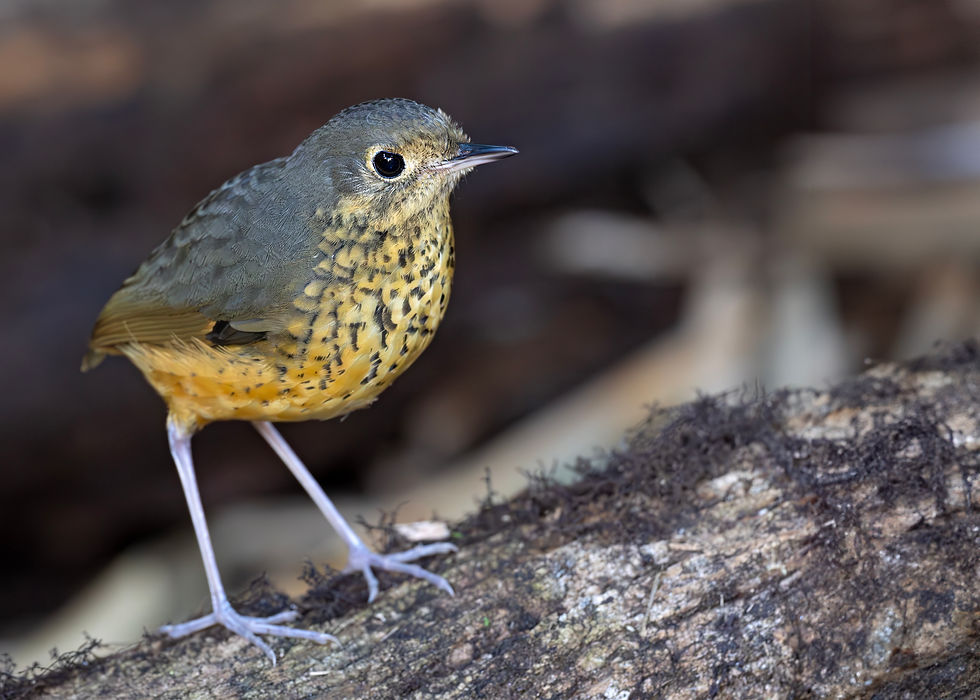
Some of the species: Buff-browed Chachalaca, Hooded Gnateater, White-tailed Cotinga, Waved Woodpecker, Black-chested Tyrant, Red-necked Aracari, Xingu Scale-backed Antbird, Pará Foliage-gleaner, and Rose-breasted Chat (Granatellus pelzelni paraensis) — the local Belém form, noticeably different from what you’ll see further west.
The Cryptic Forest Falcon is always on the list — always worth stopping for. And if you’re lucky, the Dark-winged Trumpeter (Psophia viridis obscura), the Belém subspecies, may emerge from the undergrowth with that unmistakable combination of grace and impossibility.
But the bird that stops conversations is the Bare-faced (Belém) Curassow (Crax fasciolata pinima) — a critically endangered subspecies once feared extinct in the wild, and recently rediscovered. To cross paths with one here is something else entirely. It is a reminder that extinction is not always final — and that the forest still has the ability to surprise us.
The landscape here tells a story of persistence. And of urgency.
The Amazon Coast: Mangroves, Tides, and Unexpected Worlds

Few people picture mangroves when they think about the Amazon. But along the coast near Bragança, towering mangrove forests stretch toward the Atlantic — and they are anything but a footnote.
Driving through these tidal landscapes at the right hour, Scarlet Ibises glow against the mudflats. Rufous Crab Hawks patrol the shoreline. Tricolored Herons work the margins.
Grass-filled saline flats hide smaller surprises. Mangrove Cuckoo and Mangrove Rail show up reliably between March and July. And then there’s the Black Rail — the Brazilian coastal population is currently under active taxonomic investigation, its identity still being debated. Is it the same species as the North American bird? A distinct taxon? Yes! And being described by one of our guides. Finding it here feels like participating in a story in the making.
There is also a mysterious Piculet (Picumnus sp.) in this area — a population of uncertain taxonomic status, possibly a hybrid, possibly something entirely new. We watch it carefully every time.
This coastline is a reminder that the Amazon is not only inland terra firme rainforest. It is also coast, tide, and saltwater — an ecosystem where biome boundaries blur and unexpected birds turn up with unusual regularity.
The Xingu Interfluve: Mountains in the Amazon

Moving southeastward, we reach Carajás National Forest — a landscape that challenges everything you think you know about the Amazon.
Here, the terrain rises into iron-rich plateaus called canga — open, rocky, almost harsh-looking formations where the vegetation becomes lower and sparser, resembling dryland habitats more than tropical rainforest. Trails wind through terra firme forest, dense bamboo patches, and those strange rocky highlands, each environment sheltering its own cast of specialists.
The biodiversity here is staggering. White-crested Guan, Red-throated Piping Guan, Harpy Eagle, Opal-crowned Manakin, Guianan Red Cotinga, White-browed Purpletuft, Great Jacamar, and a remarkable array of antbirds — including Spix’s Warbling Antbird, Manu Antbird, Banded Antbird — and more.
The woodcreepers alone could fill an afternoon: Xingu Scythebill, Strong-billed (Carajás) Woodcreeper (Xiphocolaptes promeropirhynchus carajaensis), Uniform Woodcreeper. And then there’s the owls — Black-banded Owl, Crested Owl, and the recently described Tawny-bellied (Xingu) Screech-Owl (Megascops watsonii stangiae), still new enough to feel like a genuine discovery every time. Among cotingas — Spangled, Purple-breasted, and White-tailed Cotingas — all can appear in the same morning if you’re lucky.
And then there is the White Bellbird. One of the most unforgettable moments in any Amazon birding trip is hearing that explosive call echo through the canopy — a sound so powerful it has been compared to the noise of a pile driver. Watching a displaying male perched high above the forest, launching that impossibly loud note into the air, is one of those experiences that stays with you long after the trip ends.

The Tapajós Interfluve: Where One River Changes Everything
Santarém sits at the confluence of two great rivers, where the clear Tapajós meets the muddy Amazon in a spectacular meeting of waters. It is a city with genuine character: freshwater beaches, cultural richness, and a surrounding landscape of extraordinary variety.
Crossing the Xingu and reaching the eastern bank of the Tapajós brings a fundamental shift in the bird community. New species appear — birds absent since we left Belém — and the forest itself starts changing character.
What makes the Santarém area uniquely interesting is the vegetation mosaic: terra firme rainforest, várzea (white-water flooded forest), and actual Cerrado enclaves — patches of Amazonian savannah embedded within the broader rainforest matrix. In one day, you can bird endemic antbirds in the deep shade of terra firme, then take a boat through flooded várzea looking for parrots and spinetails, then walk across an Amazonian Cerrado patch — all within the same general area.
The species highlights reflect that diversity: Bare-eyed Antbird, Tapajós Fire-eye, Tapajós Hermit, White-browed Hawk, Blue-necked Jacamar, Red-fan Parrot, Rufous-faced Antbird, Yellow-browed Antbird, Gould’s Toucanet, Santarém Parakeet, Scaled Spinetail, Short-tailed Parrot, Hoatzin, and Glossy Antshrike.


There are few places in the Amazon where evolution and biogeography feel this immediately tangible — where a morning’s birding takes you through three completely different ecosystems without ever leaving the county.
The Rondônia Interfluve: Pristine Trails and Hard-Won Targets

Crossing the Tapajós River is more than a logistical step — it is a lesson in biogeography in real time. On one bank, certain species occur regularly. On the other side, they vanish, replaced by close relatives shaped by a different evolutionary history. Watching clients experience this moment — identifying the species pair, understanding what the river means — is often one of the most intellectually satisfying parts of the entire journey.
We stay right at the edge of the Amazônia National Park — over one million hectares of protected rainforest between the Tapajós and Madeira rivers, bisected by the famous Transamazônica highway (BR-230). Mornings begin just minutes from pristine trails. The birding feels deep, immersive, unhurried.
The targets here are the stuff of wish lists: Brown-chested Barbet, Golden Parakeet, Vulturine Parrot, Harlequin Antbird, and Alta Floresta Antpitta. These are genuinely difficult birds. If you see more than half, count yourself lucky. We will work hard for them.
Other remarkable species fill the supporting cast: Snow-capped Manakin, Flame-crested Manakin, Crimson-bellied Parakeet, Broad-billed Motmot, Collared Puffbird, Rusty-belted Tapaculo, the local race of Musician Wren (Cyphorhinus arada interpositus), and with patience and much luck, Pale-faced Bare-eye — one of those birds where even detecting it counts as a win.
On a morning boat ride from the lodge, the main target is the Blackish-grey Antshrike (Thamnophilus nigrocinereus huberi) — a distinctive population widely expected to be split in the near future. Other riverside species include Band-tailed Nighthawk and Amazonian Inezia.
A word about the road: the Transamazônica is a working highway. Trucks, cars, and motorcycles move through at speed, and during the dry season, passing vehicles raise significant dust clouds. We time our roadside birding accordingly — and honestly, there is something memorable about watching a Spangled Cotinga from the forest edge while waiting for traffic to clear.
Riverbanks glow at sunrise here. Evenings settle into insect chorus and distant calls drifting through the trees. For many visitors, this region becomes the emotional core of the journey — the place where scale, solitude, and species density come together in a way that’s difficult to describe and easy to remember.
The Guiana Interfluve: North of the River, Another World

North of the Amazon River, the landscape changes completely.
Monte Alegre sits in a region shaped by ancient geology — rocky formations, savannah vegetation, and a state park of 3,378 hectares containing archaeological sites and cave paintings estimated at 11,200 years old. The scenery here is unlike anything else on the tour: open, rocky, almost austere in places, with a visible imprint of deep time.
The vegetation reflects old climate shifts — drier periods that shaped an open, savannah-influenced matrix rather than the dense closed-canopy forest of the southern interfluves. The core rainforest birds of the Guiana Shield are not the focus here (that’s territory for a different tour, centered on Manaus). What Monte Alegre offers is something more specific and harder to find anywhere else.
The Sulphur-breasted Parakeet is a near-endemic with accessible sightings only in Pará state. Their bright yellow plumage flashes across the sky. This species was once heavily targeted by the pet trade, which makes modern sightings feel particularly meaningful — and particularly important. Population size is still unknown. Natural history information is sparse. Every observation and documentation matters.
The contrast between this landscape and what we’ve seen further south makes a point the entire tour has been building toward: even within one state, Pará contains multiple, genuinely distinct Amazons.
Crossing Rivers, Changing Worlds

One of the most powerful aspects of traveling through Pará is witnessing, repeatedly and in real time, how rivers shape the living world.
Cross a river, and a familiar bird disappears — replaced by another with different colors, a different voice, a different evolutionary story. For many visitors, especially biologists and serious birders, these transitions spark conversations that go well beyond the day list.
You can see the exact moment it clicks — when the concept of interfluvia stops being an abstract biogeographical idea and becomes something you’ve physically experienced.
Beyond Birds: Culture, Food, and Local Knowledge

Traveling through Pará is not only about species lists.
Fresh tambaqui grilled over open fire, açaí served in its traditional savory form alongside fish, and the extraordinary abundance of Amazonian fruits — many with no equivalent in any other cuisine — are part of the experience. Try everything. The flavors are genuinely unlike anything else.
The cultural richness of Pará shows up in other ways too: local music, indigenous ceramics with intricate geometric graphism, and communities whose relationship with the forest runs generations deep.
Many of the local guides who join our trips began as park rangers or forest residents and built into expert naturalists through years of collaboration with researchers and visiting birders. Meeting them, listening to them, birding beside them — it is a reminder that conservation and community are not separate projects. They grow stronger together, or they don’t grow at all.
Frequently Asked Questions About the Pará Complete Tour
How many bird species can I expect to see on this tour?
The number varies with season and conditions, but most groups finish with between 450 and 550 species across all five interfluves. More important than the total is the quality — highly range-restricted endemics, potential future splits, and birds with tiny global populations that you genuinely cannot find on any other Amazon itinerary.
Is this tour suitable for beginner birders?
We recommend an intermediate to advanced level. Not because the logistics are extreme — though some field conditions are demanding — but because the birds reward those who come prepared. Knowing Amazonian family groups, being comfortable with long days, and having patience for difficult targets will make the experience much richer. That said, the diversity is so great that even motivated beginners will have extraordinary encounters.
What is the best time of year to visit Pará?
The tour can be done year-round, but different seasons offer different advantages. The dry season (roughly May/June through October/November) makes forest trails more accessible and road birding more productive. The wet season brings flooded forest birding by boat easier and makes certain species more conspicuous. The Black Rail at the Amazon Coast is best seen from March to July. We’re happy to advise on the best timing for your specific priorities. We run our Set Departure Tour at a time we believe is more effective.
How physically demanding is this tour?
Expect early mornings (some pre-dawn starts), some long walks on forest trails (4–10km), and occasional boat rides. The schedule follows the rhythm of the tropics: mornings are dedicated to birding, followed by lunch and a midday rest at your accommodation before heading out again in the late afternoon. Birding through the midday heat is neither pleasant nor productive — and in much of Pará, it's genuinely intense. A reasonable level of physical fitness is helpful, and some tolerance for heat and humidity is essential.
Is it possible to see other wildlife during the Pará tour?
Yes. Although wildlife watching isn't the focus, mammals are always on the radar. Much like birds, the rivers have played a major role in the evolution of primates here — Howler Monkeys, Titi Monkeys, Capuchins, and Tamarins can all be encountered along the way. With some luck, larger mammals make an appearance too: Tapirs, Agoutis, River Dolphins, and occasionally even a Jaguar crossing a forest road. Brazil's Amazon never fails to surprise.
Why does the Pará tour offer more Brazilian Amazon endemics than other Amazon tours?
Because four of the five interfluves lie entirely within Brazilian territory — no border crossings, no shared endemics with neighboring countries. Every endemic you see here is a Brazilian endemic, and many of the subspecies you encounter are strong candidates for future taxonomic splits. This is the highest concentration of exclusive Brazilian Amazon biodiversity accessible in a single itinerary.
Are there accommodation options for different budgets?
Yes. The tour uses a range of lodges and pousadas depending on the region — from comfortable field stations near the Amazônia National Park to more urban bases in Santarém and Belém. We can discuss options and tailor the accommodation level to your preferences.
Can I combine the Pará tour with other BBE destinations?
Absolutely — and many clients do. Pará pairs naturally with a Manaus-area or Amapá State Tour for the Guiana Shield core endemics, with the Atlantic Forest, or with a Cerrado extension. Get in touch and we can build something around your target list.
A State That Holds Many Amazons

Pará is not just another Amazon destination.
It is a place where five interfluves converge — where crossing rivers means entering new evolutionary worlds, where habitats shift from mangrove to iron plateau to flooded forest to ancient savannah, and where the accumulated biodiversity of those worlds produces one of the most species-rich and intellectually rewarding birding experiences in Brazil.
And because every one of those worlds sits inside Brazilian borders, it is also the Amazon tour with the deepest concentration of Brazilian endemics. Not just the named species — but the unnamed ones too. The subspecies that will one day become species. The populations that researchers are already watching.
Traveling here reshapes how you see the Amazon. It reveals complexity, contrast, and the stubborn truth that the forest is far more diverse than any map, any photo, or any single trip can fully capture.
And perhaps that is what makes Pará so fascinating — it is one more reminder that the Amazon is not one story, but many. And that we’ve only just started reading.


Comments