

Rondonia/Acre Trip Report - June 2025

Updated: Dec 15, 2025
Introduction
The Rondonia/Acre Tour — often called the Western Brazilian Amazon route — is a trip I’ve always enjoyed guiding. I first visited the region in 2013 while working in environmental consultancy, and later returned many times as a guide. What stands out to me is how different it feels compared to other Amazon circuits. It’s not the well-trodden path, and each visit still brings small discoveries, new behaviors, or species showing up in places we didn’t expect.
The variety of habitats also keeps the trip dynamic: várzea, terra firme, cerrado patches, campina, campinarana, and some boat rides. That mix usually translates into good activity and opportunities to look for some of the region’s most iconic species — Rondônia Bushbird, Chico’s Tyrannulet, White-breasted Antbird, Rufous Twistwing and others that have become symbols of this corner of the Amazon.
Over the years, I’ve seen changes in the landscape as deforestation advances. Birds that used to be true rarities in Amazonas — like Guira Cuckoo, Yellowish Pipit, and Picazuro Pigeon — now appear on every trip list. Despite these shifts, the main targets remain reliable, and the region continues to be one of the most interesting areas of the Brazilian Amazon to explore.
Day 1 (C-30 and C-01 combo)
May 26, 2025
The first day is always about warming up the engine, as my friend Brunão (Bruno Rennó) likes to say. To make the most of it, we started with the C-30 — a more open area. We left the hotel at 4:30 a.m., drove about twenty minutes, and stopped at Dona Terezinha’s place — a sweetheart who prepares our early breakfast when the hotel can’t.

By 5:30 a.m. we were on our way to C-30 and arrived around 6, with dawn just breaking. The forest was
waking up, and we listened to the morning chorus — parakeets like Yellow-chevroned (Brotogeris chiriri), Dusky-headed (Aratinga weddelli), and Golden-winged Parakeets (Brotogeris chrysoptera), along with a few herons and other wetland birds. From the forest came the calls of Barred Forest-Falcon (Micrastur ruficollis) on the right side of the road and Slaty-backed Forest-Falcon (Micrastur mirandollei) on the left. A good start with the Forest Falcons, at least by ear — getting to these forest patches early always pays off, since many species only vocalize during this brief window.
Once the light was good, we drove deeper into C-30. The road was wet — never ideal — and the car danced a little, but we managed to reach a patch of lower, more open campinarana. The first stretch was slow, though we picked up a few nice records like Peruvian Warbling-Antbird (Hypocnemis peruviana).
One of our main targets here, the Predicted Antwren (Herpsilochmus praedictus), kept us busy for more than half an hour without showing.
At the edge of the trail, near a few houses, we found a cashew tree filled with more than a dozen Campina Jays (Cyanocorax heilprini hafferi) — probably feeding on the flowers (not sure). A relief, since that’s one of those birds that can make a guide tense. While we watched them, a flock of twelve Bonaparte’s Parakeets (Pyrrhura lucianii) landed right beside us.

Then, on the way back to the cars, came Campina Thrush (Turdus arthuri) — an important one, though not everyone managed to get on it. Also Chestnut-capped Puffbird (Bucco macrodactylus) — which only a few had seen earlier — appeared again. Laura spotted the bird perched while we were still looking for the “Predicted one”. Despite its wide range, it was a lifer for all but one participant. Shortly after, we finally nailed the Predicted Antwren! Fulvous-chinned Nunlet (Nonnula sclateri) stayed silent despite several attempts, and neither the Inambari Gnatcatcher (Polioptila attenboroughi) (which Brunão had seen just a week before) nor Dotted Tanager (Tangara varia) showed up — both remain on our radar.
Around 9:30–10 a.m., we went to another spot that Brunão had suggested for Black Bushbird (Neocotantes niger) and Manu Antbird (Cercomacra manu). We got there by 10:30 but didn’t hear any sign of the Bushbird; we agreed to return later. Manu Antbird, on the other hand, put on a show — great bird. We also saw Point-tailed Palmcreepers (Berlepschia rikeri) and a few wood storks flying in the distance as well.

By 11:30 a.m. we were back at the hotel for lunch and a short rest — essential in the Amazon.
In the afternoon we headed to C-01, leaving around 2:30 p.m. It started well with Western Striolated-Puffbird (Nystalus obamai), Brown-banded Puffbird (Notharchus ordii), and Juruá Woodcreeper (Dendrocolaptes certhia juruanus). A great mixed canopy flock followed, with Yellow-throated Flycatcher (Conopias parvus), Inambari Woodcreeper (Lepidocolaptes fatimalimae), and — with a bit of luck — an Inambari Gnatcatcher (Polioptila attenboroughi) showed up. Not everyone had perfect views, but the bird was there, so we’ll try to make sure the rest of the group sees it properly tomorrow morning (try at least). We also heard White-throated Antbird (Oneillornis salvini) and decided to save that and other antbirds for the next morning.
A very good first day overall — a proper warm-up.
Tomorrow, we’ll start at C-01, aiming for Undulated Antshrike (Frederickena unduliger), White-throated Antbird (Oneillornis salvini), Sooty Antbird (Hafferia fortis), and then move on to woodpeckers, woodcreepers, tanagers and other targets that are good to see around here.
Graham was happy — he’s got about sixty-one potential lifers on this trip, and we managed to get four of them on day one. Unfortunately, he didn’t get a great look at the Campina Thrush, a tricky species, but we’ll keep an eye out for another chance.
eBird Checklists:
Day 2 (the other way around - C-01/C-30)
May 27, 2025
A morning at C-01 always comes with mixed feelings. When it’s active, it’s pure fun: toucans, aracaris, woodpeckers, woodcreepers, and a great selection of antbirds. Among the top targets is Frederickena unduliger — the Undulated Antshrike. We set out excited but slightly tense; sometimes it doesn’t sing at all, and sometimes it sings and refuses to show (many times actually).
We left the hotel at 4:30 a.m., reached Dona Terezinha’s by 5 for breakfast, and hit the road again at 5:40. The group was easygoing, no rush at meals. Love it! We got to the spot around 6:10. We started where Bruno had indicated — the place where he’d seen the Undulated Antshrike on previous tour — but nothing. Sooty Antbird appeared in a narrow trail — too tight for eight people — so some saw it, others didn’t. Same story with the Common Scale-backed Antbird (Willisornis poecilinotus). Rufous-capped Antthrush (Formicarius colma) also sang in the distance; I didn’t even try to chase it to avoid frustration.
I decided to change plans. The Frederickena — our main objective — had to be the priority. We went to a spot where I’d seen it in 2023, planning to stop the car at every place where I’d seen or heard it before. I played the recording — nothing. Meanwhile, White-throated Antbird started singing, so we tried for it instead. It came in beautifully, great photos, everyone had views.

And right then, Undulated Antshrike began to sing. We went straight for it. The bird responded quickly and perched in a spot partially obscured by a palm leaf, but still visible enough to see the whole bird — just a bit hazy through the foliage. That partial cover worked in our favor; it felt comfortable and stayed for a long time, allowing everyone to get on it. For such a shy species, that was a real treat. One person wasn’t fully satisfied, and I explained that this is a bird on the level of a Rondônia Bushbird — seeing it perched and stationary is already excellent. Many people never even hear it, let alone see it. The group was thrilled, though; for one participant, it was the most anticipated bird of the trip, so you can imagine the emotion. Made it to my Top 5 birds of the trip.

The rest of the morning went very well. We tried for the Musician Wren (no response), but had fantastic views of Sooty Antbird — with both video and photos. More aracaris and jacamars followed. Just having the Frederickena early in the day was a huge relief.
We had lunch at a buffet restaurant to save time and headed out again around 2:30 p.m.
In the afternoon we explored the east bank of the river. It was slow, and our main target — Rondonia Warbling-Antbird (Hypocnemis ochrogyna) — didn’t appear, but we still added new trip records.

Dinner at the hotel had been a bit frustrating the previous night — we waited nearly an hour and a half — so we switched to Remanso do Tucunaré, a simple but excellent local restaurant. One person skipped it, but everyone else loved it. I ordered a variety of fish prepared three different ways, like a small tasting menu — a hit.
And that’s how Day 2 came to an end.
eBird checklists:
Day 3 (Porto Velho to Humaitá)
May 28, 2025
We kept the same early routine — leaving at 4:30 a.m. for breakfast at Dona Terezinha’s — but today was a transfer day, with all our luggage packed. By 4:35 one person was missing; I called their room — they had overslept — but all within expectations. We left around 4:50, reached Dona Terezinha’s by 5:10, and headed out to try once more for the Black Bushbird (Neoctantes niger) — our second attempt at this tricky species. We arrived just before 6 a.m.
While Ciro played the recording, I searched for other species to keep things moving in case it didn’t respond. We went to a spot suggested by Bruno Rennó — if I’m not mistaken, he and Brad Davis had luck there before. We waited for about an hour without any reply. In the meantime, we picked up Black-chinned Antbird (Hypocnemoides melanopogon), Silvered Antbird (Sclateria naevia), Gilded Barbet (Capito auratus), Cream-colored Woodpecker (Celeus flavus), among others — new for the trip and for some participants.
Around 8 a.m., Ciro finally heard the target. We went after it — not easy at all. We tried looping around, but nothing. The bird called sporadically; whenever we played the tape, it went silent, only to sing again ten minutes later. I managed to record its voice and tried using that, but it didn’t make much difference. I caught a quick glimpse as it crossed once — too brief to show anyone. Then Ciro found a small entrance into the bamboo thicket, and after about 10–15 minutes, the bird crossed from right to left — everyone saw it, and Rob even managed a photo.
Rob and the Black Bushbird
We then continued to the C-30 in search of Fulvous-chinned Nunlet (Nonnula sclateri). No luck — not even a call. We did get Golden-collared Toucanet (Selenidera reinwardtii) and Bronzy Jacamar (Galbula leucogastra), but overall activity was low. On the way back, Ciro heard the Humaita Antbird (Myrmelastes humaythae), but we couldn’t get visuals. Graham was feeling very ill, in real pain. Even for the Black Bushbird — his most desired species — he could barely get out of the car to see it. By the time we were trying for the Humaita Antbird, he couldn’t even come out; the bird never showed anyway [good for him].

We left around 11:30 a.m. and made it back in time for lunch. I took Graham straight to the hotel for check-in and rest — skipped lunch myself — while the rest of the group ate and rejoined me around 2 p.m. for our afternoon outing at 3.
At 3 p.m. we checked the entrance to the PPBio trail (where we’d be going the next day) — everything was fine — and then explored the GeoTop road. We didn’t walk much but managed some good sightings: Fiery-capped Manakin (Machaeropterus pyrocephalus), Red-headed Manakin (Ceratopipra rubrocapilla), and Black Manakin (Xenopipo atronitens). We had great looks at a young Black Manakin. Inside the forest, I heard some White-bellied Parrots (Pionites leucogaster) flying above; I quickly played a call, and they came right back. They were calling from the edge, and when we stepped outside, they were in the open with perfect light — beautiful photos. One of the most stunning parrots in the Amazon; seeing them well always feels special.
We returned early to the hotel to check if Short-tailed Parrots (Graydidascalus brachyurus) roosted in the nearby trees — no luck this time. Then we stopped by the bakery to grab breakfast for the next morning and went for dinner at a nearby restaurant — excellent food. The “variety of fish” became a hit once again, and with a few beers and caipirinhas, spirits were high.
eBird checklists:
Day 4 (Full Day Humaitá)
May 29, 2025
We left “later” than usual today — 5:00 a.m. from Hotel Humaitá — and reached the PPBio trail around 5:30–5:40, still dark. In the distance, we heard Small-billed Tinamou (Crypturellus parvirostris) and Spot-tailed Nightjar (Antrostomus maculicaudus). As dawn broke, a few birds began to sing. Green-tailed Goldenthroat (Polytmus theresiae) responded beautifully to playback — two individuals perched behind a fence but moved closer to the sound until everyone had great views.
We left the cars at Seu Davi’s place, near the trail entrance, and along the way picked up a few water-edge birds — Lesser Kiskadee (Philydor lictor) and Rusty-margined Flycatcher (Myiozetetes cayanensis), among others. Along the edge of the road, reaching the trail, we saw a stunning Masked Tanager (Stilpnia nigrocincta). Near the start of the trail, both Green-backed Trogon (Trogon viridis) and Blue-crowned Trogon (Trogon curucui) showed up. And then we began the walk into the forest trail.
The morning was fairly quiet, but with some persistence and playback, a few good species started to appear. From inside the forest, early on the trail, came good views of Blue-cheeked Jacamar (Galbula cyanicollis). Also calls and songs of Amazonian Grosbeak (Cyanoloxia rothschildii), White-crested Spadebill (Platyrinchus platyrhynchos) and Ochre-throated Foliage-gleaner (Automolus ochrolaemus), though none responded to playback. A little further along, at the water’s edge, a Royal Flycatcher (Onychorhynchus coronatus) brightened our spirits a bit. Although it only responded once and never came back, it showed well the first time it came in.
Among the highlights were the spectacular Bar-bellied Woodcreeper (Hylexetastes stresemanni), Jurua Woodcreeper (Dendrocolaptes certhia juruanus), Hairy-crested Antbird (Rhegmatorhina melanosticta), and Rio Madeira Stipplethroat (Epinecrophylla amazonica). The Scaly-breasted Wren (Microcerculus marginatus) put on quite a show as well.
Since things were going well but slow, I decided to turn back at a certain point — some of these birds I mentioned were actually seen on the way out. We made it back to Humaitá in time for a quick lunch and then crossed the ferry. The road on the other side was dusty and rough, but it produced good várzea species, including the main target: Plain Softtail (Thripophaga fusciceps).
Tomorrow, as we cross the ferry again toward PiraAçu, a few várzea birds still remain, though the primary target is already in the bag. We might try a little birding both going and returning, but I’m also considering something different — to secure a few other key species.
All in all, a full and really enjoyable day. There are some species that, just by seeing them, make the whole day worthwhile. Today’s highlight for me was the Bar-bellied Woodcreeper (Hylexetastes stresemanni).
Oh! We also had the Short-tailed Parrots (Graydidascalus brachyurus) spectacle! We got to the hotel before night and found out where they are now roosting. There were certainly over 300 individuals in that tree. Quite the noise!

eBird checklists:
Day 5 (Humaitá to Pousada PiraAçu)
May 30, 2025
Transfer day: Humaitá → PiraAçu. It’s a long one — nearly 300 km along the dirt stretch of the Transamazônica — but the road was in surprisingly good shape. At one point we were doing 110 km/h, covering a lot of ground.
We met at 5:20 a.m. to catch the 6:00 ferry. We finally crossed around 6:30 a.m. Large flocks of Yellow-rumped Caciques (Cacicus cela) filled the trees around town and along the river, with a few Crested Oropendolas (Psarocolius decumanus) mixed in. Because of road maintenance, many trucks were also trying to cross, which complicated things. We were among the first to arrive but almost didn’t make it aboard because of a “parallel line.” Luckily, Ciro maneuvered the car into position just in time to also help me in.

Our first stop came around 8 a.m., at a “campina” where Kenny and I had found Chico’s Tyrannulet (Zimmerius chicomendesi) back in April 2024 during a scouting trip. We spent about an hour and a half there and got some great birds, including Dotted Tanager (Ixothraupis varia), Chico’s Tyrannulet (Zimmerius chicomendesi) — our main target — Aripuana Antwren (Herpsilochmus stotzi), Natterer's Slaty-Antshrike (Thamnophilus stictocephalus), and Kawall’s Amazon (Amazona kawalli), among others.
Aripuana Antwren Dotted Tanager
We reached km 180 around noon, refueled, and stopped at a bakery for snacks. Our goal was to reach the Aripuanã River as early as possible, since we’d learned that Brunão had finally seen the Rondônia Bushbird (Clytoctantes atrogularis) that morning after seven attempts with the couple he was guiding, Terry and Kathy Doyle. We decided to slightly adjust our plans and try for the Bushbird that same afternoon — seeing it early changes the whole spirit of the trip and gives us more time to look for other key targets.
Along the Transamazônica we made a couple of short stops — one for Pearl Kite (Gampsonyx swainsonii) and another for Chestnut-eared Aracari (Pteroglossus castanotis).
We met Brunão and his group in the middle of the road — quick photo, chat, and a few tips, as always. Generous as ever.

By around 1:30 p.m., we reached the Aripuanã River. Between unloading gear and arranging the boats, we finally departed at 2:05 p.m., reaching the Clytoctantes trail around 3:20–3:30 p.m.
In short: we saw the Bushbird! An incredible experience. The boat ride alone is always beautiful. And with Rondonia Bushbird already in the bag, even better. And yes, everyone saw it. We plan to return on the last morning for better photo opportunities. But everyone saw it very well and for a long time.
Rondonia Bushbird
eBird checklists:
Day 6 (Pousada PiraAçu)
May 31, 2025
Another intense day!
With another valuable tip from Brunão, we started on the new “Trilha da Cachoeirinha”. Breakfast at 5:30 a.m. and departure at 6:10 a.m. It was still dark inside the forest. Just a few steps into the trail and already a lifer for many: Saturnine Antshrike (Thamnomanes saturninus). It showed poorly, but there will be other chances.

Soon after, Rusty-belted Tapaculo (Liosceles thoracicus) sang nearby but didn’t show. Rufous-faced Antbird (Myrmelastes rufifacies) and Spix's Warbling-Antbird (Hypocnemis striata) were both seen very well. While we were watching them, Hoffmanns’s Woodcreeper (Dendrocolaptes hoffmannsi) started singing — called it in and had great views, with photos, recordings, and video.

A small mixed flock brought in Long-winged Antwren (Myrmotherula longipennis). Then we heard Alta Floresta Antpitta (Hylopezus whittakeri) — about half of the group saw it, and only two or three people missed out, unfortunately. For these birds that don’t show to everyone or at all, I find some comfort knowing there are more and better opportunities in other locations. This one, for example, usually performs beautifully with our good friend and local guide Gilberto, at Amazonia National Park in Itaituba.
Black-bellied Gnateater (Conopophaga melanogaster) started singing. There was a perfect fallen log, so I positioned the group for a good view. I played a short playback, and the bird came straight to that log in the sunlight — perfect but quick; I think only Rob managed to photograph it.
I didn’t mention earlier, but we had spent about an hour and a half trying for the Alta Floresta Antpitta, and it was already around 9–10 a.m. when we found an ant swarm, just as Brunão had suggested. There we had White-breasted Antbird (Rhegmatorhina hoffmannsi), White-chinned Woodcreeper (Dendrocincla merula), Common Scale-backed Antbird (Willisornis poecilinotus), and the star of the show — Pale-faced Bare-eye (Phlegopsis borbae). Excellent.

In the afternoon, the airstrip at the lodge produced some good birds: Black-girdled Barbet (Capito dayi), Tooth-billed Wren (Odontorchilus cinereus), among others.
And to wrap up the day, a fantastic night session: Crested Owl (Lophostrix cristata) beautifully seen, three potoos — Common Potoo (Nyctibius griseus), Great Potoo (N. grandis), and Long-tailed Potoo (N. aethereus) — plus Pauraque (Nyctidromus albicollis) and Blackish Nightjar (N. nigrescens).

A full and very satisfying day.
eBird checklists:
Day 7 (Pousada PiraAçu)
June 1, 2025
Second day at PiraAçu Lodge. We chose the Buiuçu Trail, a small dirt road used by the quad to reach the Buiuçu River. It gives the group more mobility, wider viewing angles, and it’s great for Green-winged Trumpeter (Psophia viridis), along with most of the key species of the region.
We started by taking the little road behind the lodge, trying for the Nocturnal Curassow (Nothocrax urumutum) — no luck. We birded part of the airstrip and, after a while, the quad arrived to give us a ride to the other side.

Good start, with new open-area birds for the trip. Before entering the forest, we found Amazonian Antshrike (Thamnophilus amazonicus), Amazonian Barred [Plain-colored] Woodcreeper (Dendrocolaptes certhia concolor), the subspecies from the right bank of the Madeira River.
Once we properly entered the forest trail, one of the first birds we saw — very well, in fact — was Pearly Antshrike (Megastictus margaritatus), a species with a relatively wide distribution in the Amazon but naturally uncommon. It’s almost always a lifer for many in the group, and this time was no different. The bird was singing persistently but staying put, so we had to leave the trail and walk a bit into the forest. It was perched and singing nonstop. Everyone got great views, and I even managed to take a few photos.

As we came back to the trail, we saw White-eyed Stipplethroat (Epinecrophylla leucophthalma); while we were watching it, a Black-necked Red-Cotinga (Phoenicircus nigricollis) started singing, and we had excellent views of an adult male — stunning bird!
We kept finding more woodcreepers and thamnophilids. In a small canopy flock appeared Sclater's Antwren (Myrmotherula sclateri), new for many people. Another highlight was Ferruginous-backed Antbird (Myrmoderus ferrugineus). For the mammal lovers, we saw the beautiful Gold-and-white Marmoset (Mico chrysoleucos).

A fun and productive morning — for me, the Pearly Antshrike was the best bird of the day. Probably over 80 species in total for the morning session.
In the afternoon, we explored the Buiuçu River, but activity was quite low. At two different spots, I tried playback of a “mobbing mix” to attract some important targets, but very little responded. Buff-cheeked Tody-Flycatcher (Poecilotriccus senex) sang but didn’t show. In the end, we saw Zigzag Heron (Zebrilus undulatus), which was the main target for this outing. Another good moment was when a Razor-billed Curassow (Mitu tuberosum) showed up and lifted everyone’s spirits a bit.
Razor-billed Curassow Zigzag Heron
On the way back, we did a night session trying for Rufous Potoo (Nyctibius bracteatus) and Tawny-bellied Screech-Owl (Megascops watsonii usta). Using the thermal camera, Ciro spotted Gould’s Toucanet (Selenidera gouldii), and at the final stop he also found the Tawny-bellied Screech-Owl with the thermal scope — we didn’t even have to play any calls; the bird was in the open! Beautiful views, with lots of photos and videos.
Gould’s Toucanet Tawny-bellied Screech-Owl
eBird checklists:
Day 8 (Pousada PiraAçu)
June 2, 2025
Today we went to the Água Linda Trail, a promising site where I’ve seen or know of records of Red-and-black Grosbeak (Periporphyrus erythromelas), Musician Wren (Cyphorhinus arada interpositus), and Uniform Woodcreeper (Hylexetastes uniformis), among others. But today was tough. We started by trying for Chestnut-belted Gnateater (Conopophaga aurita), which unfortunately remained as a heard only. We tried some other target; nothing. A Musician Wren started singing; we spent almost an hour trying to see it and, in the end, everyone managed to see it in some way, but poorly — no photos.
Everything was slow today; each bird was a small victory.
I tried some “mobbing” playback at a few points, without much success, but there was one spot with decent activity: Slate-colored Grosbeak (Saltator grossus), Bay-headed Tanager (Tangara gyrola), Long-billed Gnatwren (Ramphocaenus melanurus), and some other canopy flock species, like Euphonia, Tachyphonus, and Loriotus etc. Only three or four people saw Klages’s Gnatcatcher (Polioptila paraensis); and many birds kept difficult; same goes for Bay-headed Tanager (seen by one person) and Slate-colored Grosbeak (missed by one). Everything was hard work — necks bent upward, birds not responding. Anyway…
A bit further along, we found a flock with Saturnine Antshrike (Thamnomanes saturninus) — everyone got good views this time. Tapajos Scythebill (Campylorhamphus probatus) sang but didn’t respond at first. We decided that I would move ahead with the group while Ciro stayed behind listening. It worked: he called us on the radio about the Scythebill, and we all saw it beautifully, with lots of photos. In another canopy flock we had White-winged Shrike-Tanager (Lanio versicolor) and Slender-billed Xenops (Xenops tenuirostris), though I think only one person saw the latter. I was happy to find a pair of Tawny-crowned Greenlets (Tunchiornis ochraceiceps), calling with an unusual alarm. The PiraAçu staff later found a nestling, which explained the adults’ behavior — I recorded and photographed them.
Tawny-crowned Greenlet Tapajos Scythebill
On the way back, Para Foliage-gleaner (Automolus paraensis) responded aggressively to the call of Pernambuco Foliage-gleaner (Automolus lammi) and came right in; everyone got great looks in the end — quite interesting.
We had lunch, took a short rest, and left at 2:40 p.m. toward Jatuarana to try again for Buff-cheeked Tody-Flycatcher (Poecilotriccus senex). No luck for it again today. On the bright side, I used the afternoon to turn some “heard only” birds into visuals: Collared Trogon (Trogon collaris), Great Black Hawk (Urubitinga urubitinga), Great Jacamar (Jacamerops aureus), Black-bellied Cuckoo (Piaya melanogaster), and Red-stained Woodpecker (Dryobates affinis), among others. Then Ciro called us on the radio for Pavonine Cuckoo (Dromococcyx pavoninus); we went back and had good views.

We made another attempt for Nocturnal Curassow (Nothocrax urumutum) back at the lodge, already dark, but no success.
A quiet, slow day — but still productive in its own way.
eBird checklists:
Day 9 (Pousada PiraAçu)
June 3, 2025
Our last full day at PiraAçu. In the morning, we returned to the Cachoeirinha Trail — the new and very productive one. Breakfast at 5:30 a.m., departure at 6:00. It was a bit quieter than last time, but right at the start, I played the call of Rufous-necked Puffbird (Malacoptila rufa); immediate response and great views — a lifer for some.
Soon after, we came across a mixed flock. Since this is a new trail and the birds aren’t yet “used to” playback, the reaction was strong: Dot-winged Antwren (Microrhopias quixensis), Rufous-rumped Foliage-gleaner (Neophilydor erythrocercum), Green-and-gold Tanager (Tangara schrankii), and several canopy species.
Spot-throated Woodcreeper (Certhiasomus stictolaemus) sang; I tried playback, no response — a tough bird that usually needs/attends to a good understory mixed flock. It had also sung a few days earlier but didn’t come in. Farther away, Mournful Long-tailed Woodcreeper (Deconychura pallida) started calling — another lifer for many. It took about ten minutes to approach, but we got good views. Also seen was Uniform Woodcreeper (Hylexetastes uniformis), the large, reddish-billed one — uncommon. One person reported a male Butterfly Coquette (Lophornis verreauxii), extremely rare; I didn’t confirm it myself. I wish it had stayed a bit longer for me to have a glimpse (It is still a lifer for me).
We returned early and decided to head to Paxiúba Island in search of something different. As soon as we boarded the boat, we had a large flock of Crimson-bellied Parakeets (Pyrrhura perlata) and another of Santarem Parakeets (Pyrrhura amazonum snethlageae). Some had seen the latter poorly on the trail, but from the boat both species gave fantastic views — a fun and lively moment to close the morning.

On the way back to the lodge, we made a few photo stops. Paxiúba Island itself was rather quiet.

After lunch, we went out again at 3:30 p.m., checking a section of the airstrip and the entrance to the Buiuçu Trail. On the way back, we saw Red-necked Aracari (Pteroglossus bitorquatus), another lifer for some. It started raining as we reached the small shelter by the airstrip; the quad came to pick us up, but we got a bit wet anyway.
In the evening, a cheerful checklist session with the group (caipirinhas help!). Fishing lodges have this nice, relaxed vibe — those who want can go to bed, and those who don’t just hang out nearby, with food and drinks always close at hand. In other places, it’s usually trickier, with hotels and restaurants involved.
We’ve been making the most of it, and overall, the birds have been kind to us. The one still missing — in quotes — is the Red-and-black Grosbeak (Periporphyrus erythromelas), but we still have three mornings left in the region.
eBird checklists:
Day 10 (Pousada PiraAçu - Pousada Amazon Roosevelt)
June 4, 2025
Transfer day to Amazon Roosevelt. We kept our usual routine: wake-up at 5:30 a.m. and departure around 6:10–6:15, slightly delayed because of the luggage. We went to the Juarizal Trail (Guariba River) to try for better views of the Rondonia Bushbird (Clytoctantes atrogularis). We saw it, but didn’t spend much time — everyone had already seen it well before; the goal was better photos, which didn’t happen.
The morning, however, brought other good species like Golden-crowned Spadebill (Platyrinchus coronatus) and Snethlage's Tody-Tyrant (Hemitriccus minor) among others. Buff-cheeked Tody-Flycatcher (Poecilotriccus senex) didn’t respond. Inside the trail, we found a very nice mixed flock; one participant mentioned seeing Ihering’s Antwren (Myrmotherula iheringi), and before he called it out I thought I’d heard it too.
We had excellent views of Black-spotted Bare-eye (Phlegopsis nigromaculata) as well. At first, we tried playback, but when a small flock of Orange-cheeked Parrots (Pyrilia barrabandi) flew by, we shifted our focus. And then, one of the participants spotted the Phlegopsis interacting naturally; we watched them for about five to eight minutes — distant and in low light, but enough for filming and photos.

While working the Clytoctantes, the whole group saw Black-faced Antthrush (Formicarius analis). Personally, I had never seen it before — only heard it. Wait, maybe I did once in Carajás, many years ago. Can’t remember now. Anyways, always a great bird to see again!
We didn’t go to Serra do Breu like I usually do. I wanted to try Yellow-browed Antbird (Hypocnemis hypoxantha), but it ended up being left out of priority. “Manaus Tour” bird!
Around 10:00–10:30 a.m., we returned to the boat and arrived at Amazon Roosevelt before 11:30.
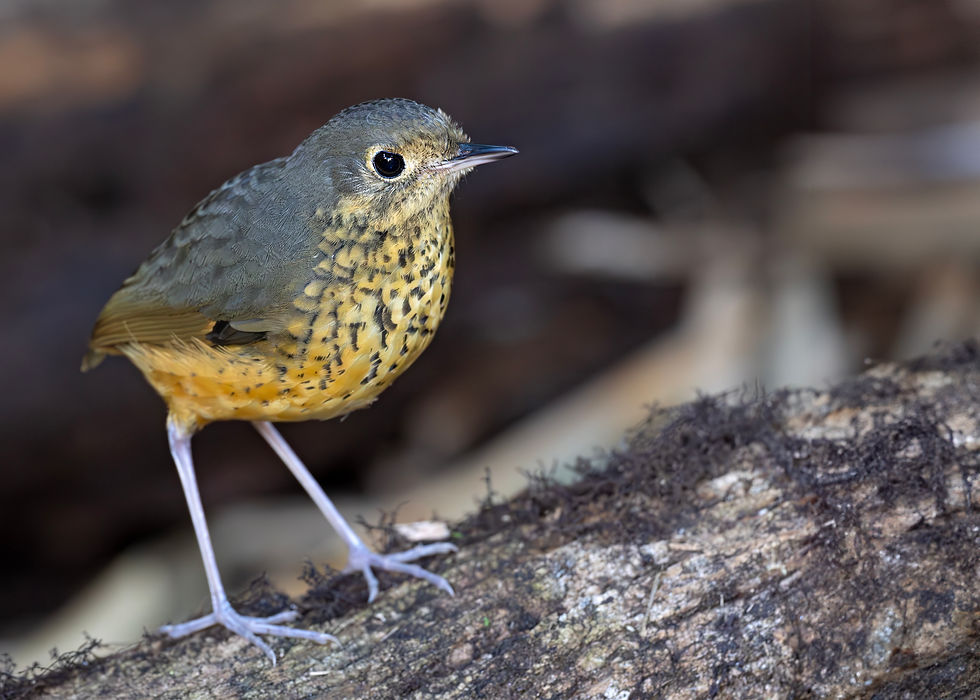
In the afternoon, we birded the Rapinas Trail — very slow overall. Still, we managed a few good additions: Spot-throated Woodcreeper (Certhiasomus stictolaemus), Madeira [Roosevelt] Stipplethroat (Epinecrophylla amazonica dentei), Manicore Warbling-Antbird (Hypocnemis rondoni), and others.
![Madeira [Roosevelt] Stipplethroat](https://static.wixstatic.com/media/96df2e_825fe14b2a6f4f51896e05b34e4faafa~mv2.jpg/v1/fill/w_980,h_700,al_c,q_85,usm_0.66_1.00_0.01,enc_avif,quality_auto/96df2e_825fe14b2a6f4f51896e05b34e4faafa~mv2.jpg)
To wrap up the day, we went back to the lodge and tried the Rufous Potoo (Phyllaemulor bracteatus), which Glauko and Brunão had reported behind the rooms. I placed the speaker right below the stump where it was expected to land — and the bird came straight in! A beautiful scene. Just out of curiosity, this bird was actually chosen as the number one highlight of the entire trip — so you can imagine the excitement.

Check out our Facebook post: https://www.facebook.com/share/v/1Ck6vz3qNT/
eBird checklists:
Day 11 (Pousada Amazon Roosevelt)
June 5, 2025
Our first and only full day at Amazon Roosevelt. One bird keeps eluding us no matter what: Buff-cheeked Tody-Flycatcher (Poecilotriccus senex). We heard it once, but at other points where I’ve both seen and heard it before — nothing. I had the impression of hearing it once with Kenny, during a scouting trip, in the same campina where we found Zimmerius chicomendesi. That area also holds several open-habitat species that are new for the group — and the Poecilotriccus would be new for everyone. I wanted to give it a real try.
So unlike the other days, we had breakfast at 4:30 a.m. and left by 5:00 to reach the campina at dawn (we arrived around 6:00). The day began with Spotted Puffbird (Bucco tamatia) and many birds crossing the road in flight, including Kawall’s Amazon (Amazona kawalli) and many Scaled Pigeons (Patagioenas speciosa). We entered a bit into the area I usually explore and saw Pale-bellied Mourner (Rhytipterna immunda), but still no sign of Buff-cheeked Tody-Flycatcher.
I tried playback for a few open-habitat species, and soon a Pearly-breasted Cuckoo (Coccyzus euleri) started singing — new for part of the group. We decided that Ciro would stay with the group watching the Spotted Puffbird and trying to spot the Pearly-breasted Cuckoo, while I walked along the road playing the Tody-Flycatcher and would call on the radio if I heard anything. I walked about a kilometer and came back — nothing.
Took a “technical break” due to a sudden stomach ache (haha). It was already past 7:00, and the sun was heating up. We went to the nearby side road, which had some shade. There we saw Rufous-crowned Elaenia (Elaenia ruficeps), heard Pearly-vented Tody-Tyrant (Hemitriccus margaritaceiventer), saw four Brown-throated Parakeets (Eupsittula pertinax) — an isolated population, quite interesting — and a group of Plush-crested Jays (Cyanocorax chrysops), which some say may represent a distinct form. Plenty of Natterer's Slaty-Antshrike (Thamnophilus stictocephalus) singing too.

We left the campina and went back into terra firme forest. The past few days have been slower overall, but still with some nice moments. For me, a highlight whenever it appears: Collared Puffbird (Bucco capensis) — gorgeous bird. We also had Crimson Topaz (Topaza pella) and a “nemesis bird” for one of the most experienced participants: Amazonian Pygmy-Owl (Glaucidium hardyi).

In the afternoon, we wrapped up the day with a boat outing to try again for Buff-cheeked Tody-Flycatcher on the Lagoinha Trail — nothing.

eBird checklists:
Day 12 (Pousada Amazon Roosevelt - Humaitá)
June 6, 2025
Farewell to the fishing lodges.

Breakfast at 5:30 a.m., and by 6:00 we were already on the boats heading toward the Xavier Trail — a site I didn’t know yet, but Kenny had spoken well of it. However, the mornings have been rather slow — except for Cachoeirinha (at PiraAçu) and Buiuçu, which were relatively active. Very little overall activity, few birds singing... The day began cold, cloudy, and with rain. Almost no song at all. No sign of Red-and-black Grosbeak (Periporphyrus erythromelas), unfortunately. But not at all an easy bird; so don’t feel special if you did not see it when you had the”chance”.
Two birds that me and Rob saw just outside the rooms before grabbing our bags:
Manicore Warbling-Antbird Black-throated Antbird
We left Amazon Roosevelt around 11:00 a.m.
In the afternoon, the group’s spirits lifted again; even an Agami Heron (Agamia agami) appeared — pure luck.

Around 5:10–5:15 p.m. we noticed a lot of movement toward the ferry, so we decided to go early to secure a spot.
Leaden Antwren Gray-headed Tanager
We crossed around 6:30–6:40 and arrived close to 7:00 p.m. Check-in at 7:10, and we scheduled dinner for 7:30; it worked perfectly, and afterward we went back to the hotel to rest.
One participant complained about loud music at the restaurant — unavoidable in some places, unfortunately. To make things easier, we decided to have dinner at the hotel tomorrow. Fingers crossed. I’d go to the restaurant again [with earplugs maybe].
eBird checklists:
Day 13 (Full Day Humaitá - again)
June 7, 2025
We hadn’t yet visited the Cerrado section of Mapinguari National Park. We met at 5:00 a.m. and arrived between 6:00 and 6:10, right at dawn. Birding the Cerrado is always fun, and for this trip almost everything there was new. For Steve — experienced, but with many lifers in this habitat — the morning brought several mega targets, like Black-masked Finch (Coryphaspiza melanotis) and Ocellated Crake (Rufirallus schomburgkii), both of which put on a real show. Seeing Ocellated Crake without playback or “training” is rare — and it happened. What a moment. Preparing the “stage” paid off.

While the group had breakfast beside the vehicle, we kept calling birds in, and they kept showing up: White-rumped Tanager (Cypsnagra hirundinacea), Wedge-tailed Grass-Finch (Emberizoides herbicola), Grassland Sparrow (Ammodramus humeralis), Peach-fronted Parakeet (Eupsittula aurea), and Red-shouldered Macaw (Diopsittaca nobilis), among others. The highlight, again, was the Black-masked Finch and Ocellated Crake.

After the Cerrado session, we had a long drive to reach the new terra firme trail now open for visitors. Along the way, we found species typical of that transition: Swallow-tailed Hummingbird (Eupetomena macroura), Aplomado Falcon (Falco femoralis), and Dark-throated Seedeater (Sporophila ruficollis), among others. Rare in this region/route but common here.
In the terra firme forest, new species for the trip included Mouse-colored Antshrike (Thamnophilus murinus) and Citron-bellied Attila (Attila citriniventris). The forest remained quiet overall, but the Attila was a lifer for many and gave excellent views for photos, recordings, and video.

We left around 11:00 a.m. and started heading back, slightly worried about fuel. We were running low, and to make things worse, one of Ciro’s car tires had a bulge on the side — risky. We stopped to buy gasoline and continued. Lunch was late (between 2:00 and 3:00 p.m.). Meanwhile, Ciro looked for a repair shop and managed to fix the tire. We gave the group an unplanned break — the idea had been to go straight to the field in the afternoon, but safety came first. I drove everyone back to the hotel in two runs while Ciro handled the tire and I restocked water, fruit, and snacks. With eight people, we go through at least 20 liters of water per day, so the logistics are a bit more demanding than for smaller groups.
We regrouped at 4:30 p.m. and went back to the field, but there were no highlights. We got close to the spot for Fulvous-chinned Nunlet (Nonnula sclateri), at Geotop, but no sign of it.
We returned and had dinner at the hotel. I was exhausted and lost my patience over delays, wrong orders, and general confusion. In the end, it was just fatigue — long drives, little sleep, no post-lunch rest, plus the stress over fuel and the tire. I went back to my room early, skipped dinner, and fell asleep around 8:30–9:00 p.m. A well-deserved rest.
eBird checklists:
Day 14 (Humaitá to Porto Velho to Jaci-Paraná)
June 8, 2025
It was one of those long transition days — from Humaitá all the way to Jaci-Paraná, already within Porto Velho’s limits and on our way toward Rio Branco. We left the hotel at 5 a.m., headlights cutting through the fog, everyone still waking up with that quiet energy that early starts bring.
Our first target was Humaita Antbird (Myrmelastes humaythae), right at the entrance of Mapinguari National Park. We got there around 6:15, and just as we stepped out, two individuals were already singing — one on each side of the road. Another crucial tip from Bruno. We had breakfast right there, with the forest slowly coming alive around us, and after a while, we ventured in. I recorded its song, and after a bit of effort, Laura spotted a small opening and caught sight of the bird perched, singing non-stop. It stayed long enough for everyone to enjoy great views. Ciro found another angle with the thermal camera — that gadget proved incredibly helpful in several moments throughout the trip. Fieldwork with him [Ciro] has been flowing beautifully.
Next stop: C-30, once again in search of the elusive Fulvous-chinned Nunlet (Nonnula sclateri). We arrived around 7:40 and stayed until just past 10. Nothing. Unpredictable as always. We did bump into Arthur and Andre leading the other BBE group — a fun surprise, though in classic birder fashion no one thought of taking a picture of the two teams together; everyone was too focused on their targets. We had lunch at 11 and hit the road again around noon.
Our next challenge was Buff-cheeked Tody-Flycatcher (Poecilotriccus senex) — yes, another attempt. We went to G-33 based on Bruno and Kenny’s recommendation — I can’t thank them enough. It took a while, but it finally responded. I played the recording I had just made at that moment as Kenny had suggested. At first it didn’t look promising from the roadside, but the bird came closer and a few people caught brief glimpses. Then Ciro found a narrow opening in a bamboo patch near a stream. We went in, and within two minutes the bird was right there in front of us — perfect views for everyone who entered. Steve decided to stay back since he’d already seen it well earlier.
We reached our hotel in Jaci-Paraná around 2:15 p.m. and set a meeting for 3:15 for some afternoon birding. During the break I ran out to buy more water — essentials first. Later that afternoon we headed to the IBAMA line and had a fantastic encounter with one of our final major targets: Rondonia Warbling-Antbird (Hypocnemis ochrogyna). Great looks. Other highlights included Snow-capped Manakin (Lepidothrix nattereri) and even a King Vulture (Sarcoramphus papa) perched quietly inside the forest. As dusk fell, we heard Little Tinamou (Crypturellus soui), Variegated Tinamou (Crypturellus variegatus), and Tapajos Antpitta (Myrmothera subcanescens). I tried for the latter, but it was across a small stream and already getting late.

When night came, we went after Ocellated Poorwill (Nyctiphrynus ocellatus) first. What a show — it almost landed on top of us! I rarely see that species so well. Rob managed a photo, and everyone had wonderful views. We didn’t insist too much so we could save time for White-winged Potoo (Nyctibius leucopterus), which, unfortunately, didn’t appear.
We closed the day with dinner at Hotel Fama — unanimously voted for “best shower of the trip.” A well-deserved award.
eBird checklists:
Day 15 (Jaci Paraná to Rio Branco)
June 9, 2025
Island day! We headed to Ilha do Búfalo.
But before that, a note about Hotel Fama — for such a small district like Jaci-Paraná, it’s surprisingly good. It had the best breakfast of the entire trip, the best shower, and possibly the best overall accommodation. Everything was spotless and, more importantly, incredibly punctual: breakfast at 5:00 meant breakfast at 5:00; dinner at 7:30 meant 7:30; lunch at 11:30 meant 11:30. In fishing lodges, things tend to be a bit more relaxed, which can sometimes be tricky for participants who rely on a tighter routine. If I could dream a little, I’d wish for a punctuality margin of 10–15 minutes instead of a whole hour — but of course, we understand the local logistics.
Breakfast at 5:00, departure at 5:45. I brought some pastries for Erivelton and his colleague on the second boat. We left around 6:00 toward Ilha do Búfalo, arriving roughly an hour later. On the way, a nice surprise — Orinoco Goose (Oressochen jubatus).
Our first landing on the island was intense: a quick succession of island specialists — Lesser Wagtail-Tyrant (Stigmatura napensis), Black-and-white Antbird (Myrmochanes hemileucus), White-bellied Spinetail (Mazaria propinqua), and Parker's Spinetail (Cranioleuca vulpecula). Several seedeaters too: Lined Seedeater (Sporophila lineola), Double-collared Seedeater (Sporophila caerulescens), and also Chestnut-bellied Seedeater (Sporophila castaneiventris), the latter photographed by one of the participants. It was one target after another.
Black-and-white Antbird Lesser Wagtail-Tyrant
We later tried a grove of Cecropia trees hoping for Pearly-breasted Conebill (Conirostrum margaritae) and Brownish Elaenia (Elaenia pelzelni), but no luck. In compensation, I got a personal lifer — an Olive-spotted Hummingbird (Thalaphorus chlorocercus), perched and, I think, photographed by one of the participants. New additions for the trip included Straight-billed Woodcreeper (Dendroplex picus) — common, though not seen before on this route — and Fuscous Flycatcher (Cnemotriccus fuscatus). A good stop.
At the next point, an Elaenia appeared and responded to playback, but we believe it was Large Elaenia (Elaenia spectabilis), not the island specialist. We also tried for Lesser Hornero (Furnarius minor), with no success. A few more stops followed, but activity naturally dropped as the morning advanced. Targets like Brownish Elaenia, Pearly-breasted Conebill, and Lesser Hornero seem scarcer on this island than on the islands near Manaus for instance.
On one of the stops, Rob was almost taken away from us by the quicksand. Jokes aside, I really got pretty scared and thought for a moment that at least his boots would be gone forever. Thanks to the boat drivers that helped tug Rob out in safety.
Stuck in the mud
We returned to the hotel around 11:00 for lunch at 11:30.
We met again at 12:55 — time to hit the road well rested (this is for the drivers).
Cars loaded, bills settled, water restocked. We drove to Rio Branco — a 5½ to 6-hour drive. With the time zone shift back one hour, we arrived at 6 p.m. sharp. Checklist and dinner were set for 7, right on schedule, with excellent food. I left a tip for Matheus, the waiter, and for the cook. We’ll probably have dinner here every night — convenient and well deserved.
eBird checklist:
Day 16 (Rio Branco Area)
June 10, 2025
One of the most fantastic days of the trip. The weather was pleasant, with temperatures around 23–24 °C, and although the birds were moving a bit slower, they kept showing up steadily. The morning list went past 80 species. Some highlights included Purus Jacamar (Galbalcyrhynchus purusianus), White-throated Jacamar (Brachygalba albogularis), and Black-capped Parakeet (Pyrrhura rupicola), among others.
Breakfast at 4:30, departure at 5:20, and arrival at 5:40. As soon as we stepped out of the vehicles, birds started popping up one after another — Olive-faced Flatbill (Tolmomyias viridiceps), White-winged Becard (Pachyramphus polychopterus), Little Woodpecker (Veniliornis passerinus), and Cobalt-winged Parakeet (Brotogeris cyanoptera).
When we returned closer to the cars to continue along the road, we noticed a big commotion in a tall tree beside us — Rusty-margined and Gray-capped Flycatchers (Myiozetetes cayanensis and M. granadensis), a mix of flycatchers and Tityras all chattering away. In the middle of it, Rob spotted an Ash-colored Cuckoo (Coccycua cinerea) — a lifer for both me and Graham. We also had a Great Potoo (Nyctibius grandis) roosting quietly nearby. Soon after came a few Tityras, Blue-gray Tanagers (Thraupis episcopus), Swallow Tanagers (Tersina viridis), and Glittering-throated Emerald (Chionomesa lactea) among others.
A bit farther along, at the small bridge, we had our first Purus Jacamar. We tried for White-throated Jacamar, but no success yet. A pair of Blue-headed Macaws (Primolius couloni) flew slowly overhead; we played a quick recording, they circled closer, but didn’t perch. Across Lake Amapá we picked up Chestnut-vented Conebill (Conirostrum speciosum). Then, while parked at another point, three Bush Dogs (Speothos venaticus) crossed the road — I caught the last one running, and everyone else saw them too. Bird activity on that side was lower, but that moment alone was unforgettable.
I returned to the first stop, still determined to find the White-throated Jacamar. It responded, though from a spot with no visibility. Moving on, we heard and ended up seeing the Western Olivaceous Flatbill (Rhynchocyclus aequinoctialis cryptus) — the floodplain subspecies, as I explained to the group. Almost back at the car, a group of about ten Black-capped Parakeets flew by. I quickly played the call and they came right in, perching just above us — perfect photos, videos, and pure joy all around. As we were walking towards the cars, there was a Dull-capped Attila (Attila bolivianus) perched in the open, great views for the ones who were nearby. And just as we were about to leave, Laura spotted a White-throated Jacamar perched calmly — what a perfect closure for the morning!
White-throated Jacamar Black-capped Parakeet
Lunch and a two-hour rest followed. In the afternoon, we went birding around the UFAC campus, only two minutes from the hotel. Nothing extraordinary, but it was a pleasant, relaxed session under the cool weather — a nice way to wind down the day.

Our only concern for tomorrow: whether the road to Noca would be dry enough to get in.
eBird checklists:
Day 17 (Full Day at Noca Road)
June 11, 2025
Our first full day on the Noca road — a complete success, despite all the difficulties along the way.
At the entrance, we weren’t confident enough to drive in without knowing the condition of the track. On the way back later, we saw that a road grader had passed through the section with the two deepest mudholes, but in the morning we decided to go on foot. We walked more than 13 kilometers all the way to Dona Eliana’s house, up and down the muddy slopes.

The good thing about walking was that we heard a lot along the way and could stop whenever it was worth it. But with the mud, the rain, the heavy backpacks, and the logistics of leaving the car behind, we forgot the machete — and that limited our access in a few spots. Even so, it turned into a wonderful day. In the more open stretches, we picked up some new birds for the trip, such as White-lored Tyrannulet (Ornithion inerme) and Riparian Antbird Antbird (Cercomacroides fuscicauda), plus many parrots flying over. At the forest edge, we had Yellow Tyrannulet (Capsiempis flaveola) and others.
The morning highlights included White-lined Antbird (Myrmoborus lophotes), Rufous-breasted Piculet (Picumnus rufiventris), Fine-barred Piculet (Picumnus subtilis), Goeldi’s Antbird (Akletos goeldii), Orange-fronted Plushcrown (Metopothrix aurantiaca), and Black-faced Cotinga (Conioptilon mcilhennyi), among many others.

Within the first 500 meters, Ciro came up with the idea of going back to town to find a 4x4 to pick up the group later. We lost communication until 1:30 p.m., when I finally caught a bit of internet at Dona Eliana’s house and learned that he had managed to find a vehicle, despite delays caused by protests along the highway.
He ended up missing lots of great birds, photos, and videos, but it was the right call. In the morning alone, we also saw four species of primates. The day’s total reached around 150 bird species. Ciro arrived at Dona Eliana’s place just as we were heading back; the afternoon was slower, though still with a few new additions.
Emperor Tamarin Toppin's titi monkey
An incredible day at Noca, as always — and the best part: the temperature never went above 24 °C. With that cool weather, the long walk was perfectly manageable; under typical Amazon heat, it would have been a very different story.
eBird checklist:
Days 18 and 19 (Noca Road and Departures)
June 12/13, 2025
Our second full day on the Noca road was also a great one. And the last morning too. But now I am too tired to write the rest… The eBird checklist will at least give us an idea of the “bird goodies” of these two last days. Sorry for the laziness everyone.
Some photos of the last two days:
Purple-throated Euphonia Purus Jacamar Tui Parakeet. Rufous Twistwing
eBird checklists:
Final Notes
This was another great run through Rondônia, Southern Amazonas and Acre — a route I never get tired of. I’ve been coming to this region, especially Rondônia, since 2013, and it’s always special. I “need” to come at least once a year to keep my balance.
In total, we covered 3,172 km by car, plus a couple hundred by boat.We recorded 555 bird species, out of which 63 were heard only.
At the end of the trip, each of the six participants + me and Ciro chose our six favorite birds. I gave 6 points to each person’s top bird, 5 to their second, and so on until 1 point for the sixth. What started as a “Top 5” quickly turned into a “Top 8.”
Final results:
Rufous Potoo (Nyctibius bracteatus) — 23 points
Pale-faced Bare-eye (Phlegopsis borbae) and Black-capped Parakeet (Pyrrhura rupicola) — 18 points each
Black Bushbird (Neoctantes niger) — 16 points
Ocellated Crake (Rufirallus schomburgkii) — 14 points
Rufous Twistwing (Cnipodectes superrufus) — 10 points
Rondônia Bushbird (Clytoctantes atrogularis) and Purus Jacamar (Galbalcyrhynchus purusianus) — 9 points each
Special mentions:
Black-faced Cotinga (Conioptilon mcilhennyi)
White-breasted Antbird (Rhegmatorhina hoffmannsi)
Dotted Tanager (Ixothraupis varia)
Rufous-breasted Piculet (Picumnus rufiventris)
Once again, a memorable trip through one of my favorite corners of the Amazon.
For more photos and medias check out the eBird checklists.
Acknowledgements
Big great thanks and warm hugs to Bruno Rennó, Kenny Uéslei and Ricardo Plácido. Thanks to the boys at PiraAçu and Amazon Roosevelt for the great company and help and to all of you that participated in this fun and productive journey.
Full eBird Trip Report:


What a great report, Caio. I felt I was with you all the way even though I doubt I am now fit enough to walk 13kms in the Amazon mud. And you manage to capture the highs without forgetting those long, tedious moments without much activity. One of the best trip reports I have read. Thanks, Arthur Grosset