

Central Brazil: Into The Heart Of The Cerrado

Something is different about the Cerrado: it doesn’t reveal itself immediately.
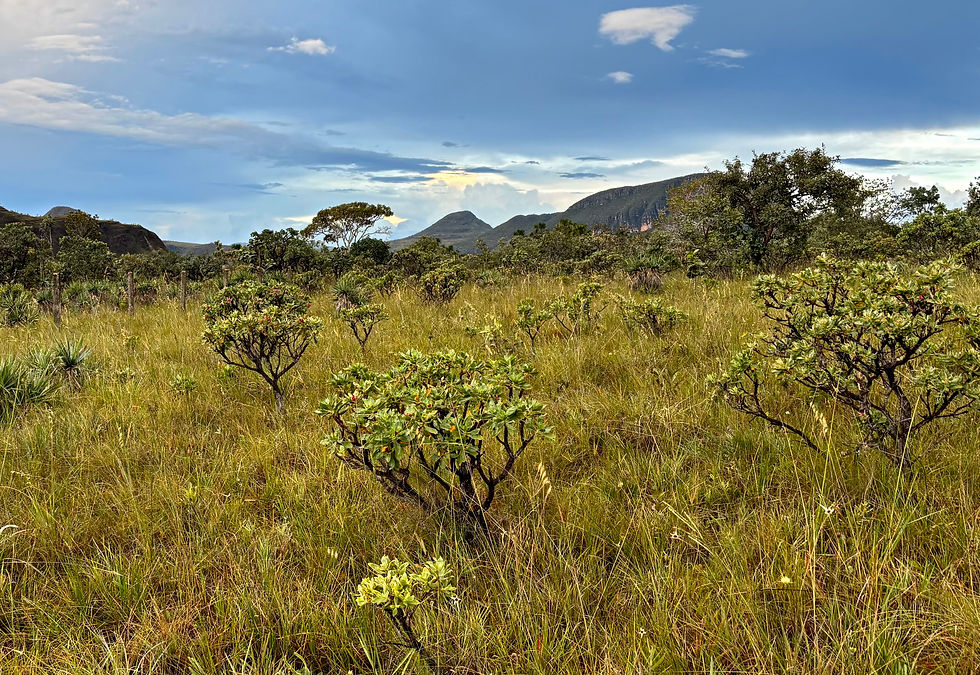
It’s not as vivid and impactful as the Amazon, nor as iconic and full of movement as the Pantanal. Instead, it unfolds slowly — through altitude shifts, geological transitions, and landscapes that feel ancient in a way that’s hard to explain until you stand there.
This tour was designed as a genuine immersion into the most biodiverse savanna on Earth — the Cerrado of Central Brazil. Moving through the state of Goiás, we traverse rolling plateaus, limestone outcrops, historic towns, vast river valleys, and some of South America’s most unique and endangered ecosystems.
Over 13 days, the route forms a natural arc across the heart of Brazil: Brasília → Chapada dos Veadeiros → Terra Ronca → Serra dos Pireneus → Araguaia River → Emas National Park → Goiânia.
More than anything, this is a journey about understanding a territory through birds, landscapes, and people.
Brasília — Where the Journey Begins
Our trip begins in Brasília — Brazil’s modernist capital, set at the core area of the Cerrado biome.
On the left: Evening In Brasilia and Jk Bridge And The Traffic Rush On The Way Back From Work. On the right: Brazilian National Congress building in Brasilia. Photos: Jonatas Buscaratti
Designed in the late 1950s and recognized as a UNESCO World Heritage Site, the city rises from the savanna in bold architectural lines and the open horizons of the Central Brazilian Plateau, surrounded by native vegetation that still shapes its character.
Despite its urban design, Brasília remains deeply connected to the biome.
Patches of preserved Cerrado, gallery forests, and the shores of Lake Paranoá offer an immediate introduction to the region’s birdlife. Species such as Suiriri Flycatcher, Curl-crested Jay, Peach-fronted Parakeet, and Campo Flicker can often be found within the city’s green spaces — a reminder that here, the savanna is never far away.
For many travelers, Brasília offers more than a gateway — it becomes the first encounter with the scale, light, and atmosphere of Central Brazil, and a transition point between arrival and immersion.
The High Plateau — Chapada dos Veadeiros
Jardim de Maytrea, in Chapada dos Veadeiros. Photos: Caio Brito
After arriving in Brasília, we drive roughly 220 km into the highlands of Chapada dos Veadeiros — a landscape shaped by quartzite formations nearly 1.8 billion years old, among the oldest in South America, rising to almost 1,700 meters above sea level.
Here, the Cerrado feels vast and elemental. High-elevation, windswept grasslands give way to rocky campos rupestres, where shallow soils and exposed stone create a mosaic of habitats. Gallery forests follow hidden streams, and waterfalls carve through ancient rock. The light is sharper at this altitude, the horizons wider, and the wind constant.
This region concentrates many of the biome’s most sought-after specialties, including Cock-tailed Tyrant, Chapada Flycatcher, Black-masked Finch, Sharp-tailed Tyrant, Cinereous Warbling-Finch, and the Yellow-faced Parrot – species closely tied to the open habitats that define the landscape.
Cock-tailed Tyrant Chapada Flycatcher Black-masked Finch Sharp-tailed Tyrant Cinereous Warbling-Finch Yellow-faced Parrot
Cock-tailed Tyrant, Chapada Flycatcher doing its display, Black-masked Finch, Sharp-tailed Tyrant, Cinereous Warbling-Finch, and the Yellow-faced Parrot feeding. Photos: Caio Brito and Tatiana Pongiluppi
In the vicinity of Alto Paraíso de Goiás, we also have chances to find some of the Cerrado’s rarer species, such as the range-restricted Reiser’s Tyrannulet.

Birding here isn’t rushed: it unfolds at the pace of the plateau itself.
The itinerary is designed to allow time to understand how the landscape functions — early mornings scanning open campo, midday raptors riding thermals overhead, and late afternoons along forest edges where mixed-species flocks move through.
At Chapada dos Veadeiros, altitude shapes vegetation, and vegetation shapes birdlife — and the rhythm of the Cerrado becomes clearer.
Terra Ronca & the Paranã Valley — Limestone, Dry Forests, and Endemics

From the plateau, the route descends nearly 1,000 meters into the Paranã Valley, where open horizons give way to a dramatic shift in landscape. The 300 km drive to São Domingos marks one of the most striking ecological transitions of the journey.
Limestone outcrops, cavern systems, and deciduous dry forests replace the savannas of the highlands, creating habitat for some of Central Brazil’s most localized birds. Here, the Cerrado reveals an identity shaped by karst topography and strong seasonality.
This is where we target one of the tour’s major highlights: Pfrimer’s Parakeet — one of the world’s most restricted-range parrots (c. 2,500 km²), confined to the limestone-associated dry forests of this region.

Pfrimer’s Parakeet at the limestone cliffs Pfrimer’s Parakeet and the limestone cliffs within dry forest habitat.
The range-restricted Pfrimer’s Parakeet and Limestone Formations. Photos: Caio Brito and Ciro Albano
Alongside it come the endemic São Francisco Black-Tyrant and Outcrop Sabrewing, equally tied to this unique environment. Other key targets include Ochre-backed Woodpecker, Black-tailed Flycatcher, and Rufous Casiornis.
São Francisco Black-Tyrant Outcrop Sabrewing
The rare and endemic São Francisco Black-Tyrant and Outcrop Sabrewing. Photos: Caio Brito and Ciro Albano
Various species of parrots add another colorful layer to the experience at Terra Ronca. Striking Red-and-green Macaws, White-eyed Parakeets, and Blue-winged Macaws nest on the limestone cliffs, where their echoing calls carry across the escarpments.
The region also offers the tour’s only opportunities to observe the beautiful Jandaya Parakeet, the scarce, Blue-crowned Parakeet, and the impressive Hyacinth Macaw, which may be found in the palm-rich veredas near São Domingos — a species that remains a highlight for many visiting birders.
Hyacinth Macaw and Serra Geral. Photos: Caio Brito and Ciro Albano
Yet beyond birding, Terra Ronca carries a presence of its own. Massive cave entrances and towering rocky formations create a sense of scale rarely associated with the Cerrado — a reminder that this biome and its biodiversity are intricately shaped by ongoing geological processes.
Serra dos Pireneus — Birthplace of Central Brazil’s Waters
Colonial street in Pirenópolis with a view of Serra dos Pirineus Ridge The top of Serra dos Pirineus Ridge
Colonial street in Pirenópolis with a view of Serra dos Pirineus Ridge. And the ridge itself. Photos: Estevão Santos
The next long transfer — roughly 560 km — climbs back onto the Central Plateau toward Pirenópolis, where altitude once again reshapes the landscape.
The ridgelines of Serra dos Pireneus rise just behind the town and dominate the horizon. Yet beyond this striking visual presence lies a quieter significance: the range forms part of a major continental watershed and serves as the birthplace of several river systems.
Streams rising here flow north to the Amazon Basin and south to the Paraná system, placing the Serra at a hydrological crossroads where species with Amazonian, Atlantic Forest, and Cerrado affinities meet.
Birdlife reflects that convergence, including five species of manakins that may occur in the same areas. Amazonian influence appears in Fiery-capped Manakin; Atlantic Forest elements emerge with Pin-tailed Manakin; and the Cerrado is represented by the endemic Helmeted Manakin, alongside Pale-bellied Tyrant-Manakin and the spectacular Band-tailed Manakin.
Fiery-capped Manakin Pin-tailed Manakin
Helmeted Manakin Pale-bellied Tyrant-Manakin Band-tailed Manakin
Fiery-capped Manakin, Pin-tailed Manakin, Helmeted Manakin, Pale-bellied Tyrant-Manakin and Band-tailed Manakin. Photos: Caio Brito, Ciro Albano and Lucas Barros
Open highland savannas and rupestrian landscapes remain present in specialties such as Rufous-winged Antshrike, the striking Blue Finch, and the dazzling Horned Sungem. Along with that, mixed flocks led by the endemic White-rumped Tanager and White-banded Tanager, together with Black-throated Saltator, move steadily across the grasslands, linking shrubs, rocky outcrops, and scattered trees into a flow of activity.
Blue Finch Horned Sungem
Blue Finch and Horned Sungem. Photos: Caio Brito and Ciro Albano
Water-associated habitats — gallery forests and streamside vegetation — add interesting contrast, harboring species such as White-eyed Foliage-gleaner, Pectoral Sparrow, Amazonian Motmot, Greenish Schiffornis, and Black-goggled Tanager, along with chances for the endemic Russet-mantled Foliage-gleaner and the rare Fasciated Tiger-Heron.
Greenish Schiffornis Russet-mantled Foliage-gleaner
Greenish Schiffornis and Russet-mantled Foliage-gleaner. Photos: Caio Brito
And then there is Pirenópolis itself — a historic town of colonial architecture and picturesque scenery. After days in rugged landscapes, its unhurried yet charming atmosphere provides a welcome break, grounding the journey in culture as well as geography.
The Araguaia River — Where the Cerrado Meets the Amazon
The Araguaia River. Photos: Carlos Gussoni
Leaving the mountain range behind, the route descends once again — this time into the Araguaia River basin. The 320 km drive to Aruanã marks a shift not only in altitude, but in atmosphere.
Humidity rises, vegetation thickens, and the rugged landscape opens into broad floodplains and imposing riverine forests.
As the Cerrado gives way to a distinctly tropical character, a bird community unlike any other on the tour begins to emerge. The Araguaia functions as a biological corridor, bringing Amazonian elements deep into central Brazil.
Much of the birding here unfolds by boat, allowing close exploration of riverine vegetation, backwaters, and sandy banks. These habitats support a distinctive set of species, including an important trio of endemics — Araguaia Spinetail, Crimson-fronted Cardinal, and Bananal Antbird — all restricted to a narrow range along the Araguaia basin.
Araguaia Spinetail Crimson-fronted Cardinal Bananal Antbird
Araguaia Spinetail, Crimson-fronted Cardinal and Bananal Antbird. Photos: Caio Brito
Seasonal flood pulses shape the landscape, creating conditions for exceptionally high bird densities, comparable to those of the famed Pantanal wetlands. Boat safaris reveal pairs of Orinoco Goose, Golden-collared Macaw, Ochre-bellied Guan, and the striking Hoatzin, while exposed sandbanks concentrate Jabiru Stork, Black Skimmer, Collared Plover, Pied Plover, and the mesmerizing Sunbittern, often at close range. Other species that could be found along the river and river edges are American Pygmy Kingfisher and Green-and-rufous Kingfisher, Amazonian Black-Tyrant, Riverside Tyrant, Maranhão Hermit, Yellow-browed Sparrow, Dull-capped Attila and many more.
Orinoco Goose Jabiru Hoatzin
Orinoco Goose, Jabiru and Hoatzin. Photos: Caio Brito
The Araguaia is one of the most scenic segments of the tour — long days on the river slow the pace, allowing birds, light, and landscape to merge into one of the journey’s most memorable experiences.
A pit stop for Kaempfer’s Woodpecker
As the journey turns south, a strategic stop near the town of Guapó focuses on one of the Cerrado’s most enigmatic and sought-after birds: Kaempfer’s Woodpecker, a species closely associated with bamboo-dominated forest habitats.
Rare and globally threatened, this woodpecker occurs at low densities and is highly localized, making any encounter the result of patience, timing, and detailed knowledge of its habitat.
While observations are never guaranteed, this stop targets the most reliable areas, carefully identified through years of dedicated searches, offering the best chances to connect with this elusive species.

Moments like this underline one of the deeper themes of the tour — understanding how vegetation, geology, and birdlife are intricately linked. Identifying the right habitat often makes the difference in finding the birds we want to see.
Emas National Park — The Cerrado at Its Wildest

The final chapter of the journey reaches Emas National Park — one of the largest and best-preserved expanses of open Cerrado anywhere in Brazil.
Here, the landscape is dominated by vast campo limpo and campo sujo formations, where grasslands stretch uninterrupted to the horizon, punctuated by towering termite mounds that create an overwhelming sense of scale.
The roughly 445 km drive to Chapadão do Céu leads into a setting where birding feels almost like a safari. Visibility is wide, movements are easy to follow, and birds and mammals are often detected at great distances from the vehicle.
This is prime habitat for some of the Cerrado’s most iconic and endangered species, absent from earlier stages of the tour. Highlights include White-winged Nightjar — a primary target here — alongside Rufous-sided Scrub-Tyrant, Bearded Tachuri, and the elusive Lesser Nothura, more often heard than seen.

Narrow ribbons of gallery forest cutting through the grasslands harbor our best chances for the endemic Russet-mantled Foliage-gleaner, White-striped Warbler, and the exceptionally rare Cone-billed Tanager, rediscovered here in 2001.

The openness of the landscape also brings outstanding opportunities for mammal encounters — a hallmark of Emas NP — with regular sightings of Pampas Deer, Giant Anteater, Brazilian Tapir, and the spectacular Maned Wolf.
Pampas Deer Giant Anteater Brazilian Tapir Maned Wolf
Pampas Deer, Giant Anteater, Brazilian Tapir and Maned Wolf. Photos: Caio Brito and Ciro Albano
Between October and December, as the first rains arrive, Emas also reveals one of its most extraordinary natural spectacles. Bioluminescent termite mounds glow softly across the savanna, transforming the night landscape into a field of scattered green lights — an unforgettable experience restricted to this site.
Bioluminescent termite mounds glowing at night. Photos: Estevão Santos
It is a fitting finale to a journey that moves constantly between ecological worlds, bringing the route full circle with the Cerrado in its most elemental and untamed form.
A Different Kind of Birding Experience

Map of route across Goiás. Brasília (A), Alto Paraíso de Goiás (B), São Domingos (C), Pirenópolis (D), Aruanã (E), Guapó (F), Chapadão do Céu (G), Goiânia (H).
What makes the Central Brazil Tour distinctive isn’t just the species count — although totals of 350 to 400 birds over 13 days are entirely realistic — but the way the journey unfolds as a genuine natural history experience.
The Cerrado doesn’t try to impress – it grows on you through horizons, ancient landscapes, and a sense of traveling across the ecological heart of South America.
Plateaus give way to valleys. Dry forests transition into river corridors. Savannas open into vast plains. Each movement reveals a different layer of the biome, unfolding its story step by step.
This is less a checklist tour — even though the route consistently delivers the Cerrado’s key specialties and endemic species — and more a narrative journey, one that follows water systems, geological history, and the deep ecological threads that tie this part of Brazil together.
By the time the tour ends in Goiânia, most travelers realize they’ve experienced something rare: not just a collection of species, but a deeper understanding of one of the planet’s most overlooked ecosystems.
When to Visit Central Brazil
The dry season — from June through November — offers the best and most consistent conditions for this itinerary.
Birds are more active, weather is stable, and longer daylight hours allow for extended time in the field. Spring also brings breeding activity, attractive fruiting plants, and the possibility of witnessing Emas’ famous bioluminescence (October to December).
Is This the Right Tour for You?
This tour is designed with a moderate pace, balancing productive birding with time to absorb the landscapes.
1. Difficulty Level & Terrain
Walking conditions are generally easy to moderate, mostly along open trails, dirt roads, and flat terrain, with no strenuous hikes required.
While some long drives are necessary to connect key regions, days in the field prioritize birding time, with transfers carefully planned to support the route’s narrative.
2. Group Size & Field Style
Group sizes are intentionally kept at 6 to 8 people, allowing for a flexible, low-impact experience in the field.
Time outdoors emphasizes careful observation, shared discovery, and room for individual interests — whether focused on birding, photography, or simply absorbing the landscape.
The guiding style favors patience and interpretation over rushed species chasing, supporting a more relaxed and immersive experience.
3. Photography Opportunities
This trip also suits photographers particularly well, with frequent opportunities, open habitats, and favorable light conditions that often allow for relaxed observation and careful composition.
4. For all types of Birders
While this journey is often recommended as an excellent introduction to birding in Brazil — thanks to open habitats, some large and visible species, and rewarding photographic opportunities — it is equally essential for experienced and world-class birders.
Central Brazil holds some of the most localized endemics and rarest species in Brazil (and South America), many of which cannot be reliably encountered anywhere else. From Cone-billed Tanager and Pfrimer’s Parakeet to Kaempfer’s Woodpecker, White-winged Nightjar and Bananal Antbird, the region offers encounters that are meaningful even for the most traveled birders.
Accessible and welcoming for those discovering Brazil’s avifauna, yet deeply significant for those pursuing the continent’s most distinctive specialties.


Comments