

Rare Encounter with a Near-Extinct Bird: Trindade Frigatebird

Updated: Oct 10, 2025
Siesta time! It was during a small break after lunch and the Northeast Popular Tour 2025 had just begun, with Ciro and André on the lead. While the guides and the rest of the group were tucked in their rooms to get a little rest before afternoon birding, Pierre was outside the rooms, wandering around to see what he could witness on his own.
And then it happened.

Pierre Van der Wielen, one of the participants, glanced up just in time to see two shadows cutting across the sky. Almost as an instinct that birders armed with a camera have, he raised his camera and clicked away. What landed on his memory card was nothing short of extraordinary—a frigatebird unlike any anyone had seen on the tour before. Its distinctive plumage and size caught the eye as being “something different” and right away, as an experienced “sea birder” he knew he had something special.
A strange frigatebird? Indeed! It was a Trindade Frigatebird (Fregata ariel trinitatis), one of the rarest birds in the world, and an almost mythical visitor to the waters off Northeast Brazil.
The Ghost of the Atlantic
The Trindade Frigatebird is no ordinary seabird.
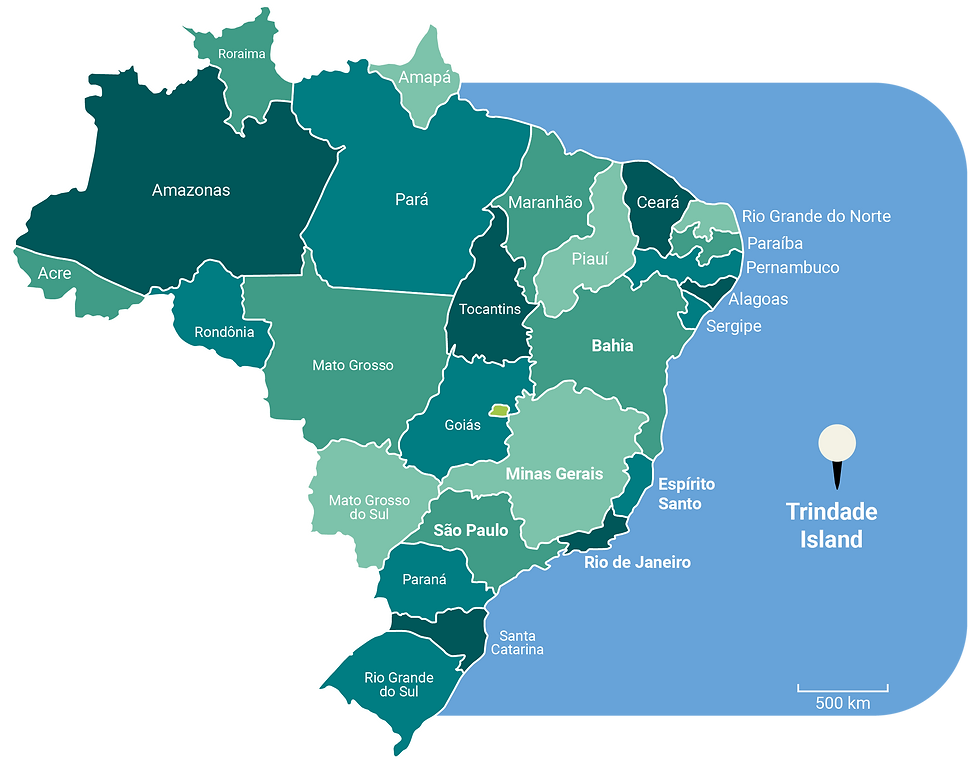
Its home is Trindade Island, a remote volcanic speck in the South Atlantic, hundreds of miles off the coast of Brazil. Here, in isolation, it has survived in tiny numbers, facing threats that its distant Indo-Pacific cousins never encounter.
For decades, ornithologists debated its status—was it merely a population of the more widespread Lesser Frigatebird (F. ariel) or something entirely unique?
Recent genetic studies have confirmed what many suspected: the Trindade Frigatebird is its own species, distinct from the Indo-Pacific group. Its sister taxa relationship with other frigatebirds highlights a lineage that has evolved in isolation for centuries, carrying with it adaptations and traits found nowhere else. And yet, despite its unique heritage, the species teeters on the edge of extinction.
With fewer than twenty known adult individuals in the wild, every sighting, every photograph, and every piece of data is precious.
Morphologically, the Trindade Frigatebird is striking. Juveniles have a rich cocoa-brown head, contrasting with a bright white belly that forms an inverted triangle extending into the vent. This peculiar pattern is unlike anything seen in Indo-Pacific frigatebirds, making even casual observers stop and stare.
As the bird matures, subtle changes unfold—the white collar of adult females, the gleaming black of adult males, and the distinctive blue-gray bill with pinkish highlights. These traits are not just markers for identification—they are clues in the complex puzzle of frigatebird evolution and survival.
The Discovery in Icapuí
The sighting in Icapuí was the sort of moment birders live for: unexpected, fleeting, and completely unforgettable. While the group was resting, Pierre’s camera captured a bird that, for most, would have gone unnoticed.

It glided effortlessly, wings stretched wide, moving with the mastery of a predator born to the sea.
“This is incredible” - is all I can think of and say as I write this article!
There, in the Northeast coast, thousands of kilometers from its only known nesting site, a bird on the brink of extinction appeared.
A rare gift from the Atlantic and a reminder of how much of the natural world remains hidden, even in places we think we know.
A Story Told in Feathers
Understanding what Pierre photographed requires a journey through the life of a Trindade Frigatebird. These birds go through complex plumage stages, each telling a story of age, sex, and development. The bird seen over Icapuí was likely a mature adult male.
Every feather, and skin color, is a message. For scientists, these details are more than aesthetic—they provide clues about the bird’s growth, health, and movements.
For example, on the Murphy’s Trindade Island Expedition, undertaken by Hadoram Shirihai in May 2022, adult males of this species were not recorded, suggesting they may have been elsewhere, perhaps at sea or in parts of the Atlantic we barely understand.
Every sighting adds a brushstroke to a portrait of understanding this poorly known and studied species.
A Fragile Existence
The Trindade Frigatebird’s rarity is a sobering reminder of how precarious life can be for some species.
With so few individuals remaining, threats from habitat loss, climate change, and human disturbance are magnified.
The birds’ reliance on remote islands for nesting makes them vulnerable to even minor changes in the environment, while the Atlantic currents they traverse are both highways and hazards, filled with predators, storms, and scarcity of food.
The Trindade Frigatebird survives precariously due to the destruction of its forested nesting sites after human colonization — a change that also drove tree-nesting Red-footed Boobies to local extinction.

Yet there is hope. Observations like the one in Icapuí are more than lucky coincidences—they are data points that inform conservation strategies. As Fabio Olmos explains, sightings in Northeast Brazilian waters suggest that F. trinitatis may use this region in ways previously undocumented, opening new opportunities to study and protect them.
If the birders’ community can continue documenting such occurrences, scientists might finally piece together the migrations, feeding grounds, and survival strategies of this elusive seabird.
Birders as Citizen Scientists
One of the most exciting aspects of this discovery is the role of birdwatchers in extraordinary science. Pierre’s photograph is more than a mere image—it is evidence. When uploaded to eBird, it contributes to a global database, helping researchers map sightings, confirm identifications, and track rare movements.

Birders, equipped with cameras and binoculars, become partners in amazing discoveries such as this one.
A Legacy in the Making
This encounter is now part of a larger story—a story of persistence, observation, and hope. It reminds us that the natural world is filled with wonders that can appear in the most unexpected places.
For a species with perhaps fewer than twenty adult individuals, every sighting is a treasure, every photograph a piece of history.
For Pierre a personal memory, but beyond that, this observation contributes to science, conservation, and the growing understanding of one of the Atlantic’s most enigmatic seabirds.
In the vast blue of the ocean, the Trindade Frigatebird flies quietly, largely unseen, yet its presence resonates loudly. It is a reminder that life is fragile, astonishing, and often just beyond the horizon of our expectations.
And sometimes, on a warm afternoon in Northeast Brazil, that life chooses to make itself known, if only for a fleeting moment.
The Trindade Frigatebird’s appearance in Icapuí is more than a lucky encounter. It is a symbol of the Atlantic’s hidden richness and the urgent need to protect it.

Congratulations for this very special documentation Pierre.
Bibliography:
Shirihai, H., Bretagnolle, V., Olmos, F. & Flood, R.L. 2025. The Murphy’s Trindade Island Expedition. Expedition to the remote Trindade Island and Martim Vaz rocks, South Atlantic to research the Trindade Petrel and the endemic frigatebirds. Privately published. - LINK


I understand that experienced seabird observers can sometimes notice when something “looks different”. However, intuition or field experience alone usually isn’t considered proof, especially for such an extremely rare species. I’m curious which specific diagnostic features were used to confirm the identification. Are there higher-resolution photos available? If experts were able to identify the species from the images, that would be very interesting. From the picture shown here I personally can’t see the diagnostic features, as the image quality seems quite limited.