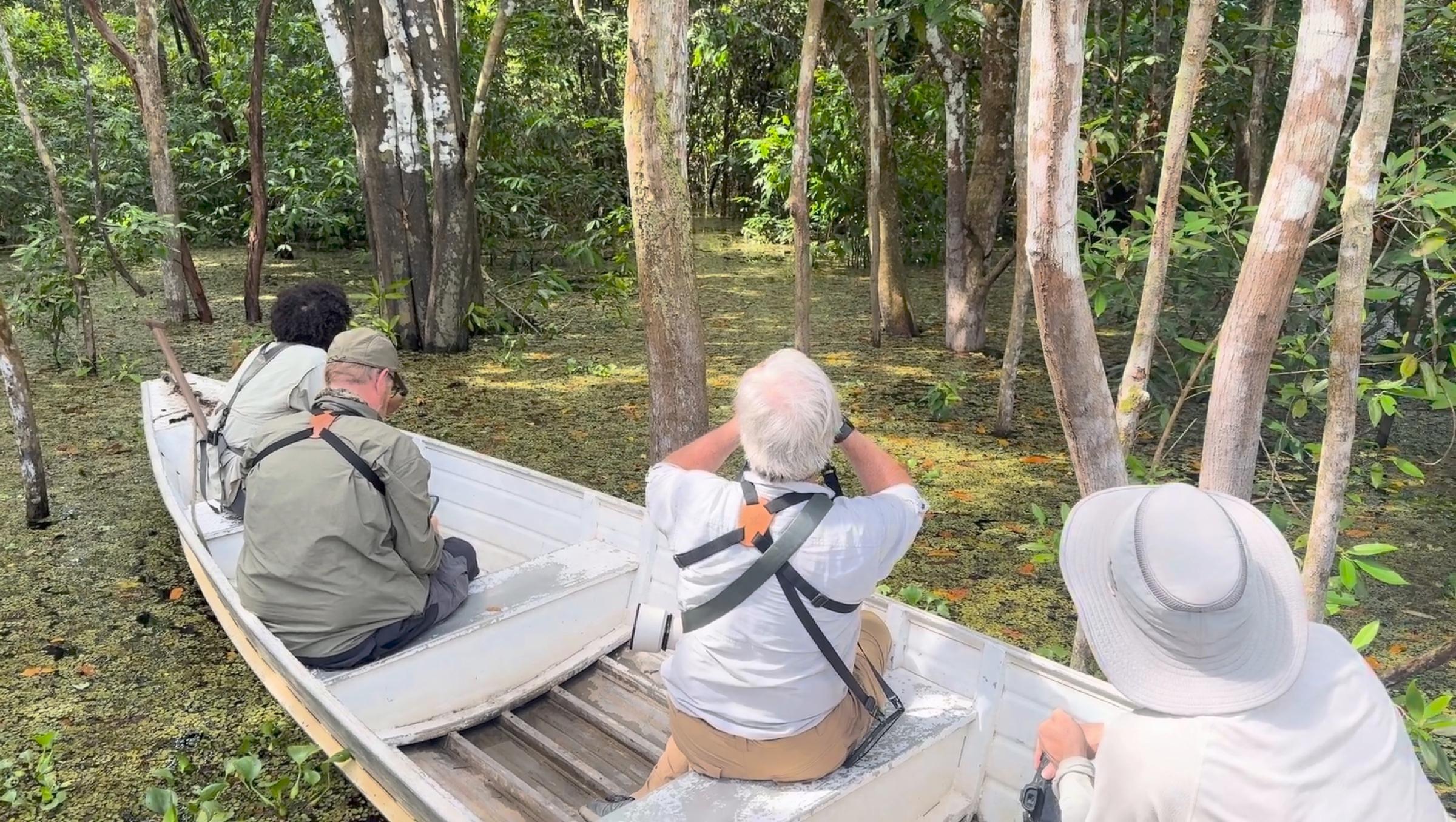
Birding clients traveling by boat through the Igapó forest

Planning Your Trip

Practical answers on booking, payment, flights, health and packing for your BBE tour.

Booking & Payment

Is there a single supplement, or can I share a room?

Prices are per person in a double or twin room. If you travel alone and would like to share, tell us at registration; we keep a list and match participants when two people ask. If nobody is available, the single supplement shown on the tour page applies. Some small lodges in remote areas have only a few rooms, and in large groups one or two participants may be asked to share or to stay at a partner pousada nearby; we tell you in advance.

Can you organize a private or custom birding tour?

Yes, that is our specialty. Tell us about the trip you have in mind and what you expect from it, in as much detail as you can, and we will design the tour for you.

How do I book a birding tour with Brazil Birding Experts?

Booking is a simple step-by-step sign-up: each participant completes our Registration Form and accepts the Terms & Conditions. Each traveler receives their own link by email, so couples and friends traveling together each sign separately. Once those are in, your place is reserved and we move on to documents and the confirmation deposit.

How far in advance should I book, and is there a waiting list?

Set departures often fill up a year ahead. Pantanal lodges, Caraça Sanctuary and several other Atlantic Forest sites must be booked well in advance, and our guides' calendars also fill quickly. Booking about a year ahead is ideal, and many clients book even earlier, up to two years ahead. There is a waiting list for all our tours: we let you know as soon as a place opens up, and when the list is long enough we may open a new departure. For custom tours we need at least 15 days to check availability and send a proposal, and groups are confirmed about three months before departure so that guides and hotels can be secured.

When is a set departure confirmed, and when can I book my flights?

Set departures with 8 places are guaranteed with 4 participants, and departures with 6 places with 3. If there are not enough reservations, we let you know 90 days before the tour starts, and you can choose to receive a full refund, transfer to another tour, or pay a supplement and travel in a smaller group. Please wait for our email confirming the tour before buying your flights.

What documents do I need to book a tour?

Each participant fills in our Registration Form and sends a copy of their passport, which we use to issue flight tickets when needed and to pre-register you at the hotels. Travel insurance is not required to book, although we strongly recommend it. In a few cases, visiting specific areas requires proof of travel insurance, and the Golden Lion Tamarin area also requires a yellow fever vaccination certificate.

Do all your tours include a guide?

All our tours include a BBE guide; we no longer organize self-drive or driver-only itineraries.

Can I pay by credit card, bank transfer or Wise?

We accept Wise, bank transfer (SWIFT), which can be made in several currencies, and card payments through WeTravel. Card payments through WeTravel carry a WeTravel fee. In some countries, the WeTravel link also lets you pay by local bank transfer.

How much is the deposit to confirm a tour?

A confirmation deposit of 25% of the tour price secures your place. The remaining 75% balance is then due 90 days before the tour starts. For tours that involve the Pantanal, the confirmation deposit is 35% of the total price.

Should I tip the guide and driver?

Tipping is optional. If you wish, a common guideline is US$10–20 per day for the tour leader and about half of that for local guides. The guide takes care of tips for drivers and hotel staff.

When is the final payment due?

The remaining 75% (or 65% for Pantanal Tours) balance is due 90 days before the tour begins. Paying this final balance on time keeps your confirmed place and lets us finalize logistics and any internal flights.

What is included in the tour price?

Accommodation in double or twin rooms, all meals with one drink per meal (alcoholic or not), drinking water and snacks in the field, all ground transport, boats and 4x4s where needed, the BBE tour leader and local guides, entrance fees, and the internal flights listed on the tour page. Airport transfers on Day 0, and on the last day when your flight is on the day the tour ends, are included for clients who book directly with us. Not included: extra drinks, laundry, international flights, personal expenses, tips and travel insurance. Extras at hotels are paid by you at check-out; if a hotel cannot take your card, the guide pays and we invoice you afterwards.

Do I need travel insurance, and can BBE arrange it?

We strongly recommend travel insurance. Brazilian insurers cannot issue policies for people who do not live in Brazil, so we cannot arrange it for you, but our clients have recommended some companies and we are happy to share them. Just ask us.

Cancellation

What is your cancellation policy?

If you need to cancel, the amount paid becomes credit toward a future BBE tour, valid for 2 years from the cancellation date, as set out in our Terms and Conditions. The credit depends on how far ahead of the tour you cancel. 120 days or more before departure: your confirmation deposit becomes credit for future trips, and it can be transferred to another person by email. 90 to 119 days before: the confirmation deposit is retained in full. 31 to 89 days before, with the full tour price paid: credit of 60% of the total tour price. 0 to 30 days before, with the full tour price paid: credit of 40% of the total tour price. The cost of any flight tickets already issued is not refundable. Cancellations must be sent by email to contact@brazilbirdingexperts.com and are valid from the day we receive the email. If BBE cancels a set departure, you can choose a full refund. We can also issue a letter for your travel insurance claim.

Travel & Flights

Do I need a visa to travel to Brazil?

It depends on your nationality, and the rules change. Citizens of the United States, Canada and Australia need an e-visa, applied for online before travel. British citizens can visit Brazil for tourism for up to 90 days without a visa. Holders of Chinese passports can visit Brazil without a visa for up to 30 days, which cannot be extended, under a temporary waiver valid until 31 December 2026; please check whether it has been extended before you travel. For all other nationalities, including European countries, please check the official table published by the Brazilian Ministry of Foreign Affairs, which has an English version: https://www.gov.br/mre/pt-br/assuntos/portal-consular/vistos/quadro-geral-de-regime-de-vistos-para-entrada-de-estrangeiros-no-brasil. If your application requires an itinerary and hotel list, we provide a letter.

Do I need cash, or can I use credit cards in Brazil?

Everything in the tour is already paid. Carry some Brazilian reais for drinks, souvenirs and personal items. Credit cards are widely accepted in shops and restaurants in towns, but some hotels and small places in remote areas take cash only. Exchange or withdraw money at your arrival airport or in the first city of the tour. In Amazon towns ATMs often do not accept foreign cards, so arrive with cash in hand.

Should I arrive a day early, and will someone meet me at the airport?

Day 0 is the arrival day. A driver meets you at the airport with a sign, and the group meets the guides at a welcome dinner in the evening. Birding starts at dawn on Day 1. On private tours Day 0 is optional, but we recommend arriving the day before to rest. If you prefer to arrive a day earlier to allow for flight delays, tell us and we can book the extra night. If you want to enter your room before the hotel's normal check-in time on Day 0, the hotel charges an extra night; tell us and we arrange it.

Are internal flights included, and can BBE book them?

Internal flights that are part of the tour itinerary are included. We are also happy to book and issue your other flights if you wish, including international flights.

What time does the tour start and end, so I can book my flights?

There is birding on the morning of the last day, and the tour ends around 10–11 am, unless the tour page says otherwise. The night of the last day is not included. Please book your international flight for the day after the tour ends, especially on the Amazon and Pará tours: these regions are served by small airports whose flights change at short notice, and a same-day connection can be lost. If you prefer to fly out on the last day, a late-night flight is also an option. We can book an airport hotel for that night.

How much luggage can I bring, including on domestic flights?

Please pack light. On set-departure tours one checked suitcase, one cabin bag and a camera or optics backpack per person fit in the van. This matters even more on private tours by car, where you share the vehicle with up to two other people and luggage space is limited. On domestic flights the allowance is 23 kg checked plus 10 kg carry-on. The golden rule: always keep your optics and any medication in your carry-on, never in checked luggage.

How much layover time do I need at São Paulo airport (GRU)?

If you arrive on an international flight, or your domestic flight is on a separate ticket, allow at least 4 hours at São Paulo–Guarulhos (GRU). This covers immigration, baggage, customs and re-check-in for your domestic flight. For a connection between two domestic flights on the same ticket, about 1 hour is usually enough.

When will I receive the practical information?

About 30 days before the tour you receive the Travel Information e-mail: weather, packing list, hotel list, the detailed itinerary and the checklist. The meeting point and the contacts of your guides and of our emergency line often arrive about a week before the tour, but we are flexible: just let us know if you need them earlier. You receive a BBE T-shirt on the tour, so please give us your size at registration. In our peak season, August to October, our replies may be a little slower.

Will I have Wi-Fi and phone signal, and should I get a local SIM or eSIM?

Not everywhere. Hotels in towns usually have Wi-Fi, but it is often slow. In parks, lodges and remote areas there may be no Wi-Fi and no phone signal for one or more days, and uploading photos or submitting eBird checklists may not be possible until the next town. A Brazilian SIM card or eSIM requires a CPF (Brazilian tax number), and Wi-Fi usually reaches more of the places we stay than the mobile networks do, so you will rarely need one unless you want to use your phone during transfers.

What kind of power adapter do I need in Brazil?

Brazil has no single standard voltage: depending on the region and even the town, sockets are 127V (often called 110V) or 220V. The official socket is type N. Bring a type N adapter, and check that your chargers and devices accept both 127V and 220V so your optics, cameras, and electronics stay powered. You can check the voltage of each state and its exceptions here: https://www.worldstandards.eu/electricity/plug-voltage-by-country/brazil/

Can I combine the Northeast Popular tour with other tours or an extension?

Yes, the Northeast Popular Tour pairs naturally with our Endangered Northeast Extension. That four-day add-on dives into the threatened Atlantic Forest of the Pernambuco Center of Endemism for critically endangered species and a hummingbird garden, deepening the conservation story of your Northeast trip. The flight from Salvador to Recife is included when you connect the two tours.

Health & Safety

What vaccines do I need for Brazil, and is there malaria?

Yellow fever vaccination is not required to enter Brazil, but it is recommended for most of the regions we visit. One dose gives lifelong protection, and it takes about 10 days to become effective, so get it at least 10 days before you travel. If you are 60 or older, talk to your doctor first, because the risk of side effects is higher at that age. Some sites, such as the Golden Lion Tamarin area, ask for the vaccination certificate.
By region, following the CDC recommendations: the vaccine is recommended for our Amazon, Pantanal, Central Brazil, Southeast and South tours, including Iguaçu Falls. In the Northeast it is not recommended for Ceará, Pernambuco and Alagoas, but it is for designated areas of Bahia, a state our Northeast tours visit; check the CDC map for your route or ask us.
Malaria occurs in the Amazon regions; consult your doctor before an Amazon tour. Malaria prophylaxis (Malarone and similar) is not sold in Brazil: if you decide to take it, buy it at home before you travel. In the Northeast, Southeast, South and Central Brazil the risk is very low or absent, and prophylaxis is not recommended. Never drink tap water; BBE provides water throughout. Insect repellent is highly advised in the field.

What happens if I get sick during the tour?

We ask everyone to arrive healthy. Our Health Protocols document, sent with the registration form, explains what happens if a participant falls ill during the tour. If you get sick, we take you to a local doctor or the nearest health facility, and we can contact your travel insurance on your behalf if you are not in a condition to do it yourself. Travel insurance that covers illness is strongly recommended.

Do I need travel insurance, and can BBE arrange it?

We strongly recommend travel insurance. Brazilian insurers cannot issue policies for people who do not live in Brazil, so we cannot arrange it for you, but our clients have recommended some companies and we are happy to share them. Just ask us.

How do I avoid ticks and chiggers in Brazil?

They exist in grassy areas, cerrado, mata-de-cipó and some forest trails, and they are the most common cause of discomfort on our tours. Your guide will warn you before high-risk sites. Use repellent (DEET or Picaridin) on your legs and waist before walking, tuck your trousers in, and bring anti-itch cream. In Carajás and at Amazônia National Park tick nymphs are tiny and can cause dozens of small bites, so apply repellent under your clothing before the trails.

Is tap water safe to drink in Brazil?

No, please never drink tap water. It is only safe in a few places inside the forest where spring water is properly captured, and your guide will let you know. Drinking water is always available on the tour.

Is there an emergency phone number or WhatsApp during the tour?

Yes. Before the tour you receive a phone number for someone at our office, along with your guide's number.

Packing & Accommodation

What are the hotels and lodges like, and do they have air conditioning?

We choose hotels and lodges first for their proximity to the birds and for early breakfast, and most have air conditioning. In cities and larger towns you stay in good, comfortable hotels. In parks and remote areas (for example Intervales State Park, Amazônia National Park, Caracaraí, Boa Nova) accommodation is simpler and basic. On tailored tours we can adjust the accommodation to your standards, except in a few areas where only basic options exist.

What is the weather like on a birding tour in Brazil?

Temperatures range from 23–35 °C in the lowlands and hotter regions down to 4–10 °C on winter nights in the mountains. Because a single tour can cross both, layered clothing is essential.

Do I need rubber boots?

In a few regions they can be useful, but bring them only if you have space in your luggage and prefer to keep your boots from getting muddy. Waterproof boots are enough for most areas if you don't mind getting them muddy.

What should I pack for a Brazil birding tour?

Pack quick-dry clothing in neutral tones, high boots for mangrove and mud, and a flashlight or headlamp for owling. Neutral colors keep you less conspicuous to birds, and quick-dry fabric handles humidity and rain. On some tours (the Amazon tours, Central Brazil, and parts of the Southeast and South in wet months) trails can be muddy and some sites have stream crossings; a mix of rubber boots and hiking boots is fine, and the Travel Information for your tour tells you whether to bring them.

Can I do laundry during the tour?

Laundry is not included. It is possible at some hotels on two-night stays, and not recommended on one-night stays; ask the guide. Pack enough quick-dry clothing for a week.

In the Field

What vehicle do we travel in on group tours?

Groups travel in a van with a professional driver, and some trips use two vehicles. Seats rotate so everyone takes a turn in the front and back rows; the rotation is explained at the briefing on the first evening. In remote areas we use 4x4 pickups. On private tours with up to 3 participants the guide usually drives, and at some sites a local guide joins the vehicle for the day.

Are your tours suitable for bird photography?

Our tours are birding tours. There are very good photo opportunities, but the group does not wait for photographs once everyone has seen the bird well. If photography is your priority, we also run some photo-focused set departures; see our Tours page or ask us.

How many bird species will I see on the tour?

It depends on the tour, the season and luck. The numbers we quote are species seen by participants on previous editions, not species heard only by the guide. Each tour checklist is based on all the records for the areas visited, and we often do not visit every habitat at a given site, so it is very rare to see everything on it; we usually see about 80% of the list. Our priority is to see all the Brazilian endemics that occur along the route, not the length of the list. The itinerary names the main targets for each site, and a few of them are genuinely rare (for example Cherry-throated Tanager, Russet-winged Spadebill, Diamantina Sabrewing); the itinerary says so. If a species is essential for you, ask us before booking and we will give you a realistic answer.

Do you keep a daily bird list and share eBird checklists?

Yes. Every evening the guide goes through the day's list with the group. Some guides also keep eBird checklists for the tour and share them with you.

How strenuous are the tours, and how much walking is involved?

Our tours run over varied terrain. Expect a mix of easy trails and more demanding ground depending on the biome, with the rhythm set by the birding rather than by covering distance (on some Amazon tours you will need to walk at a brisk pace for a few kilometres to reach the sites of certain target species). Check out the difficulty level of the tour you are interested in and let us know if you have any questions. If you have a knee, hip, heart or mobility condition, tell us before booking so we can tell you honestly whether the tour is a good fit.

What time does birding start each day?

Early. On most days breakfast is at 5:00–5:30 am and we leave right after. Some hotels cannot serve breakfast that early, so the guide arranges a packed breakfast or a nearby café. Expect a midday break for lunch and rest on hot days, afternoon birding until dusk, and owling on some evenings. On a few days the afternoon session continues past dark, so keep a headlamp in your daypack. On tailored tours we follow the group's pace, so activities can start later if the group prefers; bear in mind that leaving much after 7 am usually means seeing fewer species.

Are there venomous snakes on birding tours in Brazil?

Venomous snakes occur in every region we visit, but encounters are very rare. The forest sites are where they are most likely. Watch where you step, wear closed shoes, use a headlamp at night and follow the guide's instructions. Snake gaiters are optional, but we recommend them.

Will the guide have a spotting scope, or should I bring one?

A scope is useful on every tour. Before packing yours, ask your travel consultant whether your guide will carry one and whether other participants are bringing theirs.

Which field guide and birding apps should I use in Brazil?

We recommend the Merlin Bird ID app with the Brazil packs downloaded, and eBird. For the Amazon tours, van Perlo's field guide is the printed option we suggest. Our printed checklist is organised by region and lists species, not subspecies.

Best Time

What is the best time to go birding in Brazil?

For song and breeding nationwide, the broadly best time to go birding in Brazil is the austral spring, roughly September to November, when most regions reach their vocal peak. For a specific seasonal spectacle, however, you should time the trip to the spectacle itself: the Pantanal dry season for jaguars and waterbird congregations, or April to June for the Red-spectacled Parrots at Urupema. Match the calendar to your priority and Brazil rewards you in any month. For a month-by-month planner for each region, read our article The Best Time To Visit Brazil For Birding: https://www.brazilbirdingexperts.com/post/the-best-time-to-visit-brazil-for-birding-a-region-by-region-month-by-month-guide

When is the best time to see jaguars in the Pantanal?

The best time to visit the Pantanal for jaguars is the dry season, roughly June to October. As floodwaters recede, jaguars (Panthera onca) concentrate along the rivers of the northern Pantanal, and exposed riverbanks plus easier boat access make sightings most reliable. The same dry-season drawdown produces the great waterbird congregations, so a single trip captures both.

When is the best time for birding in the Amazon?

There is no single best month for Amazon birding, but the drier window of roughly June to November gives the most reliable access. In those months river beaches emerge, terra firme trails firm up, and canopy-tower mornings are most dependable. The high-water months are still excellent if you want to reach the igapó and várzea flooded forests by boat, so the right month depends on whether you prioritize trails or flooded-forest specialists.

When can I see the Red-spectacled Parrots at Urupema?

The Red-spectacled Parrot (Amazona pretrei) spectacle happens roughly from April to June at Urupema, in the Santa Catarina highlands. Thousands of birds gather there, drawn to the pinhão seed of the Araucaria pine, and the region's Araucaria specialists are findable at the same time. This is the only window for the congregation, so trips are timed to it.

When is the best time for birding in the Atlantic Forest?

Atlantic Forest birds sing the most in the austral spring and summer, roughly September to February, their peak breeding season. This is when males hold territory and call, mixed flocks are active, and the difficult skulking endemics are far easier to detect. The trade-off is warmer, wetter weather than the quieter dry winter.

When is the best time to bird the Caatinga?

The best time to bird the Caatinga is October to January, the prime season for the Northeast on our birding calendar. The thorny dry forest of Bahia, Ceará, Pernambuco and Piauí holds the region's signature species, including the Lear's Macaw (Anodorhynchus leari).

Is the wet season worth it for birding in Brazil?

Yes, the wet season is worth it in several regions, with trade-offs. The Pantanal floods into a lush breeding landscape, the Amazon’s high water opens flooded forest to boat birding, and the Caatinga greens and breeds with the rains. The costs are harder access on muddy roads, swollen rivers, and warmer, more humid days, so the wet season suits birders chasing breeding behaviour and flooded-habitat specialists more than those prioritizing comfort and easy logistics. For private and customized itineraries timed to the region and spectacle you most want to see, get in touch via our contact page.

FULL TRANSPARENCY

Policies and Documents

Our policies are available to download whenever you want to check the details.

Terms and Conditions

Booking, payment, cancellation and credit rules for all BBE tours.

Download PDF

Tour Policies: How We Bird

Our field policies, how we bird and what to expect on a BBE tour.

Download PDF

Health Protocols

Health guidelines, recommended vaccinations and travel insurance.

Download PDF

Public Policy on Sustainability

Our commitments to conservation, local communities, diversity and gender equity.

Download PDF

Code of Ethics and Conduct

The principles that guide our team, suppliers and partners.

Download PDF

Privacy Policy

How we handle personal data under Brazil's LGPD.

View Policy
