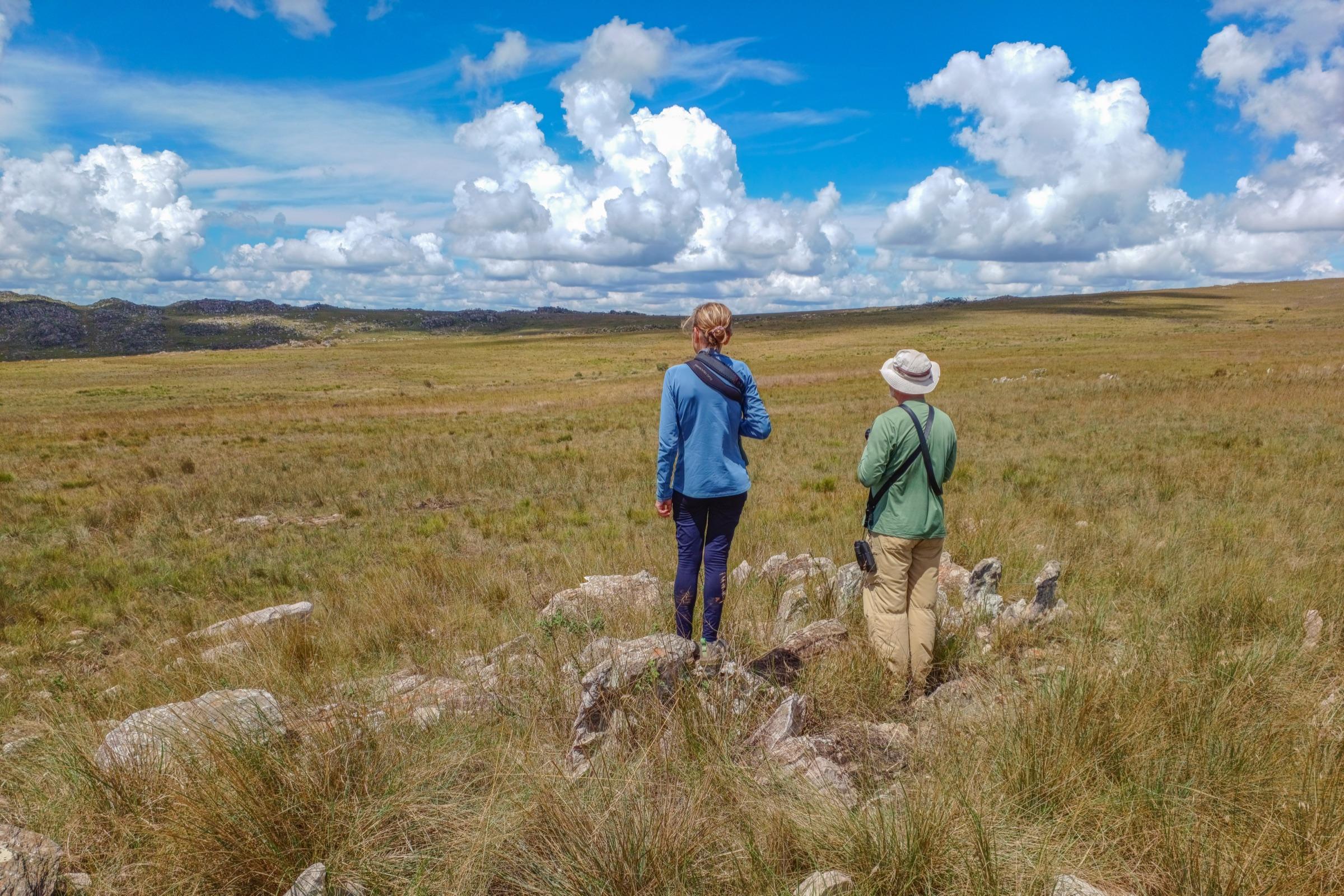
Birders walking through the Cerrado

How We Bird

Our Philosophy

At BBE, birding is not a race for species. It is an observation-first practice led by biologists, where field craft, quiet teamwork and respect for habitat shape every day in the field.

We are also flexible, and we adapt the pace to each group. On our tailor-made tours, we set the pace with you, whether you want to push hard for specific targets or slow down and take in the biome. Our set departures follow their own rhythm. Our guests range from twitchers to relaxed birders, photographers and naturalists, and our team of guides has a wide variety of birding and nature profiles. Many of them are comfortable with all of these styles in the field.

Whatever the pace, a tour with us is an immersion in the place, with ecological context. When a mixed flock moves through the canopy, we want you to know why it forms, which species lead it and what the forest around you is doing. A long checklist is a natural result of birding this way, but the experience comes first. Respect for nature is the first of our values, and it is also the better way to see birds.

What to Expect on a BBE Tour

THE PEOPLE IN THE FIELD

Our Guides: biologists who know Brazil's birds

Trained in science

Every lead guide is a biologist. Several hold master's degrees or PhDs, and many have published papers and books on the birds and regions our guests visit.

Deep knowledge of each region

Our guides know the areas they lead from years of research, field work and many visits, and some have birded the same places for more than 20 years. They know the trails, the local hosts, and where a bird was calling on the last trip. When a guide leads in a region they know less well, it is because they know its species, and they can count on a close network of cooperation among our guides, with recent tips on the best spots and a plan A, B and C for each day.

Patient in the field

Good sightings come from reading the habitat, knowing the calls and waiting in the right place.

Happy to share what they know

Behavior, ecology, why a species is rare and what is being done to protect it. Questions are always welcome.

Attentive to the group

Pace, rest, seating, dietary needs. Our guides watch over people as closely as they watch the birds.

Part of conservation

Several of our guides have worked on research and monitoring, and on the discovery and rediscovery of bird species in Brazil. They bird the way they would survey, and every tour adds records to eBird and GBIF.

Meet the team
THE PRINCIPLES BEHIND EVERY TOUR

Our Standards in the Field

Responsible Playback

Playback is a field tool that needs to be managed with care and responsibility. Our guides know the behavior of each species: how to use playback with it, how to read its response, when to stop, and when it is better to move on and try another individual.

In practice, this means short, low-volume sequences aimed at a specific target, with the guide watching how the bird responds and stopping as soon as the question is answered, or as soon as the bird shows it has had enough. Silence is also a response.

Observation Ethics

The welfare of the bird always comes before the observation, and that principle settles almost every decision in the field. We keep a respectful distance, using optics rather than proximity to get the view, and we read the animal's behavior as the sign that we are too close. We never disturb a nest or a brood, and we never flush a bird for a better photo or a clearer view. We leave no trace, taking out everything we bring in, so the next group, and the birds that live there, find each site as we found it.

How Participants Collaborate

A good tour is a shared effort, and a few simple courtesies keep it working for everyone. The first is respect for the group's pace and quiet: birding rewards patience, and a raised voice or a rushed step can cost the whole group a bird that was seconds from showing. Following your guide on when to move, when to wait and when to stay silent is the most valuable thing any participant can do.

The second is respect for habitat. We stay on trails, keep our distance from birds and other wildlife, and never disturb nests or young. The third is respect for local communities: the people who host us, guide locally and share their knowledge are partners, and we treat them that way. Throughout the tour, we ask for ethical photography, with the same care with a camera that we apply to playback.

Safety and Wellbeing

The physical and mental safety of our guests and our team comes before any species and any schedule. No bird is worth an injury or an unsafe situation, and our guides have full authority to adjust, delay or stop a plan whenever conditions call for it. We do not push into terrain, weather or wildlife encounters that put people or animals at risk.

We also look after the basics of field health. BBE provides safe drinking water throughout the tour, plans each day with heat, humidity and altitude in mind, and includes the rest that long days in the field require. Our Health Protocols explain how we handle illness on tour Health Protocols (PDF).

Conservation in Practice

Every BBE tour feeds eBird, and through eBird the open GBIF biodiversity database, so each trip adds to the global record of where birds occur. We keep groups small, within each site's carrying capacity, so the birding itself stays low-impact. Every year we visit 84 protected areas across our routes.

We work alongside conservation partners including Aquasis, Avistar Brasil and Instituto Fauna Brasil, and we keep tourism revenue in the communities we visit, working with more than 60 local guides each year. Many of our guests have also become part of conservation in Brazil: some have supported Brazilian conservation projects, and some have helped buy land to protect important habitats.

Our Public Policy on Sustainability (PDF) is aligned with UN Sustainable Development Goals 8 (decent work and economic growth), 12 (responsible consumption and production) and 15 (life on land).

Diversity, Equity and Inclusion

BBE is committed to a safe, respectful and inclusive environment for everyone: guests, guides, partners and staff. We have zero tolerance for discrimination or harassment of any kind, in the office, in the field and in every interaction. Everyone on a BBE tour should feel they belong there.

Our recruitment is merit-based and non-discriminatory, and we see people from different regional, cultural and social backgrounds as a strength of our team. We are committed to gender equity. Women already lead across our operations and regional coordination, and field guiding in our industry remains mostly male. Bringing more women into guiding is a goal we are working toward, through mentoring and professional opportunities in the field Code of Ethics and Conduct (PDF).

HAVE QUESTIONS?

Frequently Asked Questions

FULL TRANSPARENCY

Policies and Documents

Our policies are available to download whenever you want to check the details.

Tour Policies: How We Bird

Our field policies, how we bird and what to expect on a BBE tour.

Download PDF

Public Policy on Sustainability

Our commitments to conservation, local communities, diversity and gender equity.

Download PDF

Code of Ethics and Conduct

The principles that guide our team, suppliers and partners.

Download PDF
